4 Fall Beds
If you visit my garden in the fall, you’ll notice four things. First, garden beds are covered with garden vegetation waste. I do this so the soil doesn’t stay bare through the winter, and because I know from experience how crumbly and nice the soil will be come spring. My mulch is made up of leaves, straw, pulled weeds, and other vegetation waste.
Second, you’ll find one or two green-fertilized beds; the mats are primarily blue (or lacy) phacelia and Persian clover, sowed in late summer. Occasionally the entire bed is green fertilized, but more often than not one or two rows of vegetables are still lagging in the same bed.
The third thing you’ll notice is kale, salsify, leeks, parsnips, radicchio, chard, watercress, and other cold weather plants that grow well into late fall, and which can all cope in a few degrees below freezing. A few of them might even get the opportunity to overwinter.
I’m just as pleased each time that I allowed them to spread.
But the fourth and most interesting things are the plants I sowed sometimes in late July or August. That’s when I carried out forward planning, and I’m now reaping the harvest from that strategy. The Asian greens such mizuna cabbage, mustard greens, and pak choi (celery cabbage) especially love the fall. I’m not exaggerating when I say that the bed is bursting with growing power.
Land cress and buckhorn plantain are two other rascals that can also occasionally be found among the fall greens. The first grows slower than Asian greens, but has the advantage of tolerating a few more degrees below freezing. Heads up, however, for those with palates that are more sensitive: winter cress tastes like watercress but has ten times more bitterness and bite. Buckhorn plantains, which also don’t mind some degrees below freezing, are much kinder in flavor. I love its nutty taste; it’s just right for whatever salad mix you have going! Both plants are harvested in consecutive batches. Here, that means a good spell into winter.
Time To Get the Row Covers Out Again
It’s a bit of a pain to haul the row covers out again, but I advise you to do this, especially if you want to harvest long into fall and even a little in winter. It’s time to cover up once nighttime temperatures hover around 41ºF (5ºC).
The cover may not increase the temperature much more than a single degree, but it becomes very snug and warm under the cover once the sun shines. The cover protects against the wind, which in turn safeguards against the cold. The windchill effect is more significant than we imagine; the cooler it is outside, the colder the windchill. For example, let’s say that it’s 32ºF (0ºC) outside, but the wind blows at 14 meters (16 yards) per second. The effective temperature—how cold it really feels—is 5ºF (-15ºC).
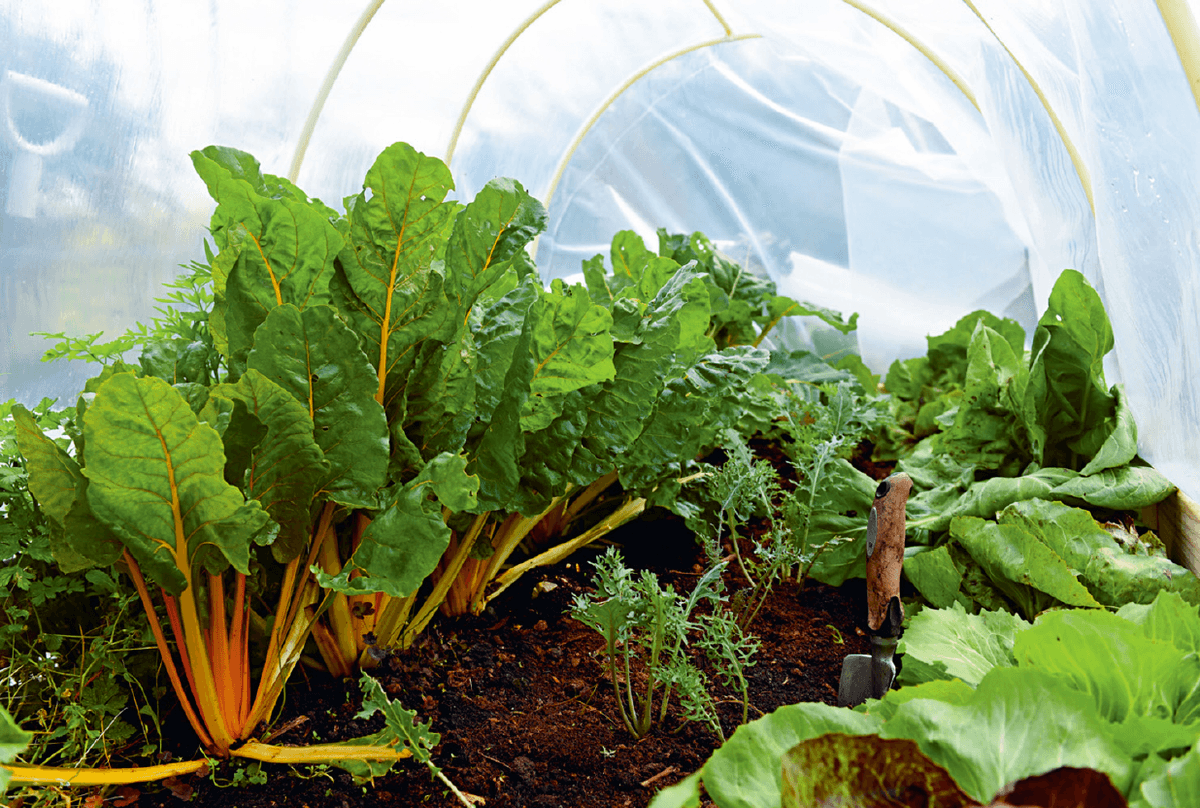
If I compare vegetables that have grown under row covers with those that grew without shelter, the former always wins. They’re both more attractive and tastier. They occasionally grow a little, even if the light is weak.
Don’t forget to secure the material properly so a fall storm doesn’t blow the cover off. Covers also protect against deer, but not 100 percent. If it snows, you must of course shake the snow off, otherwise the plants won’t get any light.
Mobile Tunnels Are a Favorite
Growing tunnels complement row covers. Tunnels are in fact better, because they’re encased in plastic, which protects more effectively against the wind than fabric. Also, woven covers become extremely brittle when they freeze. Personally, I’m extremely pleased with my mobile growing tunnel. I usually place it where vegetables, such as parsley, chard, beets, and mâche that might survive a few degrees below freezing, are already growing. It’s a few degrees warmer inside the tunnel, according to the digital thermometer.
The chard, especially, looks fantastic, and it’s a real treat to harvest chard until right before Christmas.
It’s very important that the soil be porous, regardless of how and where you garden in late fall. The soil cannot be dry or wet—just damp. The worst soils are dry and sandy, or hard, wet clay.
Growth has often ceased by late fall. Because of this you usually won’t need to fertilize. Only add nutrients if you know that no fertilizing was done in late summer.
If so, then you can water in some fertilizer.
As for choosing a site for your tunnel, remember that the sun hangs quite low in late fall, so choose a very sunny spot.
Start a Frost Watch
So what can you do ahead of time to prevent frost from killing your garden? Forward planning applies here, as does a frost watch. Keep a watchful eye on the thermometer and on online weather sites.
Everything is fine and dandy if it’s 46.4ºF (8ºC) or warmer in the evening. The probability of a hard frost striking is minimal and I’ll get a good night’s sleep.
I’ll cover my warm weather vegetables—tomatoes, peppers, cucumbers, squashes, and pumpkins—with row covers if the thermometer dips lower than 46.4ºF (8ºC). The fabric raises the temperature by a few degrees, which is usually enough to carry the plants through the first light frost, i.e., just below freezing for a few hours. However, you can’t be sure that it’ll be enough to protect from several hours of hard frost.
By contrast, frost is not fatal to cold weather plants. It can even improve their flavor, which I will tell you more about in a moment. But it doesn’t hurt to cover the plants anyway, especially if the temperatures creep down to below 41ºF (5ºC). Growth will also be faster under a cover.
These Plants Taste Better After a Cold Snap
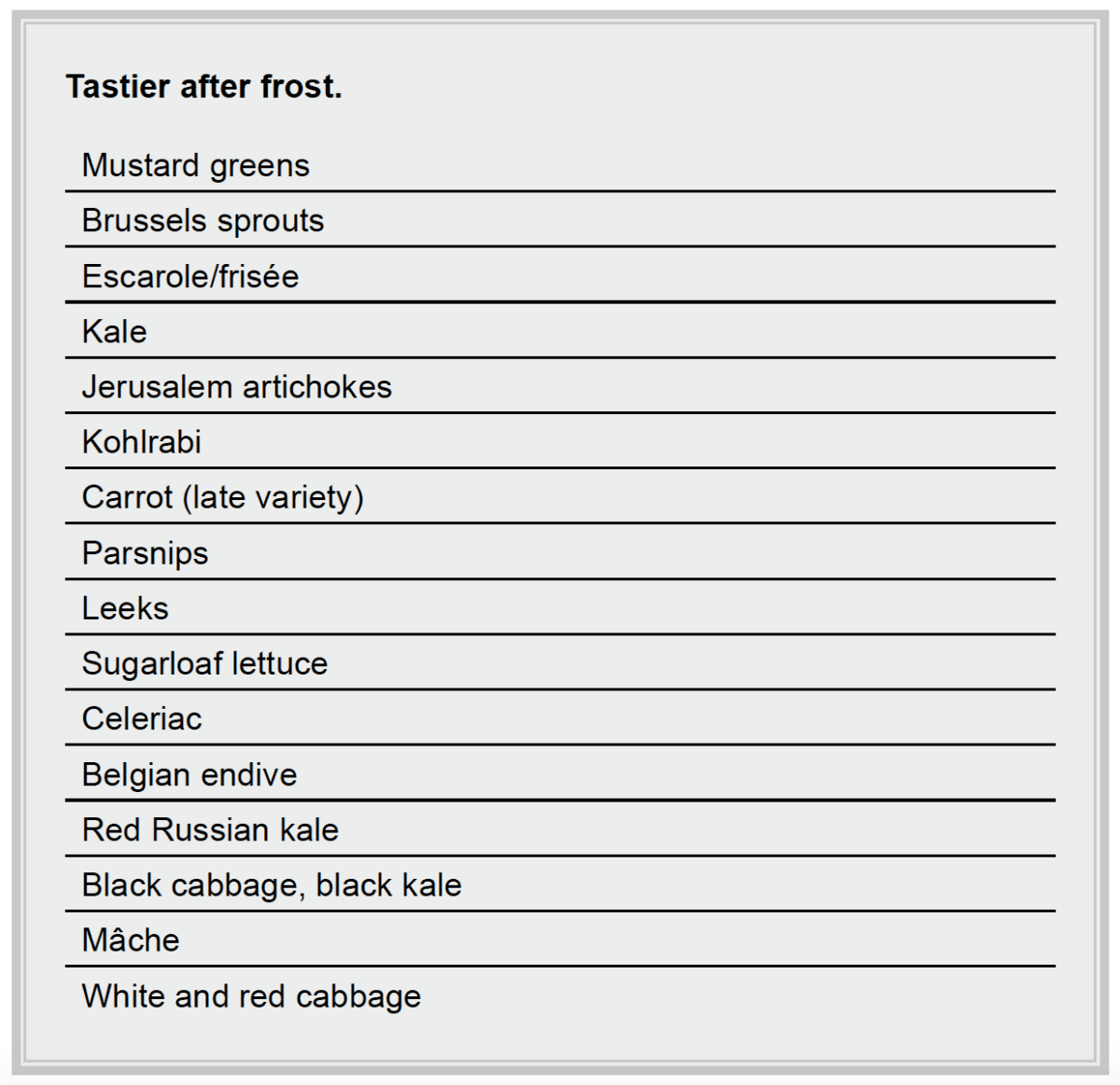
I wish you could perform a side-by-side taste test of soups made from kale harvested in July and from kale harvested in November. The positive impact of the frost would be obvious: The November kale is mellower and sweeter. Its bitter aftertaste that many don’t care for disappears with the frost.
The flavor of many other vegetables is enhanced with a touch of frost. So why harvest them before frost?
So what’s the reason for this change in flavor? Well, plants fight for their lives; they know that they’re facing a death threat and so they grab the only weapon at their disposal—they raise the sugar content of their structures. They do this by converting carbohydrates to sugar.
When sugar is dissolved in water the freezing point is lowered, so the plant can take a few more degrees below freezing. As a result, it kills two birds with one stone: It tolerates a harder frost, and it gets better tasting to boot. But eventually this sugar boosting strategy stops working, so of course the plant dies.
The Italians React
As you’ve seen, the cabbage family is most favored by frost. Another important group is the Italian lettuces of the chicory family. These include lettuce such as sugarloaf, red endive, and radicchio Castelfranco; also included are escarole and frisée.
All these plants have a natural bitterness that Swedes seldom appreciate. But after a frost, this bitter flavor changes and sweetness takes the lead. What is left is a piquant snap of bitter, and a delicious crispness that is a fit for hearty salads.
To please the Italian lettuces, escarole, and radicchio Castelfranco, they should not merely feel a nip of frost but also be bleached. A few weeks before you expect to harvest the plant, tip a bucket over it. A few air holes in the bucket are necessary; you can also leave a gap between the soil and the bucket.
Build a Hügel Bed
One of the most useful activities in the fall is to build a Hügel bed, which is a cross between a compost pile and raised bed. It’s certainly packed with garden waste, but it differs from straight composting in that the bed is watered frequently and basks in sunlight. That’s why things grow so exceptionally fast in the bed, and waste breaks down into friable soil in only one season.
The bed warms up quickly in the spring because it’s significantly elevated. As it decays it also generates a certain amount of heat. There are plenty of nutrients available for plants, which are released gradually. No wonder things grow so well in it!
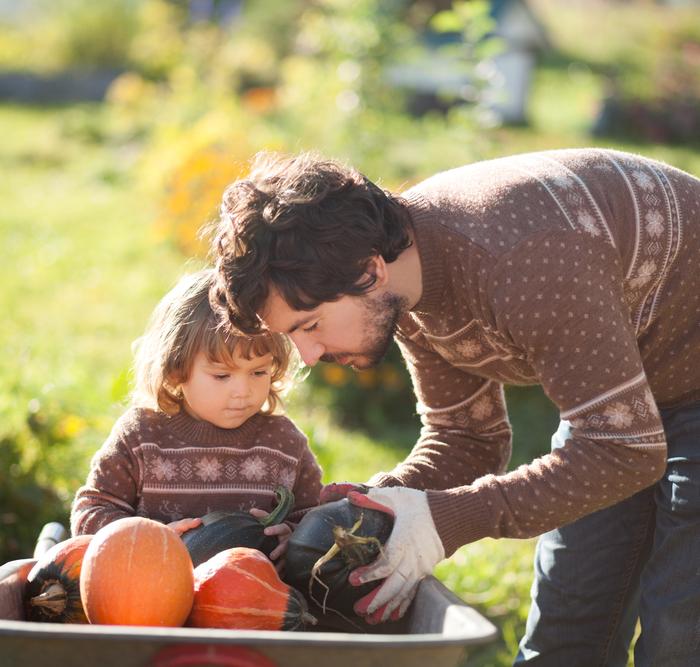
Occasionally I’ve grown pumpkins in a conventional raised bed next to a Hügel bed of comparable size also containing pumpkins. The Hügel bed ends up producing twice as many pumpkins.
The bed is built on the principle “higher is better.” You start off with small twigs and you end with partially broken down compost and soil. Some animal manure is very effective in a Hügel bed, not only because it fertilizes but also because raises its temperature. Fresh grass clippings have the same effect.
By year two, the Hügel bed will have sunk some, but it’s still a great growing site. You can also use the soil as compost.
A Hügel bed not only produces superior harvests, it also makes fantastic soil amendment. If you choose a new site each year for your Hügel bed, you’ll soon turn the worst, can’t-do-anything-with-it soil into a superb, loamy soil.
The bed builder might run into trouble now and then in early summer as the layer of soil won’t be thick enough, at which point growth stops and the leaves turn yellow. So it’s a good idea to start by sowing spinach, radish, arugula, or other leafy greens with shallow root systems. Once they’re harvested, it’s time to plant out cucumber, tomatoes, squash plants, and other heat seekers. By then the soil will have broken down and there’ll be enough room for their larger root systems.
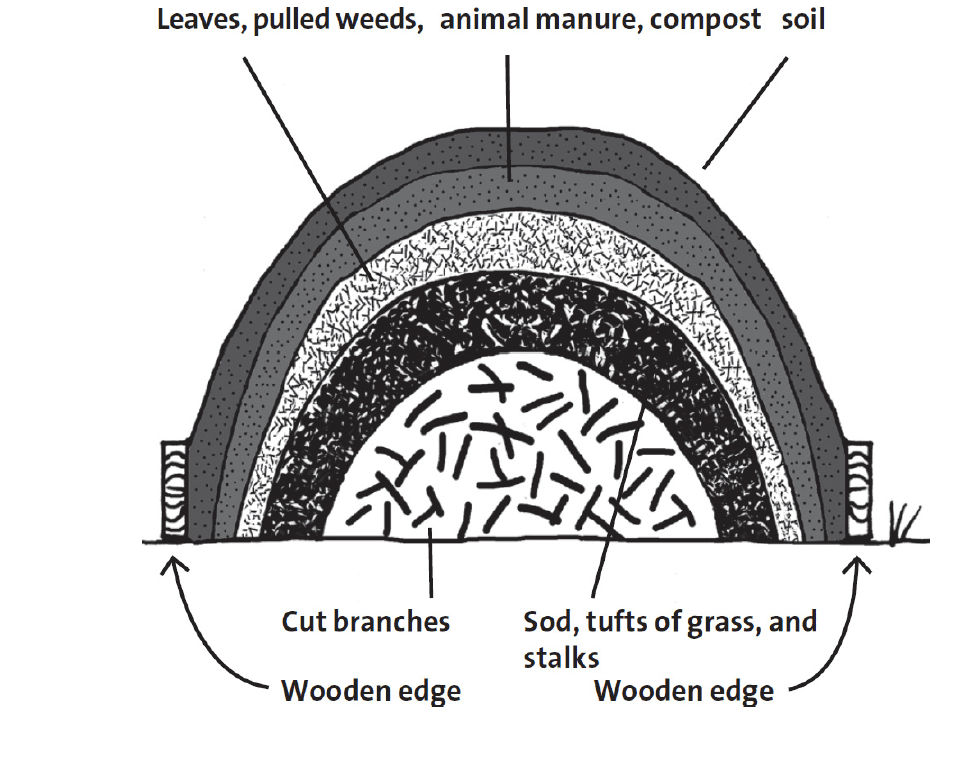
A cross section of a Hügel bed shows coarse garden waste at the bottom and finer garden waste further up. Soil covers the top layer.
Tips for Fall Sowing:
- Fall sow in only one garden bed or pallet rim/raised bed.
- Sow the seeds a little more closely than usual.
- It’s better to sow too late than too early.
- Go for the slowest growing seed varieties.
- Sow in loose soil, and by all means, cover the sown row with soil mixed with sand.
- Cover with a row cover in the spring.
Tips for Potted Plants:
- Need more nourishment? The pots are empty of all nutrients by now. Water in fertilizer weekly.
- Place the pots along the walls of the house. The plants need more sun, more heat, and more protection against the wind.
- You won’t discover dry roots until you’ve dug down into the soil a bit. Then you’ll also see if the soil is root-bound. If that’s the case, cut off a piece of the root mass and add fresh soil.
- Do the chili peppers have a hangdog look about them? If so, move them inside and place them in a sunny window! But do leave them outside for as long as possible, as this is best for them and they can tolerate a lot more than you think.
- Once the plants are past flowering and producing, empty the contents into garden beds and other plantings. They can also go into a garden compost pile, but not into kitchen compost.
- Perennial herbs and plants that are meant to overwinter tolerate the climatic conditions better if they’re dug down—pot and all—in, say, a garden bed.