The symptoms of headache and trigeminal neuralgia, a chronic pain condition affecting the fifth cranial nerve, are more than vexing. Some people have mild headaches, which can be relieved with some rest. For those with severe headaches, they may not only suffer from dizziness, but may even vomit. Trigeminal neuralgia is also known as the “No. 1 pain in the world.”
The usual treatment for pain is taking painkillers, which can provide temporary relief. However, if painkiller dependency develops, even if the dosage is increased, it will eventually be ineffective.
80 Percent of Incurable Headaches and Migraines Are Caused by Cervical Spine Misalignment
One cause of headaches is not easily noticed, and it is cervical spine misalignment.Many patients of Dr. Wu’s are those who have developed incurable headaches and dizziness after an event like a car accidents, but whose brain and cervical spine examination results with Western medicine techniques appear to be normal.
However, sometimes there can be a clinical error in the diagnosis. If the cervical spine is only slightly crooked, X-rays, computed tomography (CT), and magnetic resonance imaging (MRI) may not necessarily show it.
In fact, according to Mr. Wu’s clinical experience, more than 80 percent of people with chronic migraines have cervical misalignments. In particular, the misalignment of the 1st and 2nd vertebrae of the cervical spine would compress the blood vessels entering the brain from the neck, creating a blood circulation disorder. In addition, it can also compress the nerve bundles, causing abnormal signals to be transmitted to the brain and resulting in headaches.
Therefore, the key to treating headaches lies in the adjustment of the cervical spine.
Dr. Wu has a patient who had been suffering from headaches for seven years, and painkillers barely had any effects on his condition. Every day at 2 or 3 p.m., he would have a headache episode, and the pain was so severe that he could only lie in bed and rest. Later, he was referred by someone to seek treatment at Dr. Wu’s clinic.
Dr. Wu performed a cervical spine examination for him and found that he had a cervical spine misalignment problem. By feeling his pulse, Dr. Wu discovered that the patient’s qi (i.e. vital energy) was stuck in his head.
After Dr. Wu adjusted his cervical spine back, he immediately felt that his headache was reduced by 70 percent. Dr. Wu took his pulse again and found that his pulse was much calmer. Furthermore, his hands and feet were very cold because of the cold spell that day. However, after Dr. Wu adjusted his cervical spine, the patient’s hands and feet warmed up instantly.
‘The Worst Headache’: Causes and Symptoms of Trigeminal Neuralgia
There is another kind of severe pain that can keep people awake at night and make them lose their will to live. It is trigeminal neuralgia.Western medicine has 10 classified pain levels, and trigeminal neuralgia belongs to levels 9 to 10, which is no less than labor pain. Therefore, trigeminal neuralgia is also known as the “number one pain in the world.”
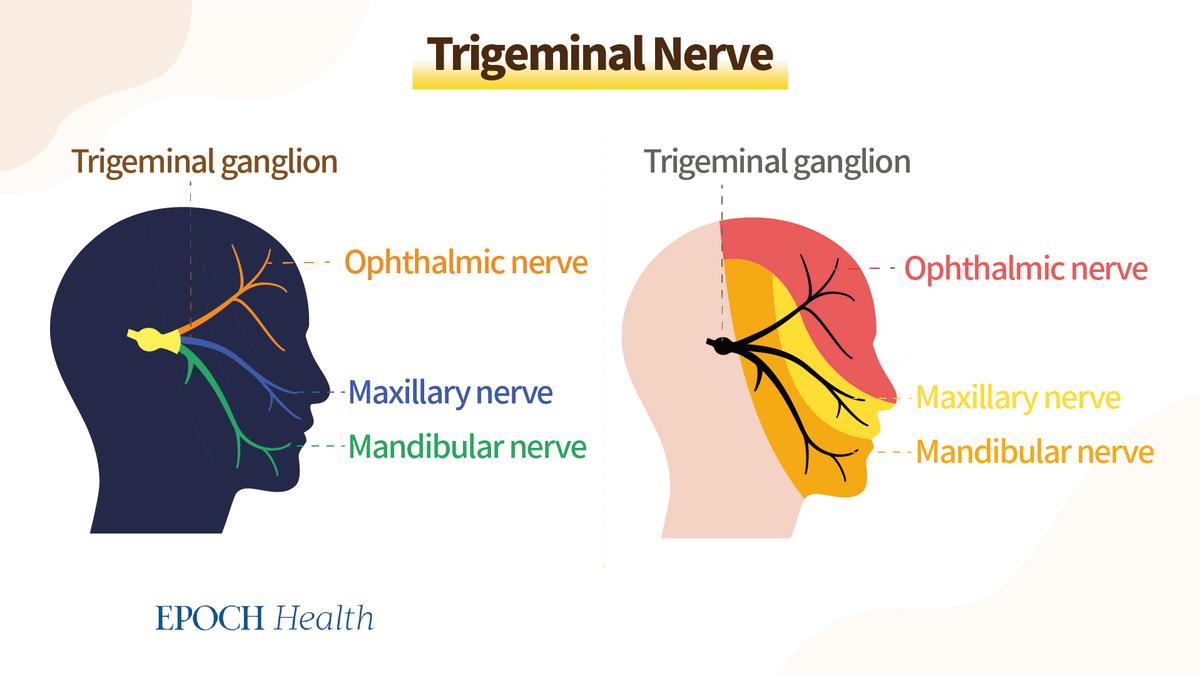
- The ophthalmic nerve: distributed at the orbital area.
- The maxillary nerve: distributed near the upper jaw bone.
- The mandibular nerve: distributed around the lower row of teeth.
Trigeminal neuralgia is easily misdiagnosed, because the initial symptom of many people suffering from trigeminal neuralgia is a toothache, so they would go to the dentist for treatment and extractions. Dr. Wu met a patient who had almost all of his teeth extracted, but his toothache still hadn’t gone away. It was only later that his trigeminal neuralgia was diagnosed.
Although it is difficult to differentiate trigeminal neuralgia from regular toothaches, there are some signs that can be used to detect trigeminal neuralgia, such as the nature and duration of the pain.
In the case of tooth decay and tooth nerve twitching, the pain tends to be relatively constant with a long duration, lasting for half a day or one day. Trigeminal neuralgia, on the other hand, is characterized by a type of pain that feels like an electric shock, a needle prick, a cut, a tear, or even a burning sensation, and it is short-lived and sudden, usually disappearing after a few seconds. It is like a sudden electric shock without warning.
The Key to Treating Trigeminal Neuralgia Lies in Cervical Spine Adjustment
Western medicine usually employs two methods of treatment for trigeminal neuralgia, including medication and surgery.Western doctors also consider trigeminal neuralgia to be intractable, because the usual pain medications are ineffective, and eventually anti-seizure medications have to be used.
In terms of surgical methods, some surgeons use open cranial surgery, as they believe that since the trigeminal nerve is too close to the blood vessels, it causes inflammation and pain. So they use surgery to insert a small pad between the blood vessels and the nerve to prevent contact. In addition, a gamma knife and nerve block are also used.
Some patients’ condition can be stable for a few years after such surgical treatment. However, in some cases, the patients have a relapse three months after surgery. One of Dr. Wu’s patients had seven such repeated surgeries, which was a horrifying experience.
According to Dr. Wu’s clinical experience, many patients with trigeminal neuralgia have very stiff necks. Therefore, he has discovered that the key cause of trigeminal neuralgia, besides the secondary causes, is mostly problems related to the cervical spine.
Some people may wonder, “The trigeminal nerves are directly from the brain. How can they be related to the cervical spine?” In fact, the spinal nucleus of the trigeminal nerve starts from the brain and extends down to the cervical spinal cord. When the cervical spine is misaligned, the neurological inhibition of abnormal activity is impaired. That is, the trigeminal nerve becomes very sensitive, and the slightest stimulation would cause a surge of pain.
Traditional Chinese medicine can also treat trigeminal neuralgia. Dr. Wu once took a course in auriculotherapy and learned that bloodletting in the ear and auricular pressure stimulation could be effective in relieving trigeminal neuralgia.
Immediately after Dr. Wu took the course, several patients with trigeminal neuralgia came into his clinic. So Dr. Wu tried bloodletting in their ears. Several of them had their pain stopped right away.
Acupuncture can also be used. For instance, Dr. Wu would have a patient lie on his or her back and perform acupuncture at around one to two finger widths from the cervical spine, to the depth of the cervical vertebrae. This would stimulate the nerves around the cervical vertebrae, relaxing the cervical vertebrae, and unblocking the flow of qi and blood.
4 Cervical Spine Adjustment Methods to Cure Headaches and Trigeminal Neuralgia
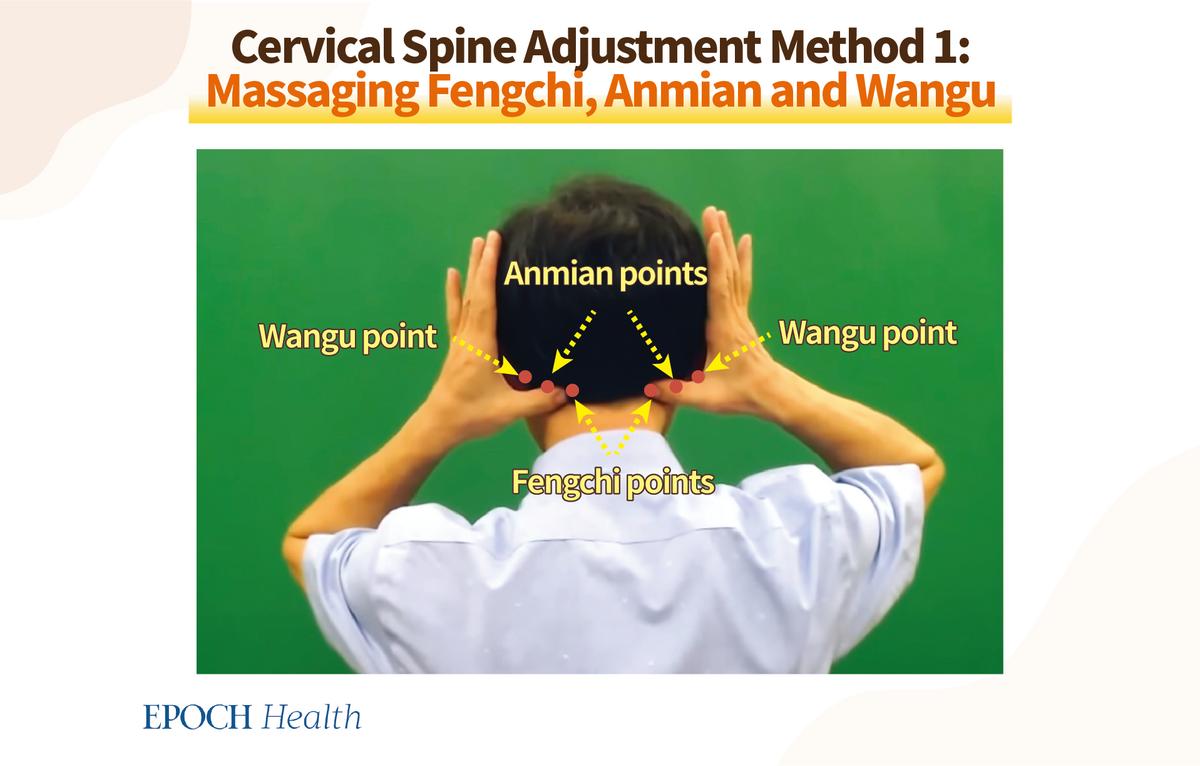
In fact, no matter which treatment methods are used, it is best to learn some cervical spine self-adjustment techniques. Below are Dr. Wu’s demonstrations of these methods.- Massaging Fengchi, Anmian, and Wangu Acupuncture Points
Raise your hands behind your head and massage the above acupoints with your thumbs. You just need to rub the muscles below your skull to loosen them.
You can even use your thumbs to clasp the acupuncture points and then shake your head with force. This is a better dynamic therapy, as the bones may return to their original position during the shaking process.
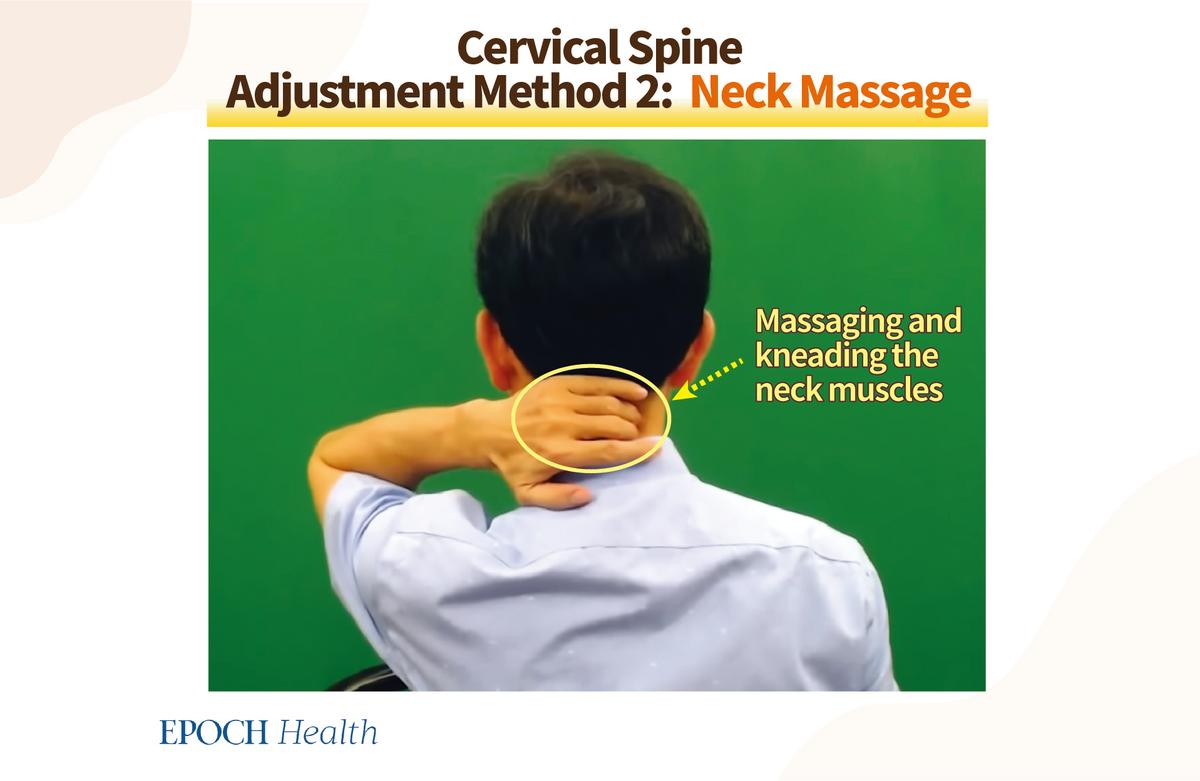
- Neck Massage
During the kneading process, you will find a certain spot to be the most painful. This is the place where the cervical spine is misaligned. By relaxing the muscles here, your headache will be much relieved.
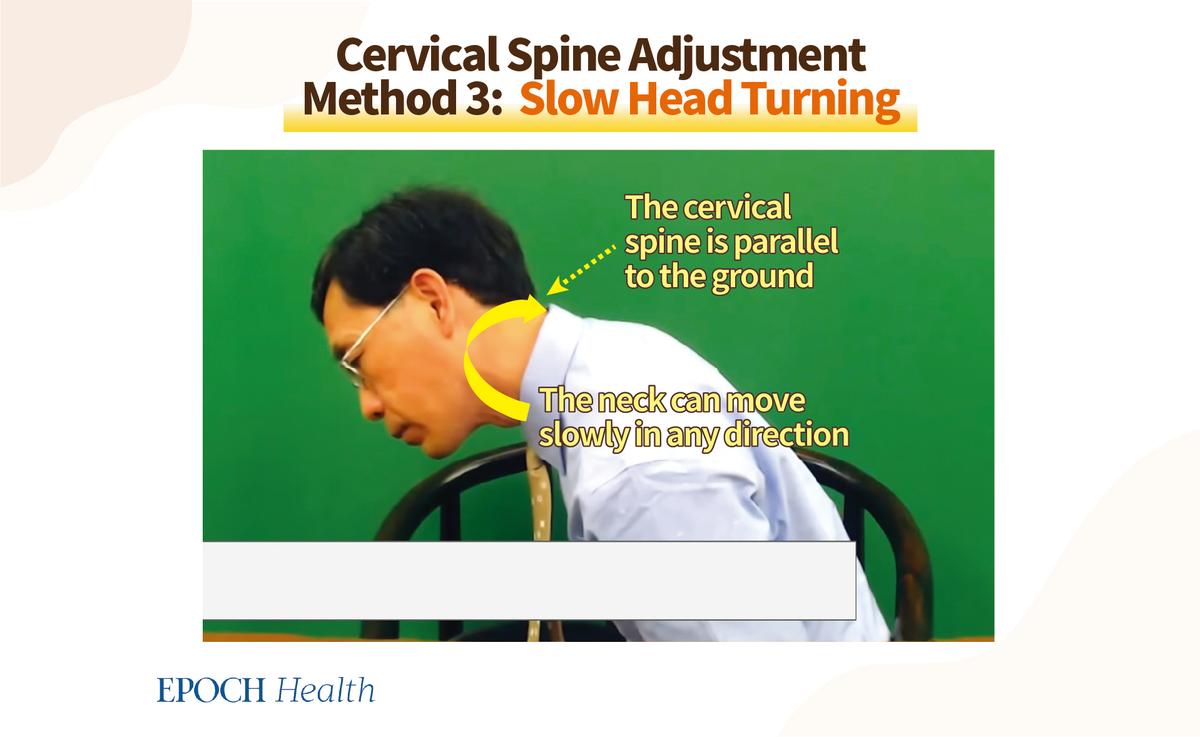
- Slow head turning
Next, your neck can move slowly in any direction, nodding, shaking, and/or stretching.
Suppose your neck moves to a certain angle, and you find that there is a spot where your neck gets stuck, or it is quite painful. Then let your neck pause here for 10 seconds, so that the joint here will be slowly pulled apart. Then, turn your neck outward a little bit more, and pause again for another 10 seconds. The joint will be pulled apart a little bit more. Repeat this movement about three times, and the stuck joint will be opened up.
You can also lie on your stomach with your elbows and forearms propped up on the bed and do this slow head turning technique. Do it before going to bed and when you wake up, and your neck will feel very comfortable.
- “Union Jack” head turning
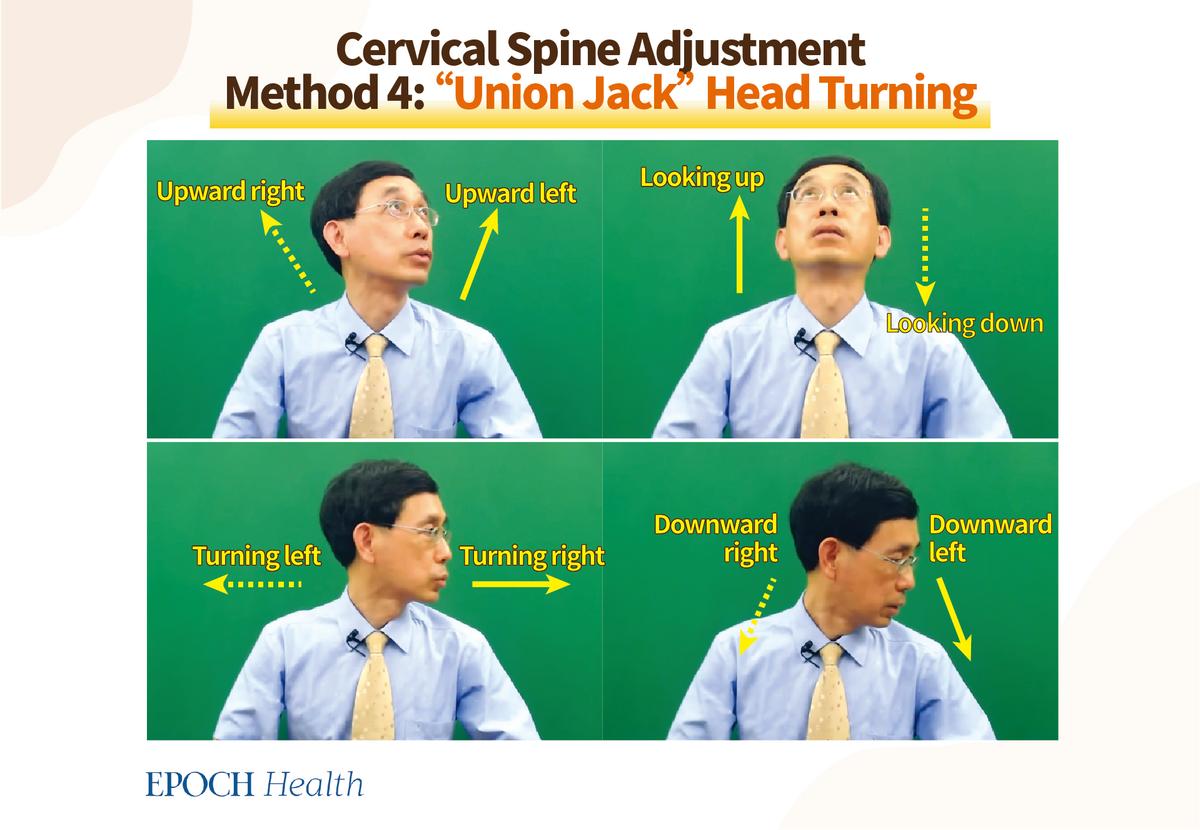
- Turn your head 45 degrees upwards to the left, stretch to the limit, then back to the center. Then turn your head 45 degrees upwards to the right, stretch to the limit, and again back to the center.
- Turn your head left to the limit (without moving your shoulders), then turn it right to the limit.
- Raise your head and look up, and then lower your head again.
- Slowly turn your head 45 degrees downwards to the left, then back to the center; and then turn it 45 degrees downwards to the right, then back to the center. Repeat each set of movements five times.