This copy is for your personal, non-commercial use only. Distribution and use of this material are governed by our Subscriber Agreement and by copyright law. For non-personal use or to order multiple copies, please contact The Epoch Times Reprints.
5 Exercises to Build a Perfect Duo of Strength and Flexibility
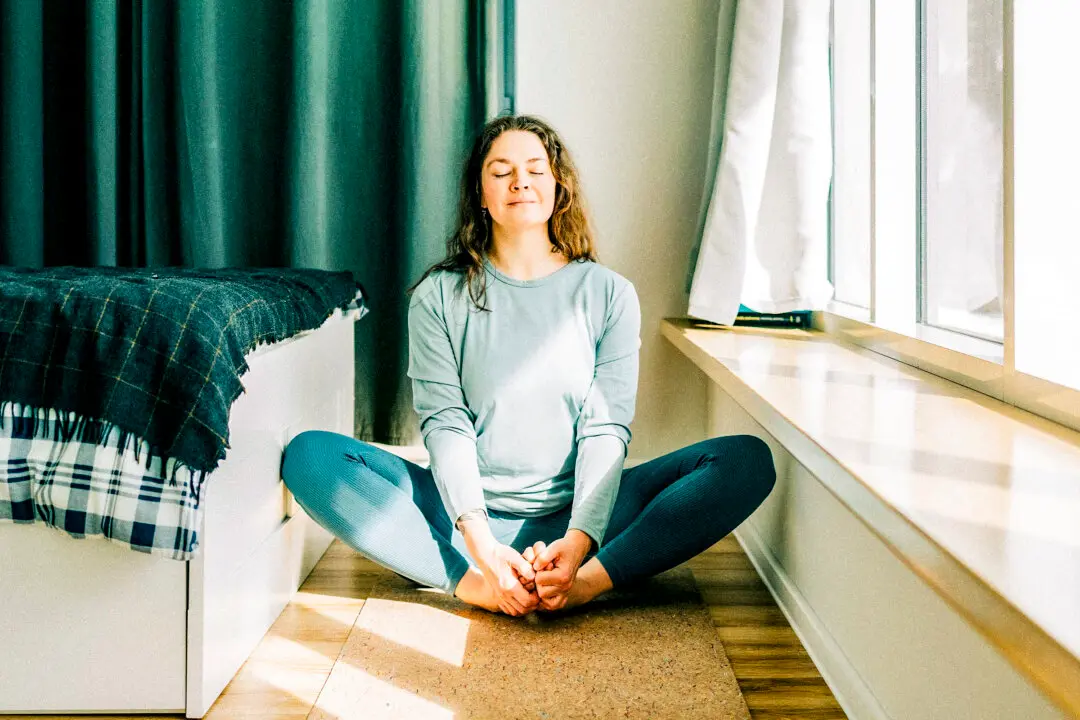
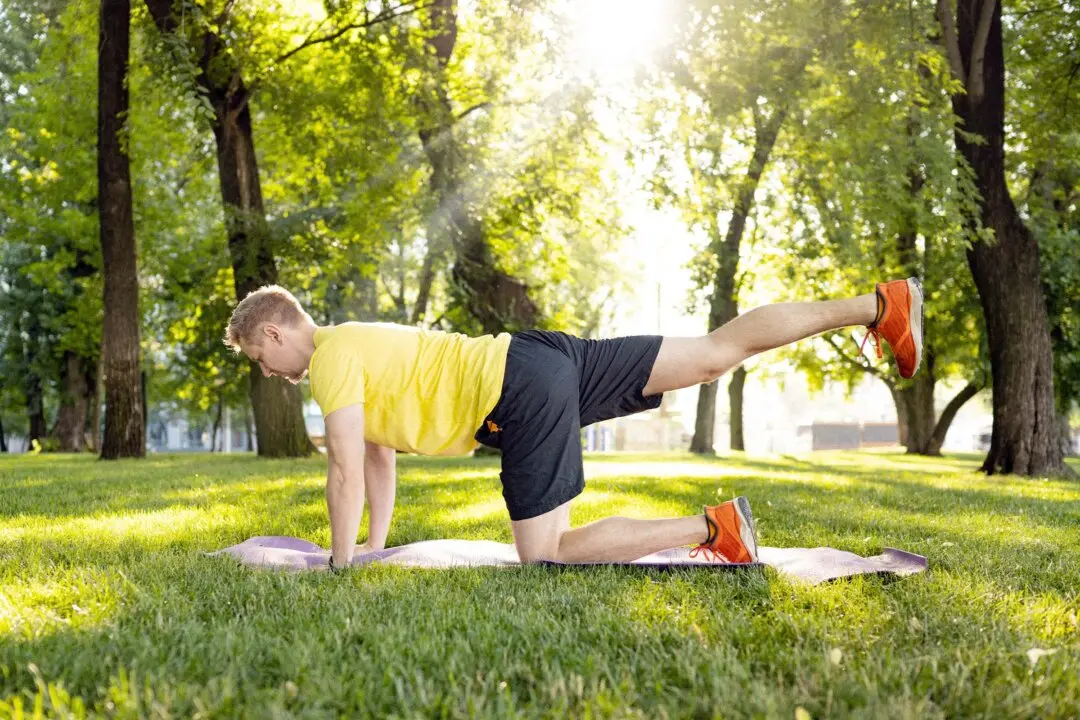
Strength and flexibility are co-contributors to your best functional safety and independence, and these exercises specialize in maximizing both of them.
One of the most important things I teach my patients is that we need to have a balance of factors in place to ensure the best outcomes. But I often see people fixated on one of them—either muscle training or stretching.
The problem is, strong muscles without flexibility will bind you up (too stiff). Being flexible without strength won’t hold you up (too weak). You need to be right in the middle, a perfect balance of strength and flexibility.
These five exercises help you achieve that.
5 Exercises to Build Strength and Flexibility
The following exercises provide excellent strengthening through a clever set of movements with overlapping benefits and emphasize flexibility to help you preserve and potentially increase your movement finesse.
They work well for my patients and me, but everyone is different, and I recommend first speaking with your medical provider to ensure they are appropriate for your current situation.
This exercise is great for practicing shoulder protraction and retraction, as well as spinal rotation. It’s also an excellent alternating contraction/relaxation exercise for your back muscles.
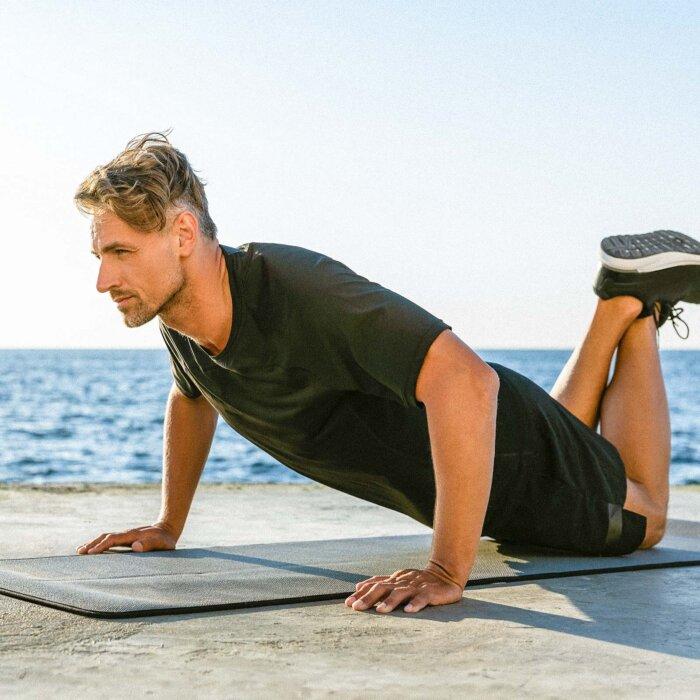
Step 1: Start on your hands and knees, with your thighs and arms straight up and down.
Step 2: Slide your right palm up under your body toward your left side, continuing until you bring it as far to the left as you can until your shoulder makes contact with the surface (or moves as close as it can). Your left elbow will need to bend a little to accommodate the movement.
Step 3: Bring your right arm back to the starting position and then sweep it up toward the ceiling, following the movement with your gaze. Moving into the stretch and back counts as one repetition. Try to perform three sets of 12 repetitions per side. You can complete all sets on one side before moving to the other, or you can alternate sides as you move through the sets. I encourage you to experiment to see what you prefer.
Modifications: If you can’t move either hand very far under your body, just move as far as you can before returning to the starting position.
Why I Like It: Thread the Needle is a unique and unconventional exercise with a rotational component that draws you into considerable spinal rotation in both directions. Besides, it just plain feels good.
2. Downward-Facing Dog
Downward-Facing Dog, my favorite readers, is big medicine for your shoulders and hamstrings. There is a bit of a learning curve, but I hope you'll accept the challenge. It actually makes you feel good for a while after you perform it.
Step 1: Start on your hands and knees in a tabletop position. Align your hands under your shoulders with your middle fingers pointing forward, knees directly under your hips, and toes straight behind your knees.
Step 2: Tuck your toes under and lift your hips upward, distributing your weight equally between your palms and feet. Press your heels toward the floor to lengthen your Achilles tendons and hamstrings, but they don’t have to touch down. You should feel a wonderful stretch in the back of your calves.
Step 3: Align your head and neck with your forearms, and keep your core strong to avoid swaying your back—keep it in a nice straight line, from your tailbone through the crown of your head.
Step 4: Hold this position for approximately 20 seconds, then return to the tabletop position and repeat the motion.
Step 5: Moving into a downward-facing dog position, then back to your tabletop position, counts as one repetition. Try to perform eight repetitions.
Modifications: If you can’t work at floor level, feel free to place your hands on a step or piece of low furniture instead. Perform this activity close to a counter or piece of furniture if you need help getting up. Only do as many repetitions as you reasonably can at first.
Why I Like It: This is somewhat of a high plank, which makes it excellent for strengthening, but it also moves your shoulders and hips to approximately 90 degrees of flexion, placing a superb stretch on your lats and hamstrings. As a mild inversion, downward-facing dog increases blood flow to the brain, helping to lighten your mood, clear your mind, and alleviate stress.
3. World’s Greatest Stretch
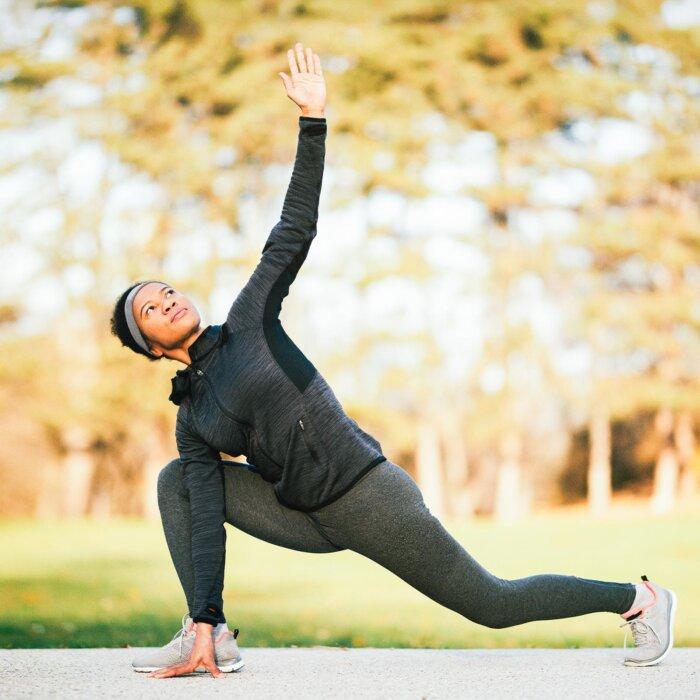
Well, with a name like that, you can’t go wrong. This stretch is, in fact, an excellent movement that dials in heavily on your ankles, hips, hamstrings, and especially your thoracic (upper back) rotation, but it has more of a strength component than you might think. Why? Because it integrates a bit of the plank exercise.
Step 1: Start in a standard push-up position, with your hands and feet supporting your body weight while keeping your posture straight. Next, bring your right foot all the way up beside your right hand into a deep lunge position.
Step 2: Next, while keeping your trunk straight, lift your right hand off the floor and, keeping your elbow straight, swing your arm in an arc toward the ceiling. Move your arm either straight up or as high as you can, following the movement with your head. Relax your spine so it rotates easily as you go. Hold for 10 seconds once you move as far as you comfortably can.
Step 3: Return your arm and leg to the starting position, and then repeat the motion. Reaching up and then returning to the starting position counts as one repetition. Try performing three sets of 12 repetitions per side. You can either perform all repetitions on one side and then the other, or alternate sides as you go, which requires more work but is highly effective. Either way is great. I suggest trying both to see which format works best for you.
Modifications: If you can’t raise your arms fully overhead, just move them as far as you can. Only move your feet as far into the lunge position as you can. If you can’t do this exercise with straight knees, you can place the rear knee on the floor as needed.
Why I Like It: The World’s Greatest Stretch offers great flexibility and increased strength, and that’s what we’re here for. I love, love, love its thoracic rotation and chest-opening feature.
4. Crab Stretch
I’ve grown to love the crab stretch as I’ve gotten strong enough to feel comfortable with it. While it was somewhat of a struggle at first, I stayed with it and mastered the move, and I think you will too.
Step 1: Sit on the floor, with your knees and hips bent to 90 degrees and your feet flat on the floor, leaning back with your palms flat on the floor.
Step 2: Keeping your palms on the floor, push your chest upward as far as you comfortably can and hold it there for approximately five seconds to stabilize your shoulders.
Step 3: Slowly lift your hips upward. The goal is to push up to where your midsection is horizontal. If you can’t raise your hips that high, just move up as far as you can. Hold the position for approximately 15 seconds.
Step 4: Moving up and holding the position for 15 seconds counts as one set. Try to perform five sets.
Modifications: Only bring your hips up as far as you comfortably can. Even if you can’t lift them off the floor, simply trying to do so will be beneficial. By all means, feel free to play around with the sets and hold times to make the exercise work best for you.
Why I Like It: The Crab Stretch works your anterior muscular chain, such as your abs, very well and gives some love to the posterior chain muscles, such as your glutes. It also “opens” your chest, shoulders, and hips, all at the same time, and that’s pure gold.
5. Horse Stance
First dog, then crab, and now horse. Goodness, we’re up to our ankles in exercise denizens, but never fear, this one is yet another excellent way to magnify your strength and flexibility. Let me be honest: This is a challenging exercise by any standard, but it is also very scalable and thus available to a wide variety of people. Trust me, though you’ll definitely have a learning curve, you’ll be able to get great benefit from this exercise—especially over time. By the time you master this exercise, you'll feel strong as, uh, well, a horse.
Step 1: Stand with your feet as wide apart as you comfortably can and with your toes turned slightly outward.
Step 2: Slowly lower down as far as you can—preferably, get your hips as low as your knees.
Step 3: Keep your back upright as you push your hips slightly forward and open your legs as far apart as you comfortably can. Hold this position for 30 seconds before returning to standing. If you notice that your legs shake during this activity, join the club. Most people experience shaking, and there isn’t a thing wrong with that.
Step 4: Moving into the squatting position, holding, and then returning to standing counts as one repetition. Try to perform three 30-second squats.
Modifications: Only go down and spread your knees as far as you comfortably can. Feel free to modify hold times to suit your needs. If you struggle with balance, stand next to a counter or piece of furniture that you can use for stability as needed.
Why I Like It: The low squat, coupled with the wide knee spacing, provides a deep stretch for your hips, while also challenging your leg, gluteal, and core musculature.
These exercises can build strength while preserving flexibility and work you in patterns that are highly transferable to your daily functional task performance. I recommend performing them at least three times per week to maintain your strength and flexibility, and ideally, five times a week. I hope these exercises help you discover a stronger, more flexible you.
About the Fitness Model: Aerowenn Hunter is a health editor for The Epoch Times. She’s an accredited yoga therapist with more than three decades of teaching experience.
Views expressed in this article are the opinions of the author and do not necessarily reflect the views of The Epoch Times. Epoch Health welcomes professional discussion and friendly debate. To submit an opinion piece, please follow these guidelines and submit through our form here.
Kevin Shelley
Kevin Shelley is a licensed occupational therapist with over 30 years of experience in major health care settings. He is a health columnist for The Epoch Times.