Introduction
From my clinical experience, patients with lumbar spondylolisthesis generally see limited improvement with treatments such as lumbar traction, acupuncture, or herbal medicine, as these methods do not reposition the displaced vertebrae. While traditional Chinese medicine (TCM) techniques can realign the vertebrae temporarily, the spine often shifts out of alignment shortly afterward. This occurs because the surrounding muscles and ligaments have adapted over time to the misaligned position.Therefore, it is essential to first relax the muscles and ligaments around the spine before attempting realignment, as this helps the vertebrae maintain their correct position. However, multiple sessions may still be needed to achieve lasting stability.
Exercise 1: Double-Leg Lift and Double-Leg Press Down
Lumbar spondylolisthesis can be classified as either an anterior slippage, where the vertebra shifts forward toward the abdomen, or a posterior slippage, where it shifts backward toward the lower back, with the former being more common.Posterior slippage (slipping backward)
Steps:
- Lie on your back with your legs together.
- Raise your legs to a 30-degree angle, hold for seven seconds, then lower them back down.
- Rest briefly and repeat the exercise for 14 repetitions.
When performing this movement, engaging the abdominal muscles is necessary to keep both legs lifted together, which also helps strengthen them. Stronger abdominal muscles can support the stability of the lumbar spine.

Anterior slippage (slipping forward)
Steps:
- Place both lower legs on a half-round foam roller, adjusting the height so that the counterforce targets the forward-slipped vertebra.
- Gently press your lower legs down onto the foam roller, using only light pressure.
Exercise 2: Knee-to-Chest Hold
After completing the above exercise, you may experience soreness in the lower back muscles. To relieve this tension, perform a “knee-to-chest hold” stretch. For those with lumbar spondylolisthesis, any movement that arches the back is not recommended, as it can worsen vertebral slippage. In contrast, the forward-bending motion of the knee-to-chest position can effectively alleviate symptoms.Steps:
1. Prepare three straps and wrap them above the knees, below the knees, and above the ankles. If using three straps feels excessive, wrap at least one below the knees for added stability to ensure proper form.2. Lie on your back, holding both knees with your hands or gripping the strap below the knees. Gently shake your legs toward your abdomen 20 times as a warm-up.
3. Firmly hold your knees or the straps and pull your legs toward your abdomen, bringing your head as close to your knees as possible. Hold for three seconds, then relax, returning your head and knees to the starting position. Repeat this movement 20 times.
4. Repeat Step 2 as a cool-down movement to relax the muscles.
5. With your feet together, gently sway your legs from side to side 20 times to help release tension and increase flexibility.
Exercise 3: Prone Stretch on Half-Round Foam Roller
This exercise is a specialized technique taught to me by my spinal alignment mentor. First, it is important to identify the location of your vertebral slippage. In most cases, slippage occurs between the third and fourth lumbar vertebrae (L3–L4), the fourth and fifth lumbar vertebrae (L4–L5), or between the fifth lumbar vertebra and the sacrum (L5–S1).- The L4–L5 region corresponds approximately to the level of the navel.
- The L3–L4 region corresponds to an area about two finger widths above the navel.
- The L5–S1 region corresponds to an area about two finger widths below the navel.
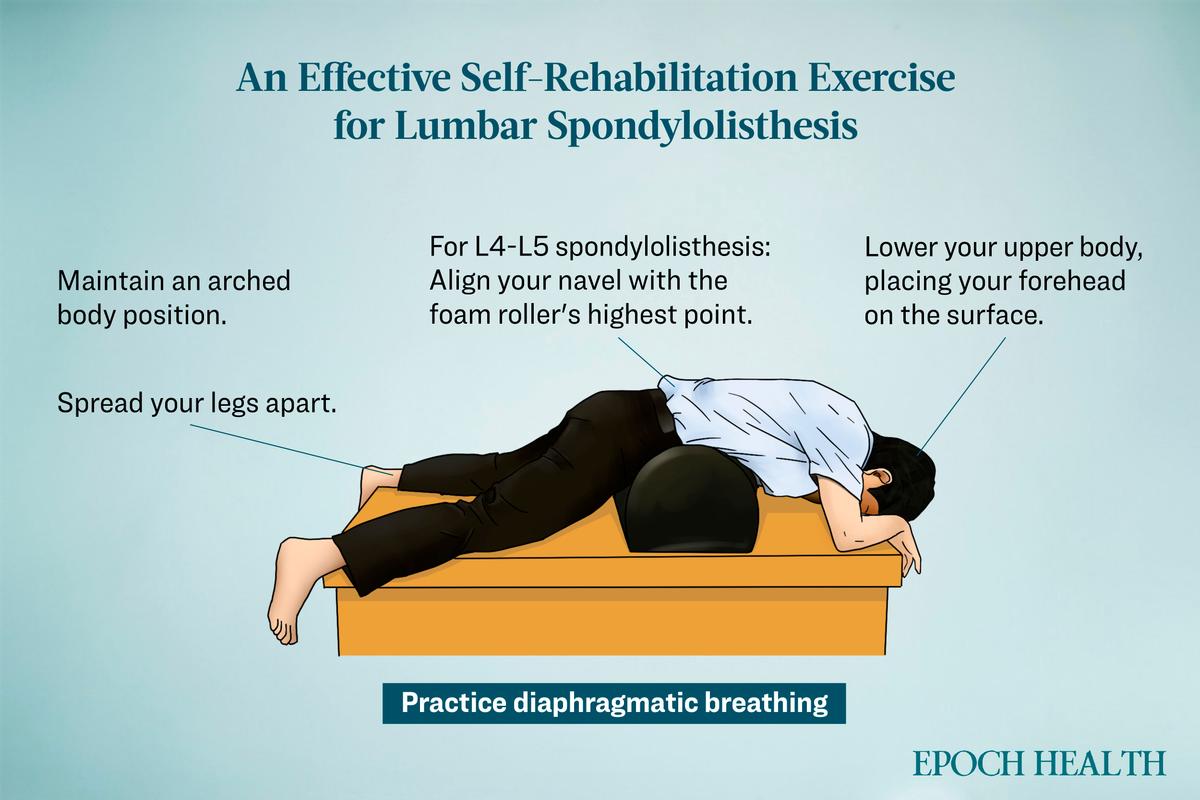
- Assuming the slippage is between the fourth and fifth lumbar vertebrae (whether forward or backward), position your navel over the highest point of a half-round foam roller and lie face-down.
- To maintain the natural arch in your body, let your upper body sink as low as possible and place your forehead on the bed. Position your arms on either side of your head, and spread your legs apart so that your hips shift back and sink down.
- Next, practice diaphragmatic breathing, allowing your abdomen to expand with each inhale and contract with each exhale. Aim for deep, slow breaths to create a gentle rise and fall in the lower back.
- Refrain from lifting your hips as you breathe. Instead, keep them pressed back and down to maintain the arch in your lower back, allowing the slipped vertebra to decompress.
Precautions:
- Always perform this exercise on an empty stomach—ideally before meals, upon waking, or at least two hours after eating. Pressure on a full stomach can cause discomfort or even lead to acid reflux.
- Some people may experience dizziness or muscle soreness in the neck, shoulders, or upper back while lying on the foam roller, usually due to tightness in these areas. To relieve this, start with a cervical spine self-treatment routine to loosen the muscles and ligaments. Additionally, while lying face-down, position your head so it extends slightly over the edge of the surface, which can reduce pressure on the cervical spine and help alleviate dizziness.
- Mild soreness in the lower back or numbness in the legs is normal during this exercise—it is part of the stretching process and should ease after a few days of consistent practice. Many people find that, over time, this stretching helps decompress the lumbar spine, relieving nerve pressure and thus reducing back and leg pain. This method is gentle and generally has few adverse effects. However, if symptoms worsen after five days of practice, this approach may not be suitable for you, and it is best to discontinue the exercise.
Principle of Exercise 3:
The spine is made up of vertebrae stacked one atop the other, forming a natural arch, much like an arched bridge. If one of the stones in an arch bridge protrudes, it needs to be repositioned, but simply hammering it back or applying vertical stretching is not effective. Instead, when the entire arch moves rhythmically, the stones naturally realign, allowing the protruding stone to settle back into place.Dimensions of a Half-Round Foam Roller:
The foam roller typically measures 20.5 inches (52 cm) in length, 10.6 inches (27 cm) in width, and 9 inches (23 cm) in height. The sides, at 4.5 inches (11.5 cm) high, taper toward the center to form a rounded arc at the highest point. Additionally, it is filled with high-density foam. Regular pillows are usually too soft and lack the necessary support for these exercises.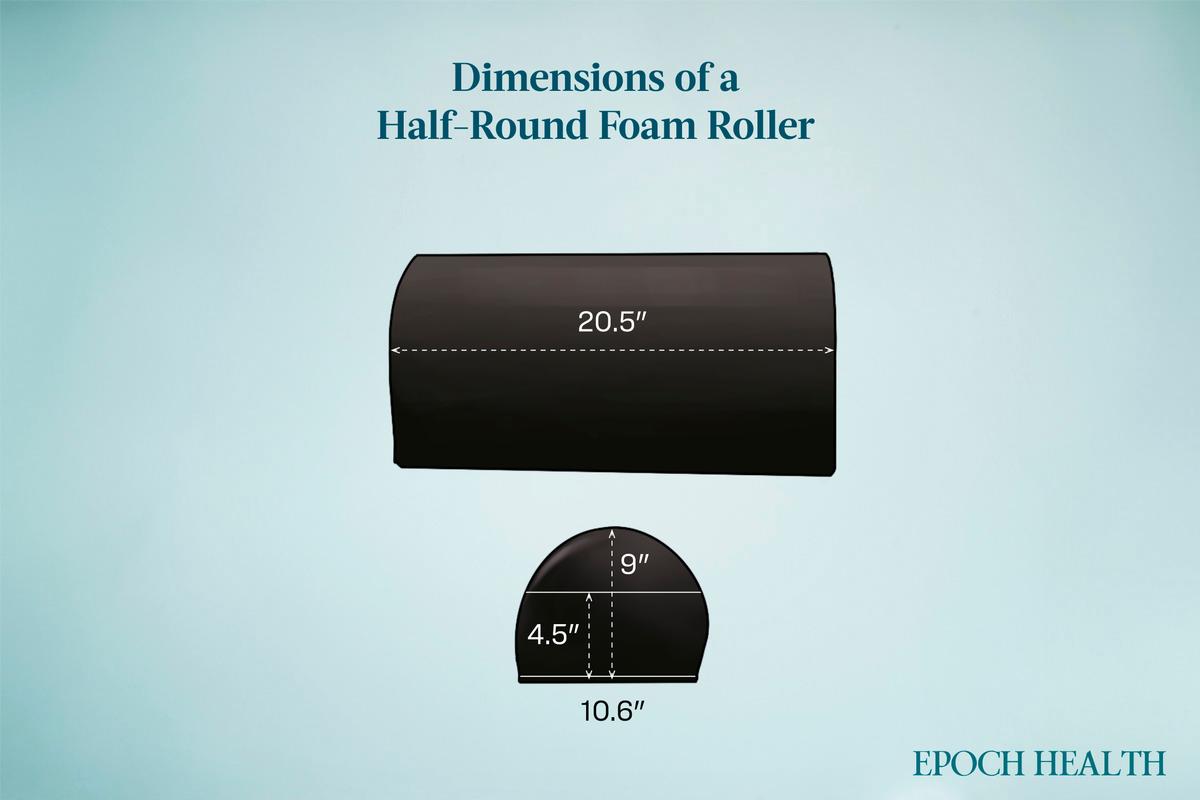
Effectiveness of Exercise 3:
Based on my clinical experience, this exercise is more effective for patients with relaxed lower back muscles, while those with tight lumbar muscles tend to recover more slowly. In such cases, traditional Chinese herbal medicine that relieves muscle rigidity and activates collaterals can help ease the tension.About one-third of patients with vertebral slippage achieve full realignment of the lumbar spine. Another third may not experience ideal realignment, but they report a more than 50 percent improvement in back and leg pain. The remaining third may find the exercise too painful and choose to discontinue.
In other words, this rehabilitation method has a success rate of more than 50 percent, making it a worthwhile option to consider before resorting to surgery.