Comprehending Caricatures
Cruikshank’s illustrations of Charles Dickens’s “Oliver Twist” were a perfect demonstration of Cruikshank’s ability to reveal both plot and characters. He followed the orphan Oliver Twist as he made his way through life, trying to find his place in the world, illustrating the boy’s journey from a horrible workhouse, to a criminal gang, to the care of Mr. Brownlow. He successfully paralleled Oliver’s struggle to retain his morality and to finally find a home.In one of Dickens’s most memorable scenes, little Oliver Twist asks the workhouse master for more food, to which the master replies by “aim[ing] a blow at Oliver’s head with the ladle, pinion[ing] him in his arms, and shriek[ing] aloud for the beadle.”
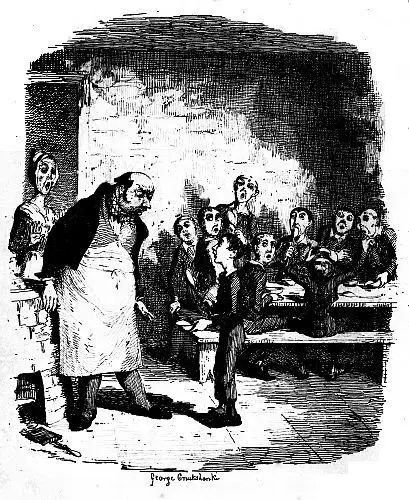
Cruikshank perfectly portrayed this scene by depicting all of the boys, including Oliver, as small, thin, wide-eyed, open-mouthed, and starving for both food and attention. The master, on the other hand, is plump with a ferocious scowl, pointed nose, and bent figure. Cruikshank’s caricatures quickly aided the reader in distinguishing the needy and hungry from the fat and well-fed. Through this contrast, he conveyed the abysmal situation in which Oliver found himself.
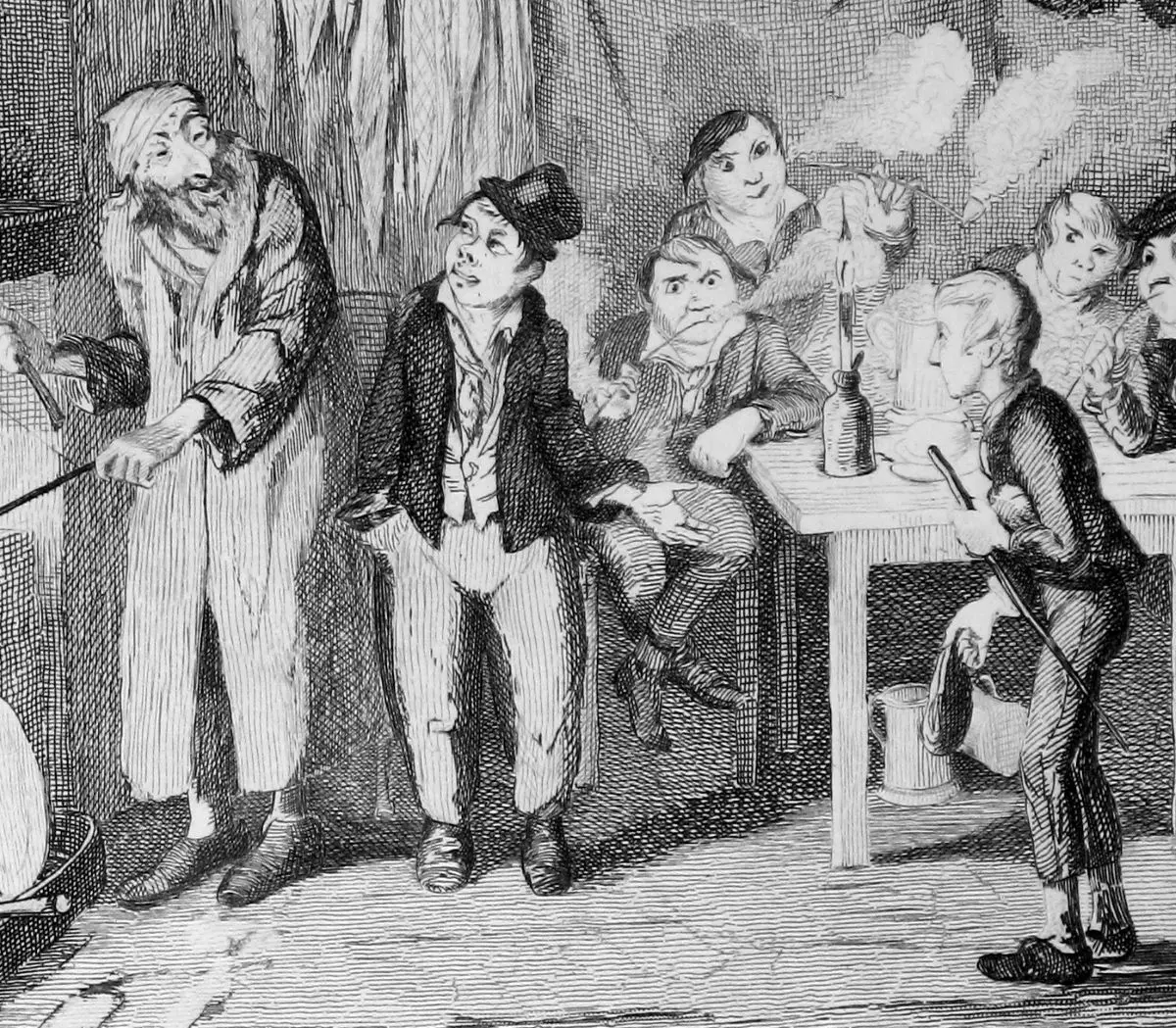
Later in the story, Oliver enters London and falls into the company of the Artful Dodger, a teen-aged thief. Cruikshank’s illustration of Dodger shows the teen introducing Oliver to Fagin, the old leader of a thieving gang of children. Unlike the workhouse boys, Dodger and the other boys have round faces, yet their faces convey suspicion and a lack of innocence as they all smoke pipes.
Well-Rounded Moral
Cruikshank finished Oliver’s character arc by illustrating him among morally upright people, who, accordingly, are more realistically drawn.In his illustration “Rose Maylie and Oliver,” Cruikshank presented the characters in a normal domestic setting. Rose Maylie and the others appear without exaggerations and distortions, so that they contrast the caricatured Fagin, workhouse master, and Dodger. Their virtue shone through their nearness to reality.
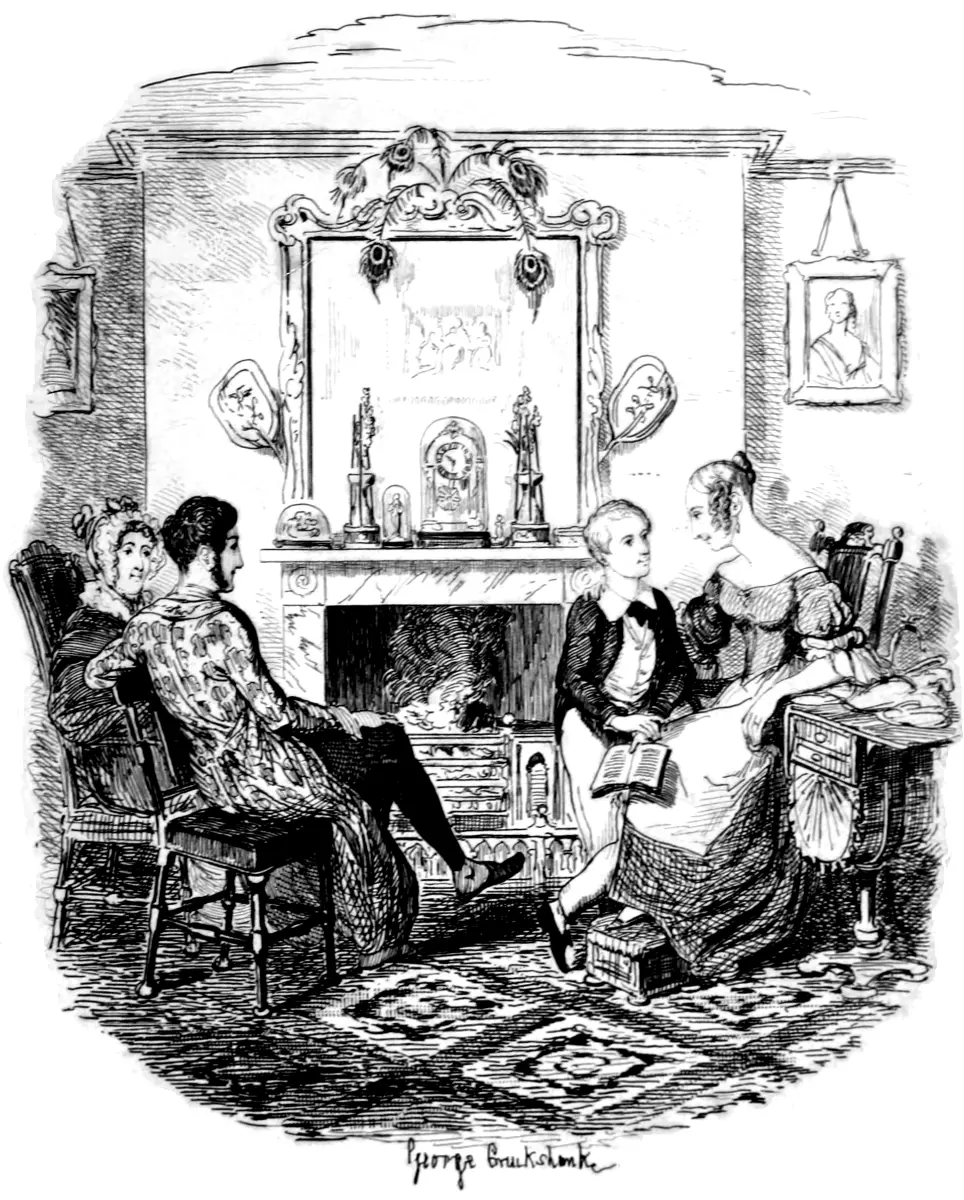
Even Oliver is less caricatured in this Cruikshank illustration. Whereas he was skinny, bent, with wide eyes and an open mouth while facing the workhouse master, Oliver now stands tall, smiling, healthy, and whole.
Cruikshank achieved moral truth through caricature in much the same way that G.K. Chesterton described in “All Things Considered”: “The same is true of the perpetual jokes in comic papers. … It is all a frantic exaggeration, but it is an exaggeration of a truth.” Cruikshank drawings demonstrate that, the further people are from virtue, the further they are from reality. Thus, his illustrations are invaluable because they provide the reader a visual story of virtue against vice.