The Power of Noticing
Lear’s gift for noting and marveling at the world around him couldn’t be more apparent than in his illustrations of exotic birds, specifically parrots. In his illustration of a “Greater Sulpher-crested Cockatoo,” Lear illustrated a cockatoo in amazing detail.
With succinct outlines and several minute strokes, he discriminated among the cockatoo’s wide variety of feathers, showing the direction of the feathers coming off the bird’s body, as well as the direction of the barbs coming off of the feathers’ shafts. The bumpy texture of the eye-ring is clearly depicted as is a small sliver of the cockatoo’s brown iris. He also achieved the sandpaper texture of the feet by drawing several circles of various sizes.
The Gift of Noticing
Yet Lear’s great gift of attention wasn’t confined to the natural, animal world, for he took note of people too. While working as an illustrator for the Earl of Derby, Lear engaged with the earl’s children, from whom he got the inspiration to compile a book of limericks. He loved making children laugh, so he wrote “A Book of Nonsense”—filled with his own illustrations—to do just that.Though more elementary and less magnificent, Lear’s cartoon illustrations were meant to be fantastical, for, in that way, they elicited laughter from children.
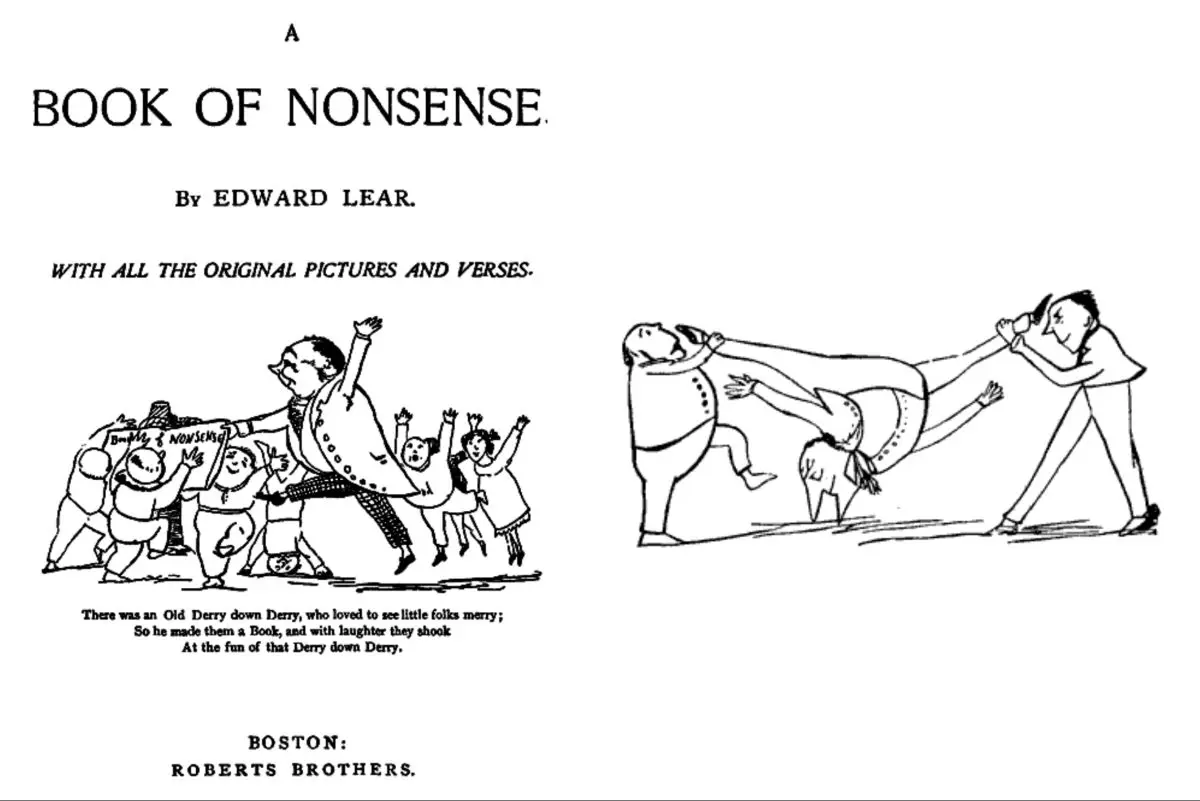
There was an Old Man of the West, Who never could get any rest; So they set him to spin on his nose and his chin, Which cured that Old Man of the West.
Such a limerick, along with the image of a man upside down in a complex grand jeté, would undoubtedly make children laugh. The very lack of detail in the illustration make it funnier. The sharp angles and round shapes, much like comedy, are abrupt and, thus, can draw laughter.Lear’s illustrations reached people of all ages, bringing joy and inspiring laughter. Even now, his illustrations inspire viewers to cultivate paying attention.


Through his illustrations, Lear seemed to say, much like author Markus Zusak in “The Book Thief”:
“People observe the colors of a day only at its beginnings and ends, but to me it’s quite clear that a day merges through a multitude of shades and intonations with each passing moment. … In my line of work, I make it a point to notice them.”
Lear’s works provide an example for viewers of all ages and times to look at the world with wondering, perceptive eyes. For, by observing the world, they can appreciate its true beauty and worth.