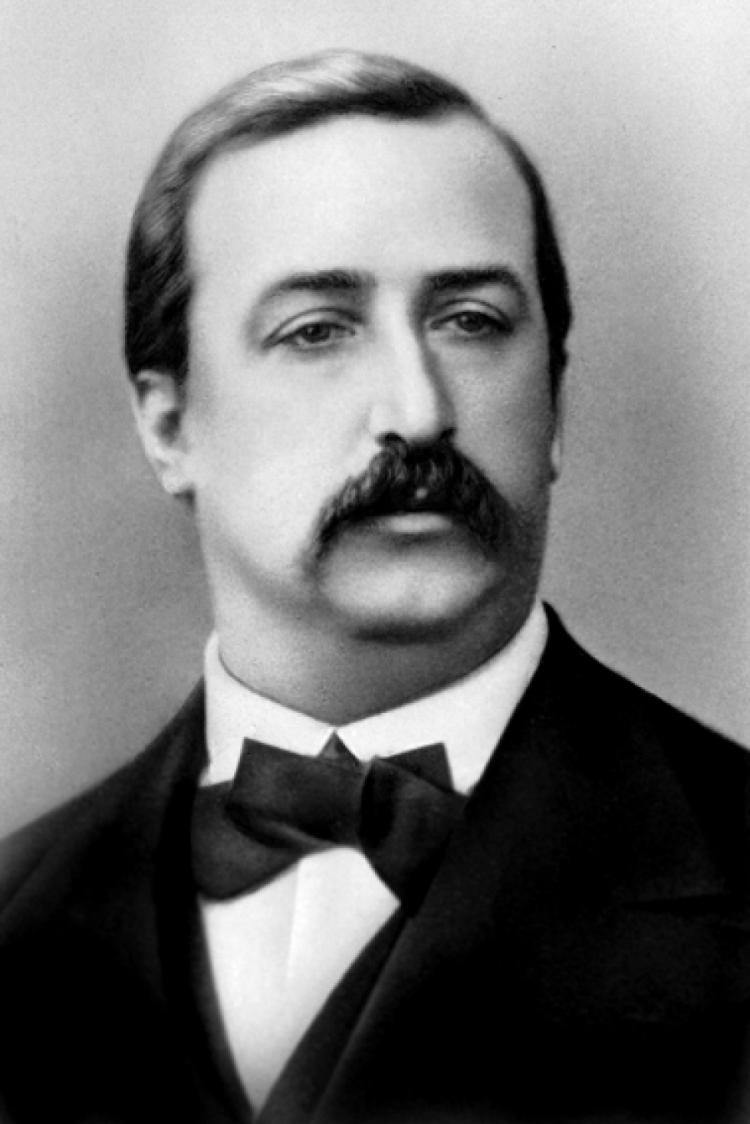
While studying at the Medical-Surgical Academy in St. Petersburg, Alexander Borodin’s professor warned him against his pursuit of music. “You can’t hunt two hares at the same time,” he was told. As a brilliant chemistry student, Borodin was simply being pushed by his professor to channel his energy in a realistic direction, to the detriment of his great talent for music.
Borodin (1833–1887) struggled his entire life to find time for music. After graduation, he worked as a full-time chemist, making valuable contributions to the budding field of organic chemistry. Domestically, he lived in a state of constant chaos, harboring a crowd of two adopted daughters, various animals, and a rotating cast of visiting relatives.
His wife, pianist Ekaterina Protopova, suffered from poor health, her care requiring much of Borodin’s free time. As a result, his music often fell to the wayside, with his compositions taking him years to finish. He referred to himself deprecatingly as a “Sunday composer.”
Among the “Mighty Five,” whose goal was the development of “uniquely Russian” music, Borodin was considered a traditionalist. While anti-Western nationalism dominated the ethos of the other members of “The Five,” Borodin balanced nationalism with traditional forms. His love for chamber music made him, and to a lesser extent Rimsky-Korsakov, the only members of the group to compose chamber music of note.
In fact, his second String Quartet in D major isn’t only notable; it’s one of the most beautiful pieces in the entire repertoire. Playing the piece in today’s recording is the “Borodin Quartet,” a famed group of musicians named in honor of the great composer himself.
Borodin’s String Quartet No. 2
Today’s recording of the third movement of Borodin’s String Quartet No. 2 in D major, “Notturno: Andante,” is by the Borodin Quartet. (Listen)This slow movement begins with the syncopation of hushed strings. The cello enters with a gentle melody full of warmth and lyricism, which would later be adapted into the song “And This Is My Beloved” from the Broadway musical “Kismet.” Here, Borodin showcases his talent for melodic invention, crafting a sense of yearning in the music through forays into distant harmonies. Through an inspired application of harmony at 0:50, the mood grows ever more wistful.
The violin soon takes over with a lustrous rendition of the opening melody. The music transitions into a lively dance, a middle section where each instrument gets a turn in the spotlight. The main theme is passed from voice to voice in related keys as hints of the energetic dance figure ornament the music.
When the tune finally returns in the original key, the cello is now accompanied by an echo from the violin. Borodin’s “Notturno,” or “Nocturne,” is often cited as his most popular work, alongside his “Polovtsian Dances” from the opera “Prince Igor.” Capturing the feeling of the night, “Nocturne” brings to life the tranquility of the Russian twilight.