He’d come to Prague to drink its beer, his favorite beverage, and to compose a set of three symphonies, which today we know as No. 39 in E-flat, No. 40 in G minor, and No. 41 in C.
Though he lived another three and a half years, these were Mozart’s last symphonies. Nobody knows why he wrote them. There was no commission, no expectation of performance, no obvious professional reason to spend nearly two months of his life composing for the heck of it when finances at home demanded his attention. Some scholars suggest the symphonies were written for a concert series at a Vienna casino, but there’s little evidence to support the their notion and no evidence whatsoever that the concerts took place.
The Symphony
The symphony as a form began as a stand-alone orchestral version of the opera overture, with its fast-slow-fast structure. The three parts of the overture became three separate movements of what came to be called a “symphony.” In time, a minuet was inserted between the second and final movements. The result: four separate pieces that formed a whole greater than the sum of their parts.The earliest symphonies exploited contrasts made available to the composer by an orchestra of winds (pairs of oboes and horns, sometimes bassoons, and later clarinets) and strings, contrasts of color, texture, key, and dynamics. The best of the very first symphony composers (works by Johann Stamitz, 1717–1757) tossed the new form around like a bauble, creating musical entertainment of a high order. Then came Franz Josef Haydn (1732–1809), who pushed the expressive range of the symphony forward, composing over 100 examples of the form and earning the title, “Father of the Symphony.” But Haydn, like Stamitz and others, composed for specific audiences and occasions—a coronation here, a baptism there.
Art to Further Art
What was this about? In 1788, composers didn’t write music just to “say something.” As far as I can determine from research, the last three symphonies of W.A. Mozart are the first examples of symphonies written for their own sake alone. As such, they should be (but are not) regarded by musical scholars as the initial sparks of Romanticism.
Mozart dared to devote nearly two months of his life to saying something in purely orchestral terms. What did he say? Music is incapable of stating facts about the world of objects and actions. If one goes no further than this, the notorious proclamation of Igor Stravinsky peeps over the horizon: “Music is, by its very nature, essentially powerless to express anything at all.”
But stopping there is a materialist error. Music cannot show us a tree or a pair of lovers kissing, but it can create the emotional conditions that accompany the majesty of nature or the ecstasy of love. J.S. Bach knew this. If you listen to Bach’s Chaconne and don’t know that Bach composed it on the death of his first wife, you will nonetheless recognize that it expresses grief. It can’t show you someone’s death, but it can let you feel what a grieving person feels.
And then there is our subject, Symphony No. 41, scored for flute, two oboes, two bassoons, two horns in C, two trumpets in C, timpani in C and G, and strings. Nicknamed “Jupiter” by a London concert promoter long after Mozart’s death, here is a performance by the Danish National Chamber Orchestra, conducted by Adam Fischer.
And here’s a brief outline of its four movements:
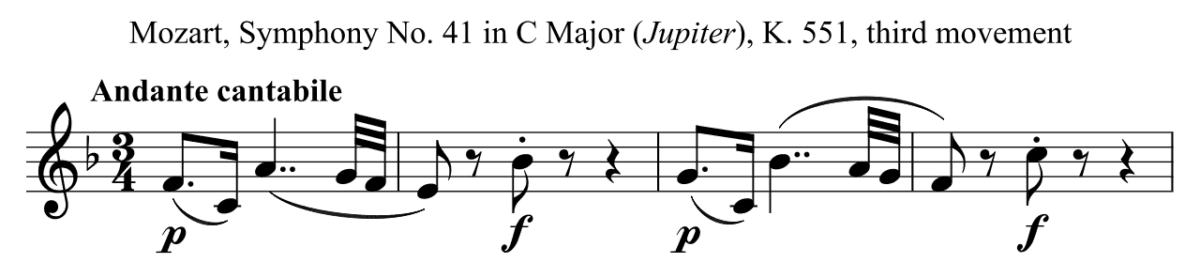
There are no words. Judged by many to be the most beautiful slow movement of any symphony, it makes love to the ear in glowing F major.
A graceful interlude between absolute beauty and the hair-raising finale to come.
This is it: Mozart’s final symphonic statement, and he goes out not with a whimper, but a bang. Five motifs appear: 1) At the start, four long-held notes, followed immediately by 2) a stabbing motif of four short notes. At 26:57, the long-note motif is developed in close imitation. At 27:14, 3) a sharply rising six-note idea sweeps in, and at 27:46 comes 4) an angular three-note idea, sharply down and then sharply up. At 28:04 the “stabbing” motif reemerges. Suddenly, at 28:21, 5) a new, fanfare-like motif appears.
Don’t fret if you can’t keep up. That’s the whole point: Mozart is introducing new ideas at breakneck speed. Much will happen, intertwining the five motifs; don’t try to identify them, let them flow over you.
Now let’s skip to the very end: 33:56, the start of one of the most spectacular endings in symphonic history. First we hear motifs 1 and 4 in counterpoint. Then, at 34:01, motif 3 enters, and before you know it, motif 5 shows up. All combine in a gigantic weave until motif 2, our “stabbing” motif, allied with motif 5, announces the end of the movement, the symphony, and the greatest triptych of orchestral scores ever assembled.