This copy is for your personal, non-commercial use only. Distribution and use of this material are governed by our Subscriber Agreement and by copyright law. For non-personal use or to order multiple copies, please contact The Epoch Times Reprints.
While some writers and artists had vast realms of silence and solitude in which to let their artistic ideas foment, others weren’t so fortunate. Always living in a household with others coming and going, Jane Austen (1775–1817) struggled to find long, undisturbed periods of time in which to weave her tales of genteel English society.
While artists such as Charles Dickens and Ludwig van Beethoven could schedule their days and rely on rigid routines, Austen’s days were less predictable. Yet she still generated a substantial literary output of the highest quality, proving that the flower of artistic achievement grows even in inhospitable environments. By hook or by crook, writers find a way to write. The things burning inside them to be expressed will scorch a hole right through their chests if they don’t.
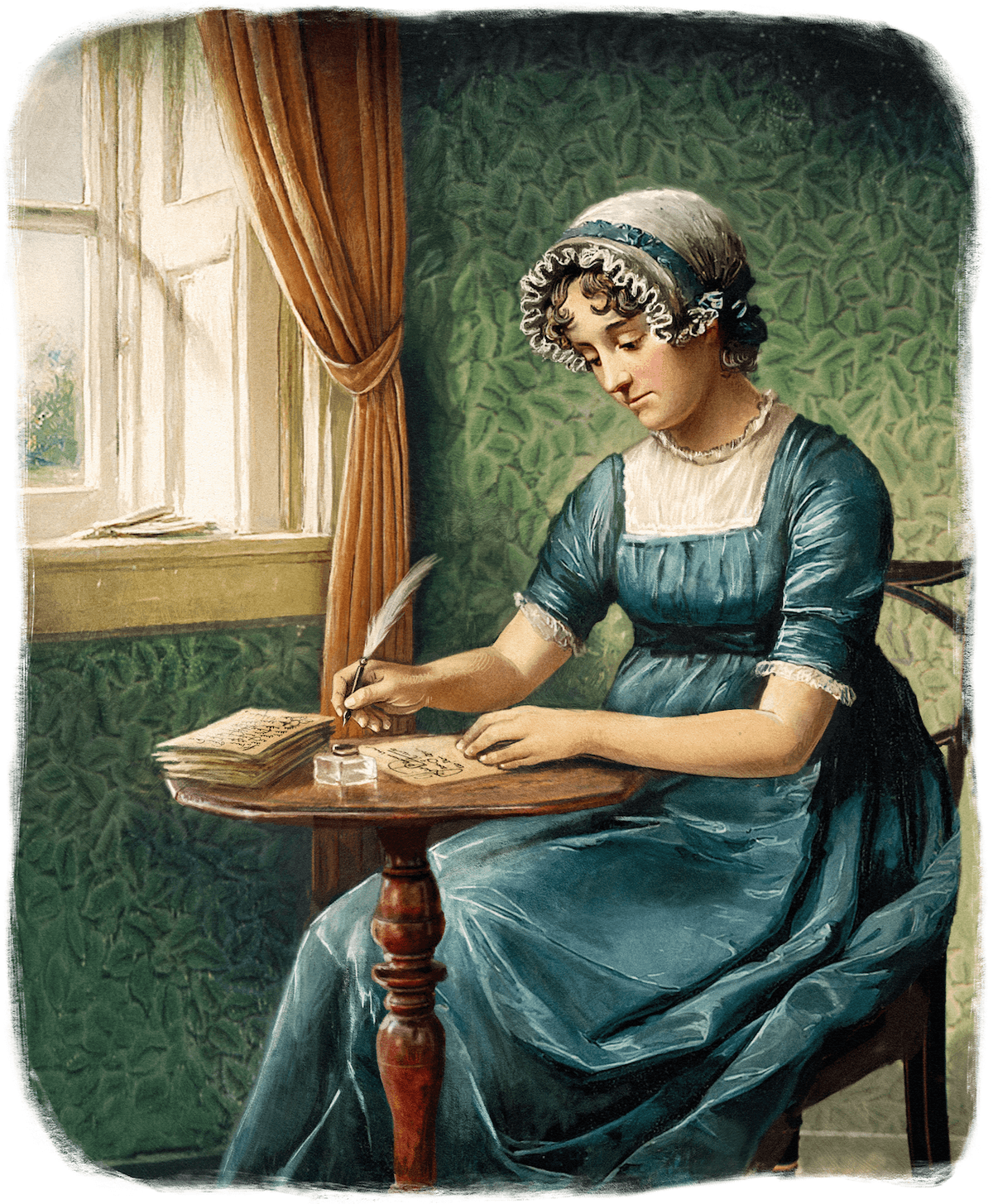
Austen woke up early, before her mother and sister did. She started her day by playing the piano—or pianoforte, as it was then called—running errands, writing letters, or walking. Her primary domestic duty was to arrange the family breakfast at about 9 a.m. Afterward, she worked on her writing in the sitting room, sitting close to a window for light, while her mother and sister sewed. Before his death, her father gave her a very small writing desk, which included a writing surface and storage for ink and other writing supplies.
Austen wrote at a modest desk near the light of a window, often amidst the quiet hum of household activity. Biba Kayewich
According to some accounts, Austen swiftly concealed her papers when visitors arrived—which they often did. In his book “Daily Rituals: How Artists Work,” Mason Currey quoted the recollections of Austen’s nephew: “[She was] subject to all kinds of casual interruptions. She was careful that her occupation should not be suspected by servants, or visitors, or any persons beyond her own family party.
“She wrote upon small sheets of paper which could easily be put away, or covered with a piece of blotting paper. There was, between the front door and the offices, a swing door which creaked when it was opened; but she objected to having this little inconvenience remedied, because it gave her notice when anyone was coming.”
Austen’s concealment of her writing endeavors extended even to the publication of her novels: They were all published anonymously, and it was only after her death that her name became connected to her works. During her lifetime, the works were simply credited to “a Lady.”
Why this secrecy? While we don’t know for certain, there appear to be a few reasons. First, Austen probably valued her privacy. Second, publishing under a pseudonym wasn’t uncommon at the time. It had already become a literary convention. This was especially true for female writers, since many considered writing an unladylike occupation.
As Greg Buzwell wrote on the British Library website: “During the late 18th and early 19th century. ... Unseemly parallels with prostitution arose regarding the notion of women writing novels which were then sold to anyone willing to pay. ... By the mid-18th century the tag ‘By a Lady’ became a common sight on title pages.
“This indicated not only the sex of the author but also that the book was by somebody of a certain class and thus suitable for perusal by respectable women.”
So Austen, “a Lady,” sat at her small desk, dreaming up vast narrative expanses, exploring and articulating the contradictions of human nature with a piercing insight. She wrote on small slips of paper with a quill pen and ink made from iron gall (tannins mixed with iron sulfate, gum arabic, and water). Austen wrote an initial draft of a novel, crossing out phrases and sentences and reworking them. Afterward, she completely revised the entire manuscript.
She experimented with a literary technique called free indirect discourse, wherein the narrator’s voice blends with the characters’ voices and thoughts until the two are almost indistinguishable. She was one of the first writers to use the technique extensively in her work.
Austen finished writing for the day at about 3 or 4 p.m., when the family partook of the day’s main meal. Austen frequently mentions food in her letters and appears to have had a sweet tooth. Dinner was followed by conversation, tea, and games. In the evening, the family read aloud from novels, including, sometimes, Austen’s own manuscripts. Receiving feedback from her mother and sister was an important part of Austen’s writing process.
With characteristic humor, Austen once penned a letter that read, “I think I may boast myself to be, with all possible Vanity, the most unlearned, & uninformed Female who ever dared to be an Authoress.” We might well beg to differ.
Whatever shortcomings she may have had in book learning—and I doubt that they were significant by modern standards—she was an excellent observer of human nature. No one could write with such perceptiveness about the follies and fortitude, hubris and heroism of human nature without being well-versed in that school.
Before becoming a freelance journalist and culture writer, Walker Larson taught literature and history at a private academy in Wisconsin, where he resides with his wife and daughter. He holds a master’s in English literature and language, and his writing has appeared in The Hemingway Review, Intellectual Takeout, and his Substack, The Hazelnut. He is also the author of two novels, “Hologram” and “Song of Spheres.”