Remington’s Untamed West
Remington was born in upstate New York and educated at Yale. He was fascinated by the frontier and made 16 trips out West as well as into Mexico and Canada. As an artist-correspondent on these sketching sojourns, he observed soldiers and cowboys and went on to incorporate accurate details into his finished works. Remington’s artistic career began as a professional illustrator for magazines. Later, he became a renowned painter and sculptor. The images Remington created were consumed by fellow Easterners and shaped their vision of a mysterious and exciting West.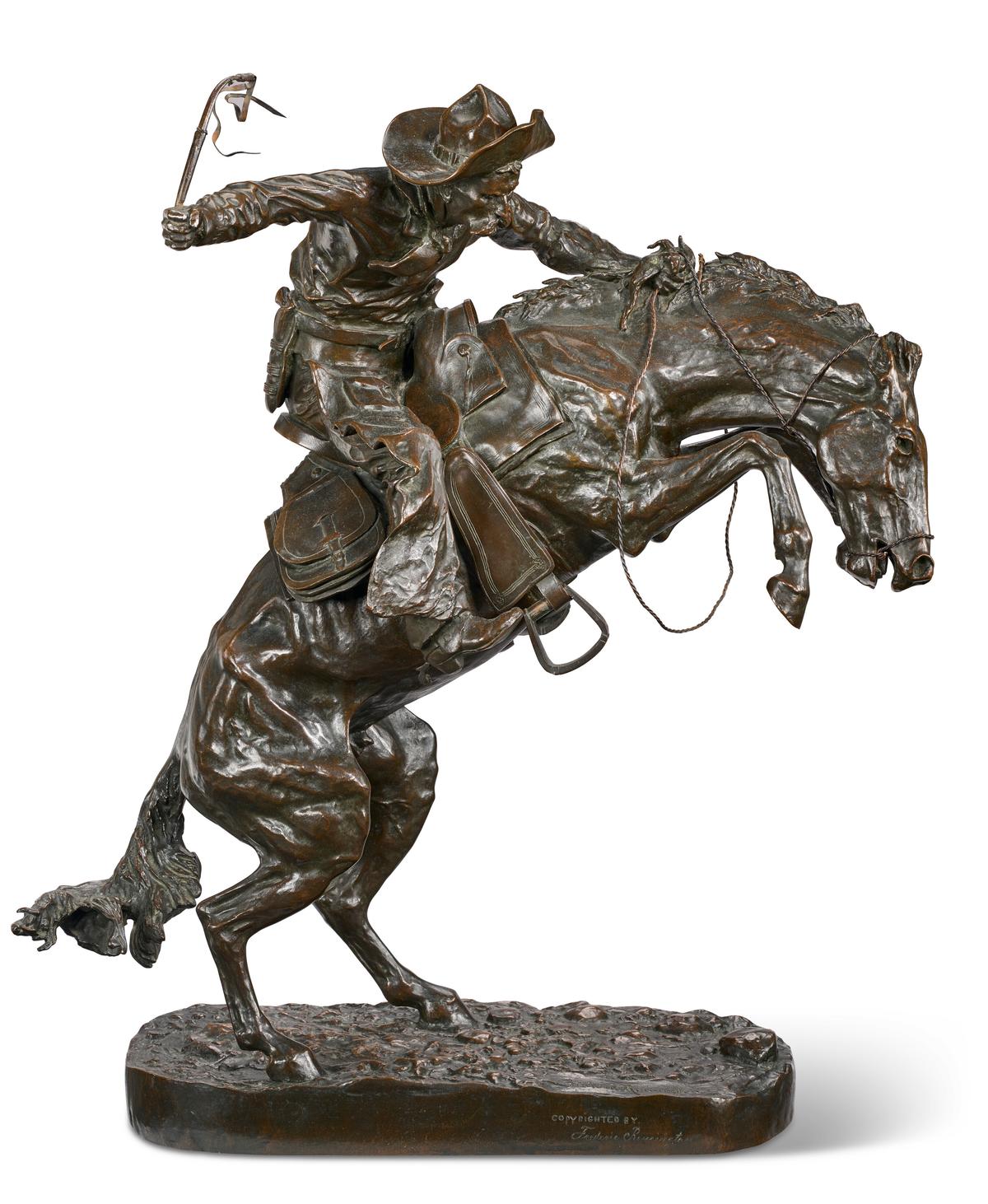
Remington’s first foray into sculpture came mid-career and was immediately ace-high. “The Broncho Buster” was modeled in 1895. Two versions of it are in the Christie’s sale. The smaller is estimated to sell for $250,000 to $350,000 and was cast in his lifetime. A celebration of the cowboy, this famous action bronze shows a rider breaking a rearing wild horse. It is a triumphant symbol of rugged grit as well as a great technical feat. The artist continued to push the bounds of sculpture, especially in the daringly complex “Coming Through the Rye,” an example of which is being offered for $4 million to $6 million. It is one of the only casts still in private hands.
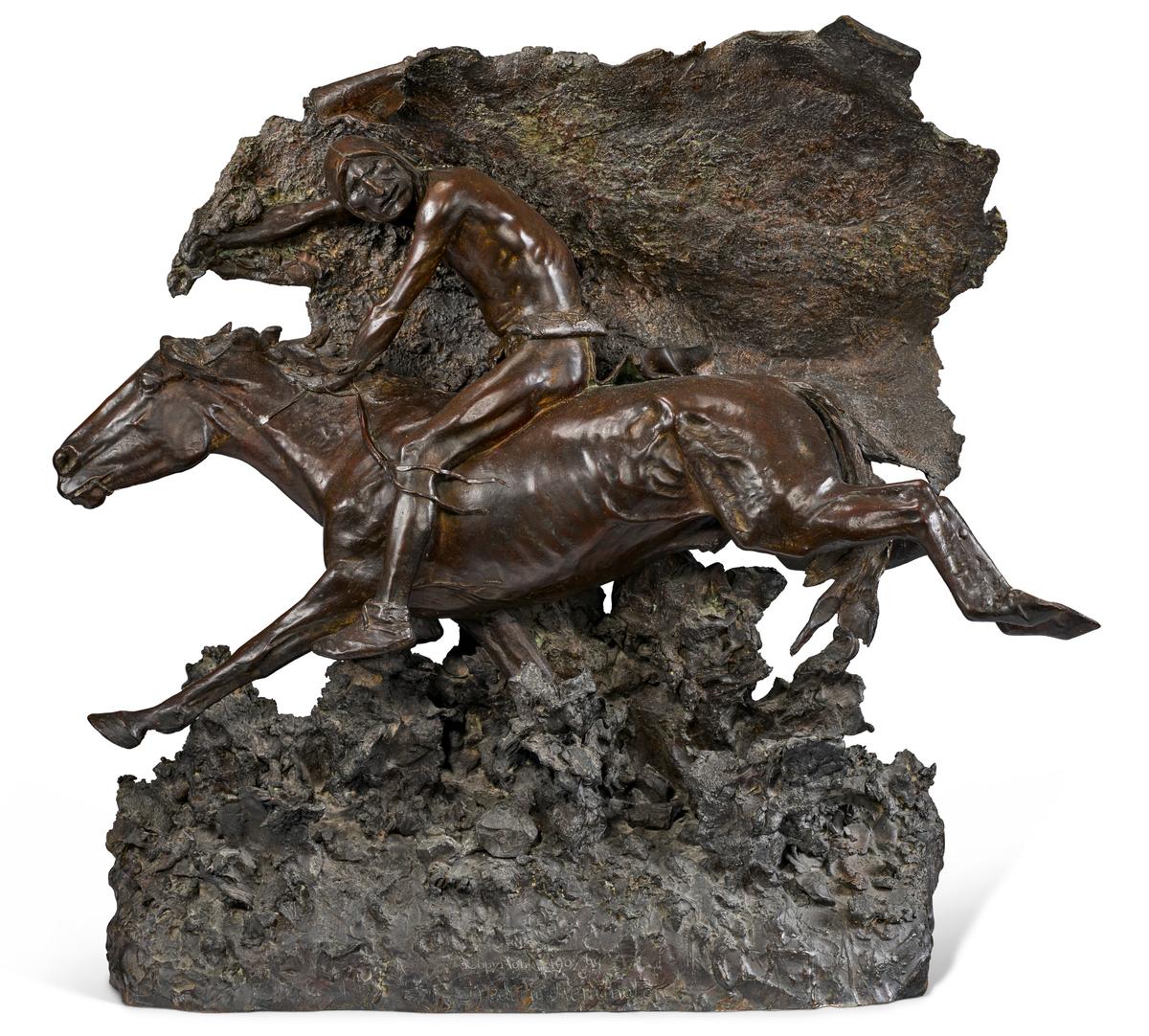
“The Horse Thief” is among Remington’s rarest bronzes. It was modeled in 1907, making it one of the artist’s final sculpted works before his death. There are only three known casts, the other two are in museums, hence the hefty estimate of $3 million to $5 million. The work conveys a rousing sense of dynamism.
It shows a Native American wearing a windblown buffalo robe taking flight on a horse. The figures’ straining muscles are emphasized as they appear almost suspended in air. In this work, which was his only freestanding relief sculpture, Remington focused on surface texture, from the smooth polish of flesh to the rough and thickly worked hide.
The sale’s lead lot is a circa 1905 painting by Remington. “Coming to the Call” is one of approximately 70 nocturnes the artist did in his last decade before he died unexpectedly at 48. This magnificent sunset painting was heralded in his lifetime as one of his four best painted works. It is representative of the heightened painterly direction his art was taking. In it, he explores light, atmosphere, and tonal harmonies while retaining narrative, albeit without his usual cowboys, calvary, Native Americans, or horses. The original purchase price was $500. It is now estimated at $6 million to $8 million.


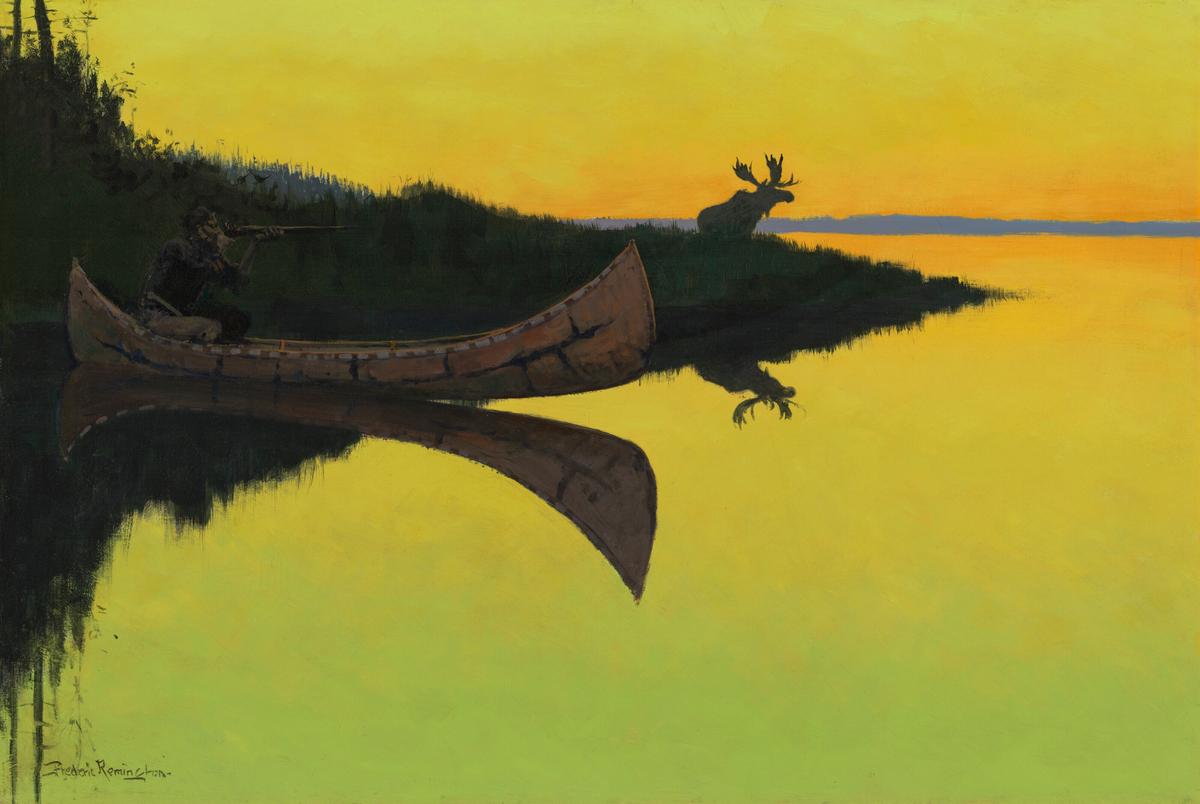
The canvas was probably painted on the Canadian side of the St. Lawrence River, where Remington had maintained an island home since 1890, enamored of its still untamed landscape. Twilight canoe trips, during which he notated the effects of light and color across the water, were integral for studio works like this painting. This artwork depicts a solitary moose standing at the water’s edge that shows its reflection.
The ‘Cowboy Artist’
Charles Marion Russell was born in St. Louis, Missouri, the “Gateway to the West.” He spent most of his adult life in Montana, working first as a wrangler and a night herder before becoming a professional painter. Self-taught, he was known as the “Cowboy Artist.” In contrast to Remington, he was a Westerner.While Remington mythologized the West, Russell memorialized his lived experience, honoring his community and the landscape. Though they were initially professional peers, after Remington’s death Russell was seen as his successor in constructing the iconography of the West.
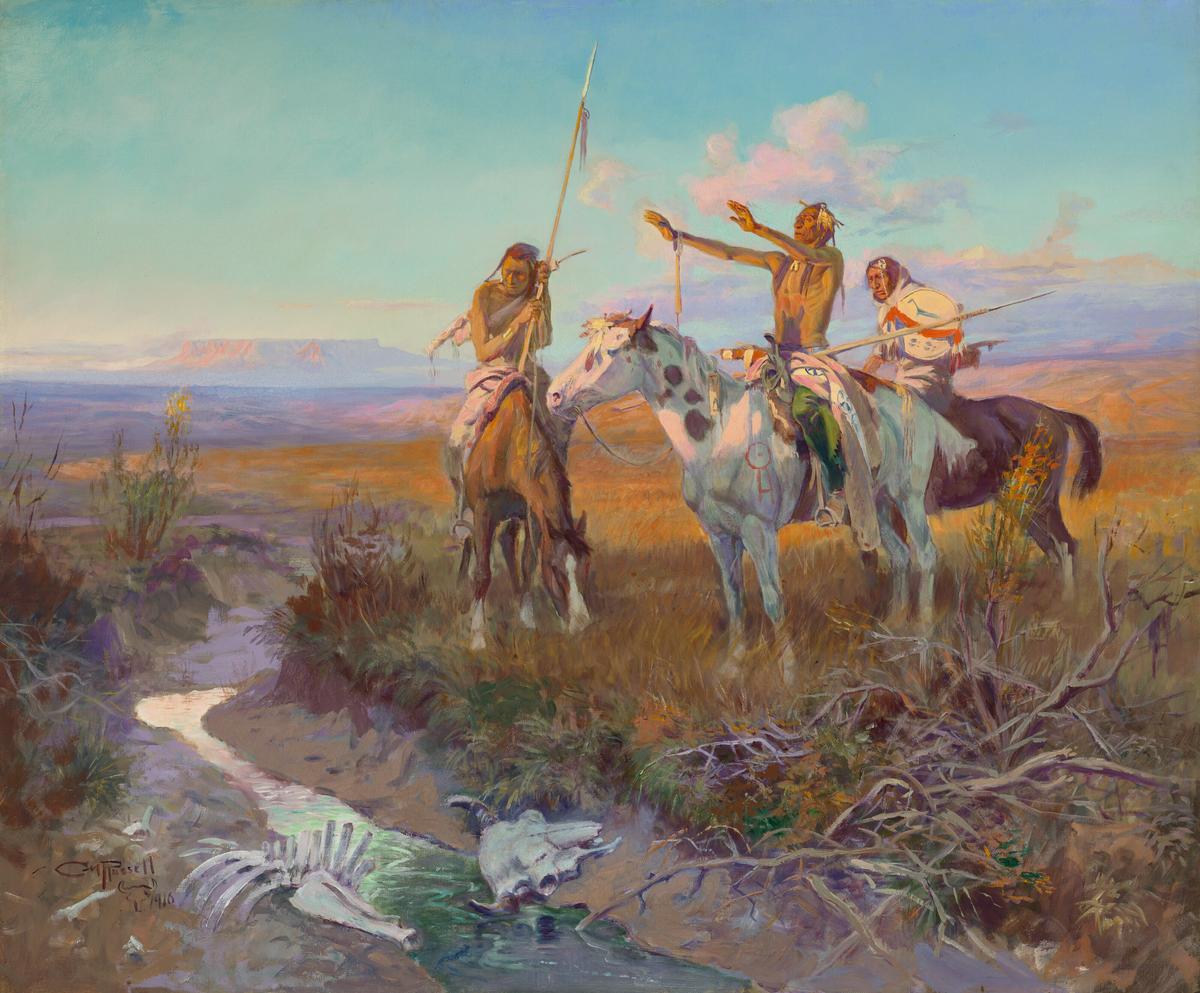
Two sweeping, emotional canvases by Russell in the sale are “The Sun Worshippers” and “Dust.” The former was painted in 1910 and is estimated at $4 million to $6 million. Its setting is a Montana plain at daybreak. Three Native Americans on horseback have stopped by a shallow stream. They show reverence to the sun’s ascent. An older man lifts his eyes and arms in a gesture of devotion.
“The serenity of the scene is only tempered by the bleached skeleton of a fallen buffalo—a quiet emblem of loss that deepens the painting’s spiritual register. The contrast between death in shadow and life in sunlight creates a natural allegory for renewal.”
Russell identified the painting’s location as Sun River, called Medicine River Valley by Native Americans. The background is Sun River Buttes, an area favored by the Blackfeet. The artist wrote that the figures are an advancing hunting party, with the old man asking the sun for a successful buffalo run. Russell was not painting a completely made-up or unknown scene, as he was deeply tied to the area and had lived alongside the Blackfeet and other tribes. He admired their culture and their harmonious approach to living with nature.
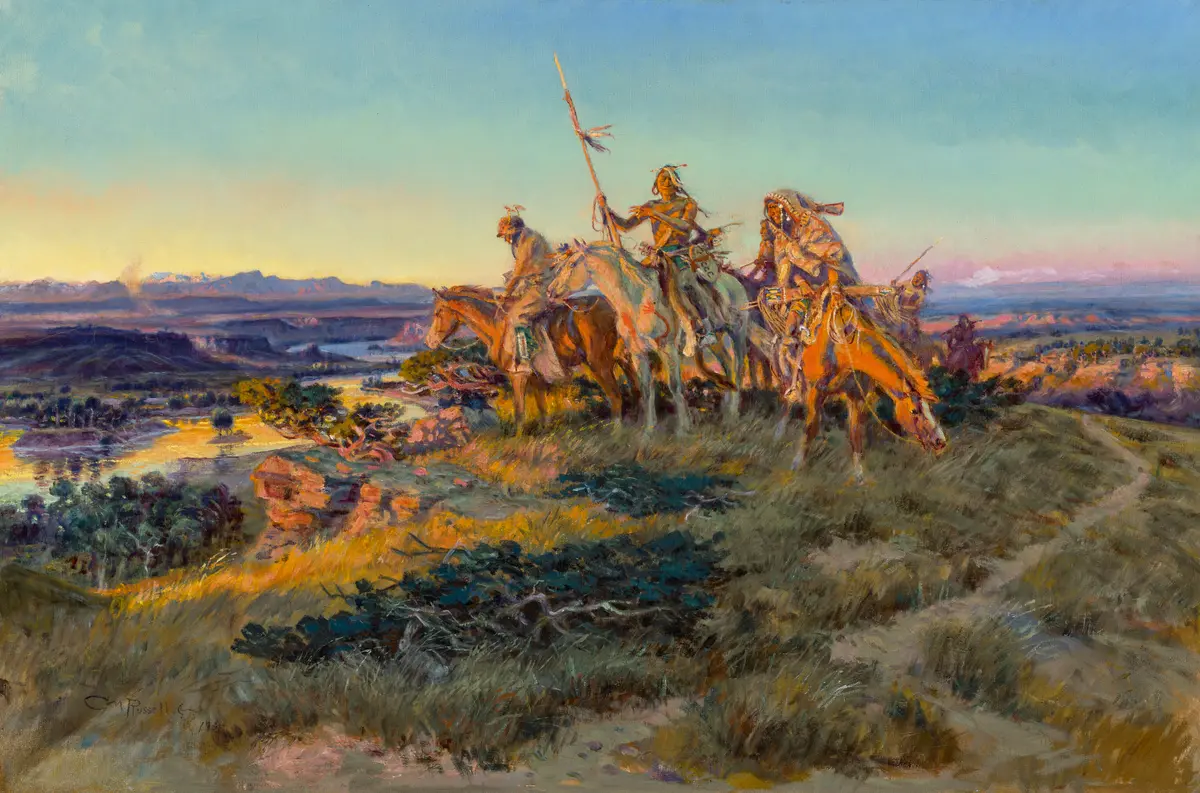
Russell’s sensitivity to the Native American experience is also found in the luminous “Dust,” circa 1925 with an estimate of $5 million to $7 million. The painting’s central figures are Native Americans situated on an elevation. Below them are faint traces of a wagon trail. Russell places the viewer on the perch with the Natives, instead of with the settlers’ wagon train that symbolizes their displacement. The canvas was painted a year before the artist’s death, when his palette was glowing, and embodies the culmination of his life’s work.
Remington and Russell created the mythic frontier in the public’s imagination: a land of beauty, action, courage, freedom, and promise. Both men lived to see the land they loved in their youth disappear, as railroads replaced wagon trails, settlers enclosed land, and the buffalo disappeared from the plains. Yet, what they chronicled endures through the celebration and influence of their epic art, with peerless examples in “Visions of the West: The William I. Koch Collection.”