R | 1h 50m | Drama | 2025
Maine-based author Stephen King is the undisputed heavyweight king of horror literature. His lucrative books and their subsequent movie spinoffs likely eclipse any 10 mega-budget movie franchises, combined.
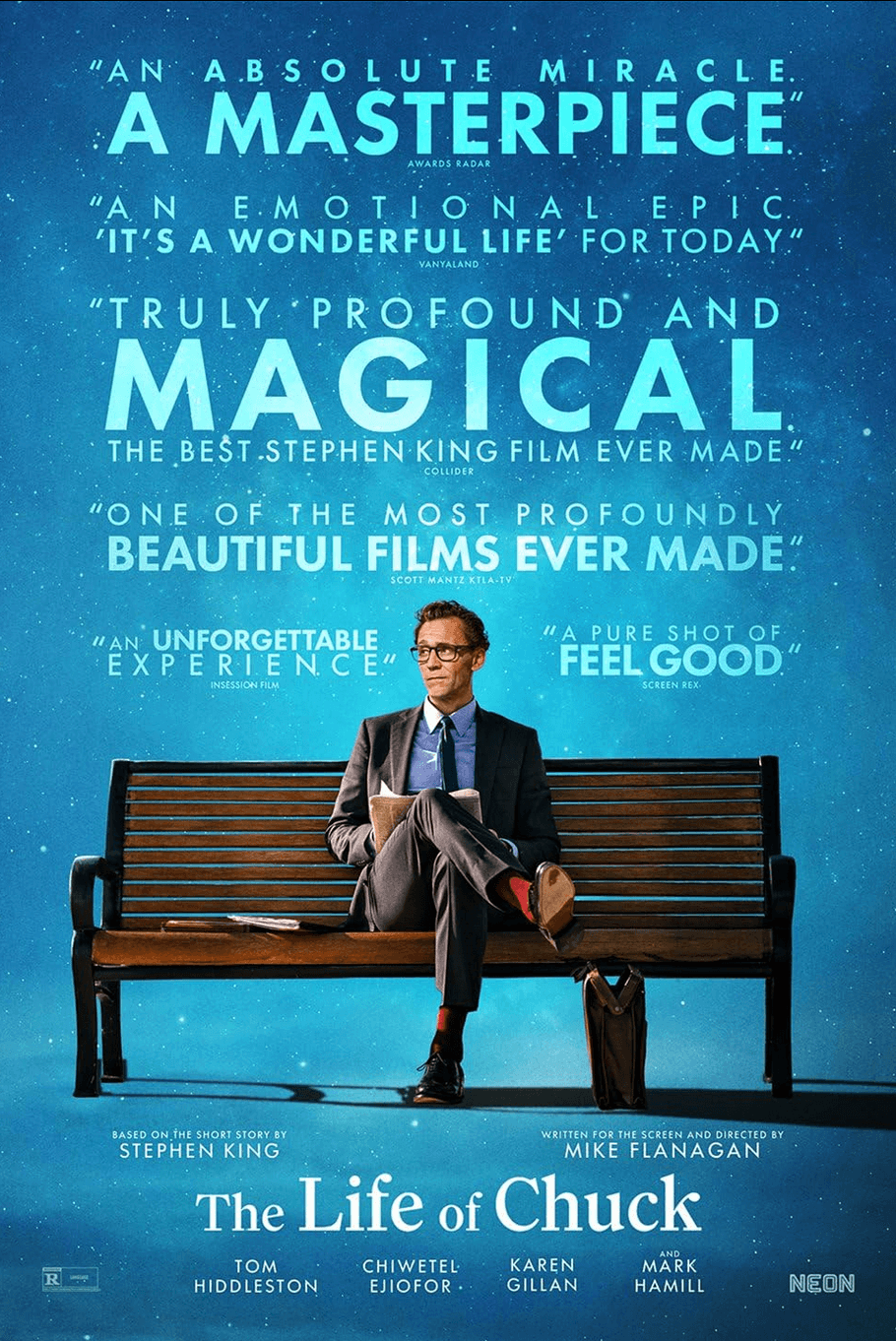
“Life of Chuck,” Flanagan’s third adaptation of King, is from a short story called “If It Bleeds,” told in reverse order, about the life of a fairly nondescript accountant named Chuck Krantz (Tom Hiddleston).
Act III
Narrated by Nick Offerman, the film begins with Act III, which has the title card “Thanks Chuck,” wherein the universe appears to be reaching its end. We’re introduced to several seemingly random characters who give us a quick recounting of their lives.First is Marty Anderson (Chiwetel Ejiofor), a small-town high school English teacher whose Walt Whitman class is interrupted by news that a huge earthquake has shaken a large piece of California loose, into the ocean.

About Chuck
When we finally meet Chuck, he begins spontaneously dancing in front of a mall to the beat of Taylor Franck, a busking drummer (Taylor Gordon in real life, who also goes by the stage name of “The Pocket Queen”).Chuck grabs a random woman named Janice (Annalise Basso) from the crowd of onlookers. She’s depressed due to her boyfriend breaking up with her five minutes earlier, via text. Chuck and Janice dance up a storm. It’s one of the best movie dance scenes since John Travolta and Uma Thurman’s in “Pulp Fiction.”
What’s It All Mean?
“The Life of Chuck” deals with topics familiar to the Stephen King readership, like the apocalypse (“The Stand”) and ghosts (“The Shining”). While it slowly reveals its intentions, mostly the film is dedicated to poetically teaching the importance of living in the moment and savoring the small things in this crazy little thing called life. After all, it’s looking like the world could end pretty soon.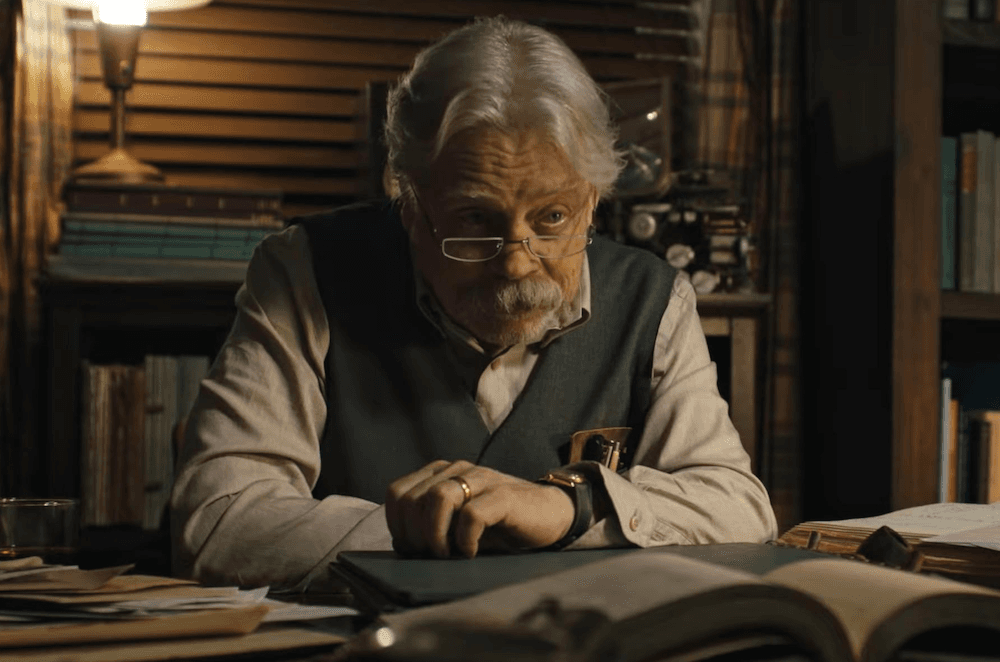
While “Tree of Life” went macrocosmic, depicting massive galaxies and then skittering a tiny human story across the surface of that gargantuan backdrop, “Life of Chuck” goes microcosmic. The entire film boils down to a line from Walt Whitman: “I contain multitudes.” We contain multitudes.
What that means is that life can’t possibly be mundane due to the fact that if, as mentioned in the book “Zhuan Falun,” one had an impossibly powerful microscope, as well as an impossibly gigantic telescope, one would be able to observe that an an atom and its orbiting electrons are basically a tiny model of the solar system’s planets orbiting the sun.
Say a grain of sand is made up of 3,000 atoms. That’s 3,000 microcosmic worlds in one grain of sand. In those tiny worlds also exist tiny oceans with tiny beaches. Tiny beaches made up of tiny sand. And that would repeat, as Buzz Lightyear suggests, “to infinity and beyond!”
As Albert Einstein famously said: “There are two ways to live: you can live as if nothing is a miracle; you can live as if everything is a miracle.”
Who knew horror-meister Stephen King was this spiritual?