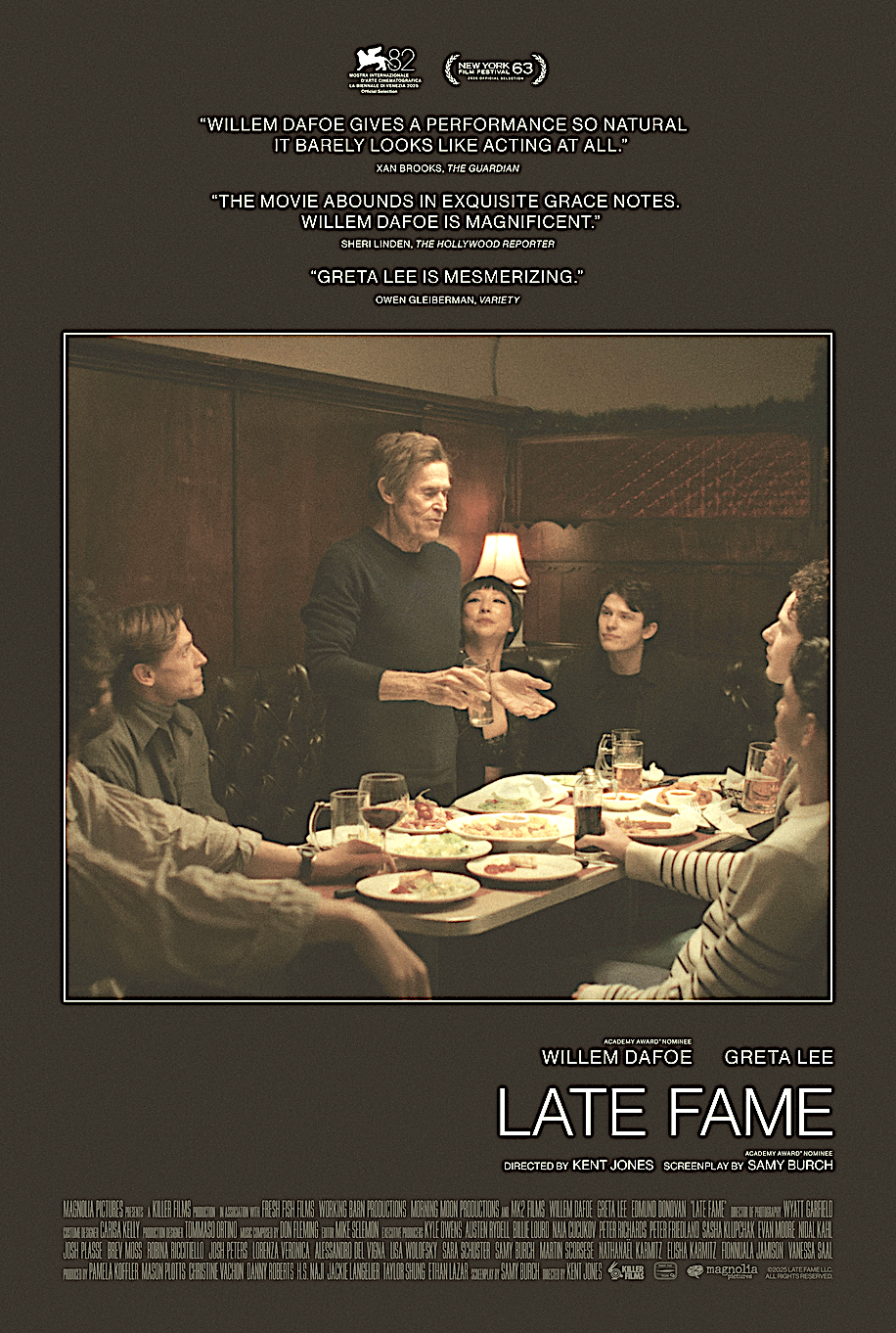
Not Rated | 1h 36m | Dramedy | 2026
Unassuming postman Ed Saxberger (Willem Dafoe) lives a quiet, blue-collar existence amidst the Lower Manhattan working-class milieu that still exists but just barely.
He spends his free time in a “Cheers”-type bar where everyone knows his name; “everyone” meaning other middle-aged working men. The cute bartender also has his usual dinner order waiting for him as soon as he arrives.
A Fan
One day, he discovers a young man (Edmund Donovan) hanging around his stoop. This blue-streak-talking, exceedingly nervous, literary name-dropping individual, who insists on being called by his surname, Meyers, has discovered Ed’s out-of-print book of poetry in London.Meyers proclaims the book to be a work of genius. He’s overjoyed to be able to tell Ed face-to-face of his great respect and admiration. He’s also overeager for Ed to stop by the cafe where he and his circle of young intellectuals hang out.

Young Turk Wannabes
When Ed finally makes an appearance at the establishment housing Meyers’s little confederacy of hopeful nouveaux Beat poets, he’s slightly taken aback to see it’s only young men. The kind of pretentious, pampered-prepped-Ivy-League’d-originally-monied little beta-males who wear Izod sweaters, designer eyewear, and … capes. It’s the perfect example of how all genuine culture in America eventually becomes a hollow fashion statement— posers devoid of authenticity and integrity.

Meyers’s introductions of his literary compadres is reminiscent of a similar scene in Neil Simon’s hilarious “The Sunshine Boys” (1975), in which Walter Matthau’s, over-the-hill, 70-something Willy Clark introduces his nephew/agent to a bunch of long-washed-up vaudevillians, with words to the effect of “And this is so-and-so, a rising young comic.”
The effete, supercilious young men mock the equally young influencer group over in the other corner for being glued to their phones. Similar to the way millennials mocked boomers, eschewed CDs and other such advanced tech, and proclaimed that only retro vinyl was cool, these Gen-Alphas want to be famous, influential writers with important things to say—not just shallow social media content—but without doing any actual reading of literature. When Ed name-drops the only poet he really knew around the time of his book’s publishing in 1979 (Amiri Baraka), they nod as if in-the-know, but it’s obviously just more posing.
Gloria

Gloria brings Ed to the cabaret where she works and performs Bertolt Brecht’s “Surabaya Johnny” in its entirety, a hymn to abusive love that has the men-only audience, including Ed, in the palm of her hand. Ed knows better and ends up kicking himself, when he drops by her place on another occasion, and realizes she’s meeting another, different, older man, to, er, pay the rent.
Conclusion
The movie’s main drawback is making the young artist poseurs full-fledged adults instead of students. If they’d still been in college, their grandiose, trust-funded posturing would be slightly more forgivable. Nonetheless, these privileged loafers don’t exactly come across as caricatures. They’re young people trying to find themselves and the art they intend to make. For all their ridiculous affectations, there’s an earnestness to their search that makes them somewhat relatable. Kids today have it easy, but life is paradoxical, which means they also have it hard.“Late Fame” is a melancholy (but mildly comedic) wistful little tale. There’s some cringe, due to Saxberger’s over-the-hill, out-of-touchness, and the rampant, exploitative disingenuosness of the Gen-Alpha wannabes, who, due to social media, have 50 to 100 times the amount of showbiz and business savvy that earlier generations of artists had.
The youthful art-scene milieu naturally has some of the same outward dynamics as the early Soho artist-parties Saxberger describes, but sans integrity. There are ostentatious paeans to integrity, but it’s all hollow. “Late Fame” is a quiet but meaningful film, portraying the slow, inexorable effects of entropy and the dissolution of meaningful culture.