Thirteen was Beethoven’s lucky number—his lucky opus number, that is. “Opus” means work, and classical composers (or their publishers) frequently number their scores in chronological order using the word. A composer’s first work is “Opus 1,” his next is “Opus 2,” and so forth. Major exceptions are J.S. Bach and Wolfgang Mozart, who did not assign opus numbers. Others created numbered catalogues after the fact: BWV for Bach, K. for Mozart.
Ludwig van Beethoven (1770–1827) labeled as his Opus 1 a set of trios for piano, violin, and cello. Opus 2 was his first piano sonata in F minor. It was the first of 32 sonatas for solo piano, a series that, side-by-side with his 16 string quartets, would graph his progress as a composer.
From Beethoven’s first piano sonata, a slim, Haydnesque score in F minor, to the final sonatas of massive length and textural complexity, such as the “Hammerklavier” in B-flat, is a journey from earth to some distant musical galaxy. Listen to No. 1, then listen to No. 32, and the connection will elude you. Listen to all 32 consecutively, and the connections will make sense. Though the composer’s progress was steady, some stops along the way represented new plateaus of musical language. Beethoven’s Sonata No. 8 in C minor, Op. 13, is the first of them.
The composer’s eighth piano sonata is unlike any of the previous seven. Beethoven biographer Maynard Solomon wrote: “It was the first to utilize a slow, dramatic introduction,” and the first to link movements “through the use of related thematic material and flashbacks or reminiscences.” It was more than a technical advance, however. Its content lifted the sonata form to a higher form of expression. English musicologist Barry Cooper on Beethoven’s Opus 13:
“It surpasses any of his previous compositions, in strength of character, depth of emotion, level of originality, range of sonorities, and ingenuity of motivic and tonal manipulation.”
Here is a legendary performance by Vladimir Ashkenazy from 1972.
(Listen)
The first thing you’ll notice is that the first movement does not begin Allegro. Fast or relatively fast first movements were the norm and to be sure, Beethoven here sticks to that tradition. But he opens with a very slow (tempo indication: “Grave”) that continues for two-plus minutes. In our clip, the proper Allegro (“Allegro di molto e con brio”) does not start until 2:38. Beethoven’s idol, Mozart, and his friend Muzio Clementi had both written slow intros to some of their fast movements, but none with the gravity and substance of this one.
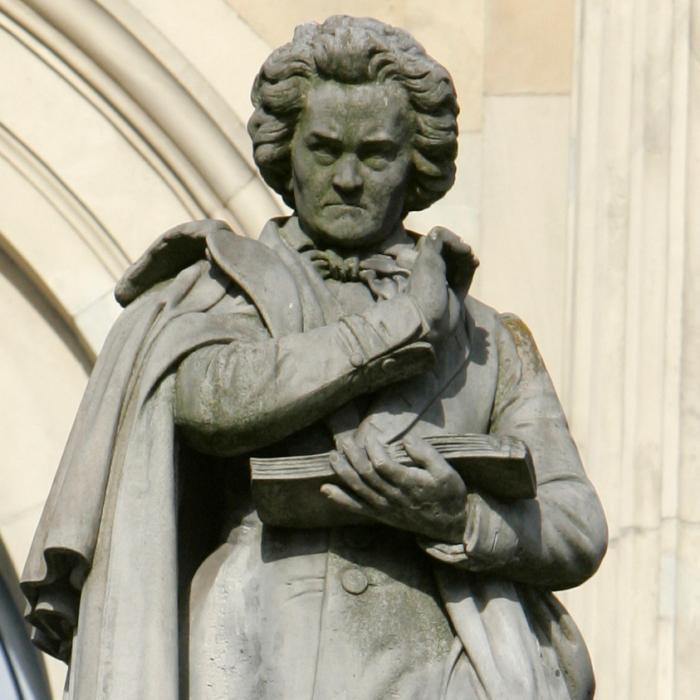
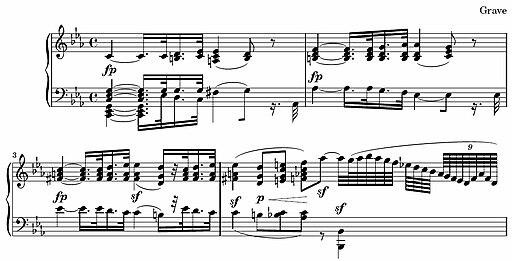
Introduction to Beethoven's Sonata No. 8 (1799) CC BY-SA 2.5
Once the Allegro is underway, you think you’re safe, but then, at 5:45, the Grave appears once more, a beginning now repositioned to just before the development of the sonata’s themes. We are thrown back into the darkly meditative mood of the introduction for almost a full minute, until at 6:43 the Allegro returns with its development section.
Think we’ve heard the last of the introduction? Guess again. From 8:43 to 9:39, we get a transformed statement of the introductory material before the Allegro at last concludes the movement. Why all these interruptions? They don’t feel like interruptions at all, but like the return of an initial question. The slow material seems to make existential inquiry, and it is never satisfied with the dashing answers of the Allegro. Nothing like this had ever been done in sonata form before, by anybody. When Beethoven’s publisher first heard the work, he said it deserved the title, “Pathétique,” meaning melancholic, deeply moving. Beethoven agreed.
After the high emotional profile of the first movement, you wonder, “What more can he do?” And then Beethoven gives you one of the five or six most perfect melodies he ever composed. The main theme of the second movement is played three times, with two contrasting sections sandwiched in between the first and second, and second and third statements: ABACA, a rondo. The A theme is among the composer’s most memorable. The final movement, another rondo, is a whirligig of motion that brings the piece to a dazzling close.
Beethoven went on to experiment with form in another 24 piano sonatas. In one, the idea of a slow introduction expanded to become an entire slow first movement: the “Moonlight” sonata. All of music history seemed to crowd into Beethoven’s comprehension and come out as unique musical objects.
What arts and culture topics would you like us to cover? Please email ideas or feedback to [email protected]