This copy is for your personal, non-commercial use only. Distribution and use of this material are governed by our Subscriber Agreement and by copyright law. For non-personal use or to order multiple copies, please contact The Epoch Times Reprints.
‘Renaissance to Runway: The Enduring Italian Houses’ at the Cleveland Museum of Art weaves contemporary Italian fashion with 15th- to 17th-century art.
“Renaissance to Runway: The Enduring Italian Houses” is a stylish special exhibition on view at the Cleveland Museum of Art (CMA) through Feb. 1, 2026. It features approximately 80 ensembles and garments and 40 jewelry pieces from the 20th and 21st centuries alongside Renaissance artworks. The CMA features Italian fine, decorative, and textile arts dating from the 1400s to the early 1600s from their permanent collection. Connections between couture, called “alta moda” in Italian, and Renaissance, Mannerist, and early Baroque periods are vividly brought to life through eye-catching ensembles juxtaposed with historic art amidst richly textured backdrops.
Gallery view of "Renaissance to Runway: The Enduring Italian Houses" at the Cleveland Museum of Art. Shelly Duncan/Cleveland Museum of Art
Famous names in fashion and jewelry—Armani, Buccellati, Bvlgari, Ferragamo, Pucci, Valentino, and Versace—are in dialogue with Old Master art by the likes of Bronzino and Veronese. While these clothes and accessories are not directly inspired by a specific artwork, Italian brands have maintained their heritage’s dedication to creativity, craftsmanship, ingenuity, and beauty. The exhibition’s curator, Darnell-Jamal Lisby, connectsthese brands, referred to as houses, with Renaissance society and politics:
“More than 500 years ago, families, or ‘houses,’ who ruled the states across the Italian peninsula, such as the Medici of Florence and the Sforza of Milan, used fashion as a form of power and influence, from dictating fashionable styles that were immortalized through painted portraits to controlling textile production as a form of currency.”
Runway Vignettes
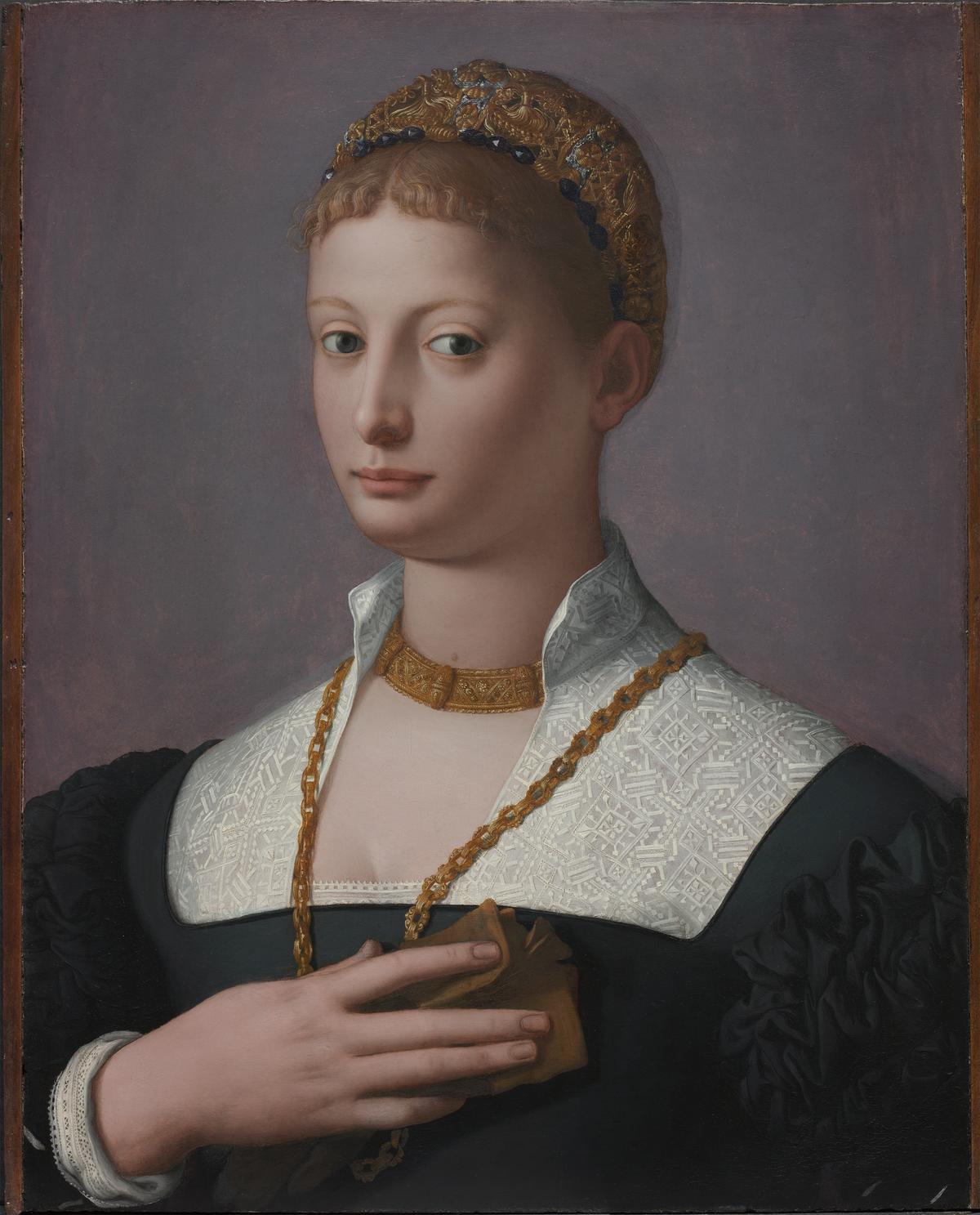
"Portrait of a Woman," circa 1555, by Agnolo Bronzino. Oil on wood; 23 5/8 inches by 19 3/16 inches. Cleveland Museum of Art
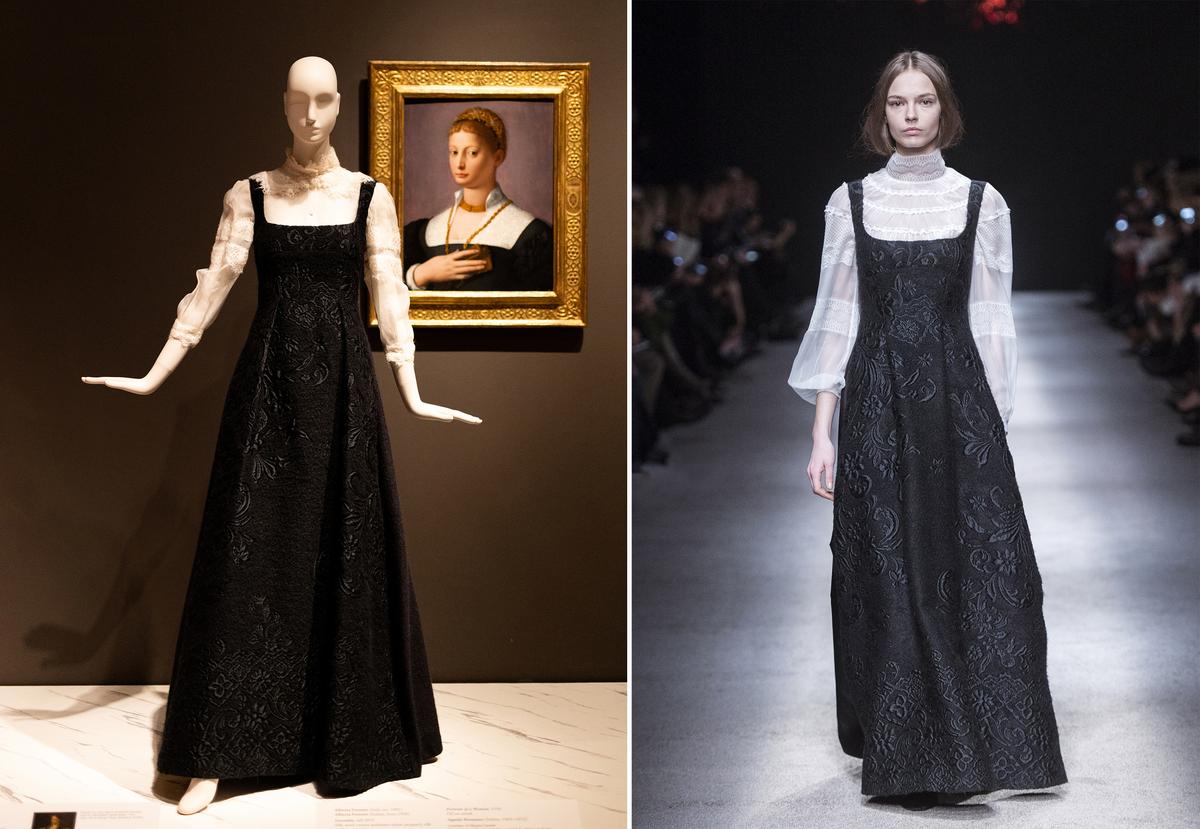
One of the show’s most striking vignettes is the display of circa 1555 “Portrait of a Woman” by Mannerist painter Bronzino, court painter to powerful Florentine ruler Cosimo I de' Medici, beside an Ensemble from Fall 2015 by Alberta Ferretti. The CMA painting depicts an unknown woman who was likely associated with the Medici court.
(L) Gallery view of "Renaissance to Runway: The Enduring Italian Houses" at the Cleveland Museum of Art. (Shelly Duncan/Cleveland Museum of Art) (R) Ensemble, Fall 2015 by Alberta Ferretti. Silk, wool, cotton, polyester, nylon jacquard, silk chiffon, nylon lace. Copyright AlbertaFerretti
Bronzino’s use of a simple background highlights the sitter’s fine clothes, which symbolize elegance, wealth, and status. The woman wears a linen collar, called a partlet, that is finely embroidered in matt stitch. Some of the material is trimmed in lace, as are her cuffs. In Ferretti’s Fall 2015 collection, she referenced pointedly Italian Renaissance fashion. The CMA notes, “The emphasized lace around this ensemble’s blouse alludes to the evolution of lace collars, particularly in women’s fashion, from partlets to ruffs, throughout the 1500s.”
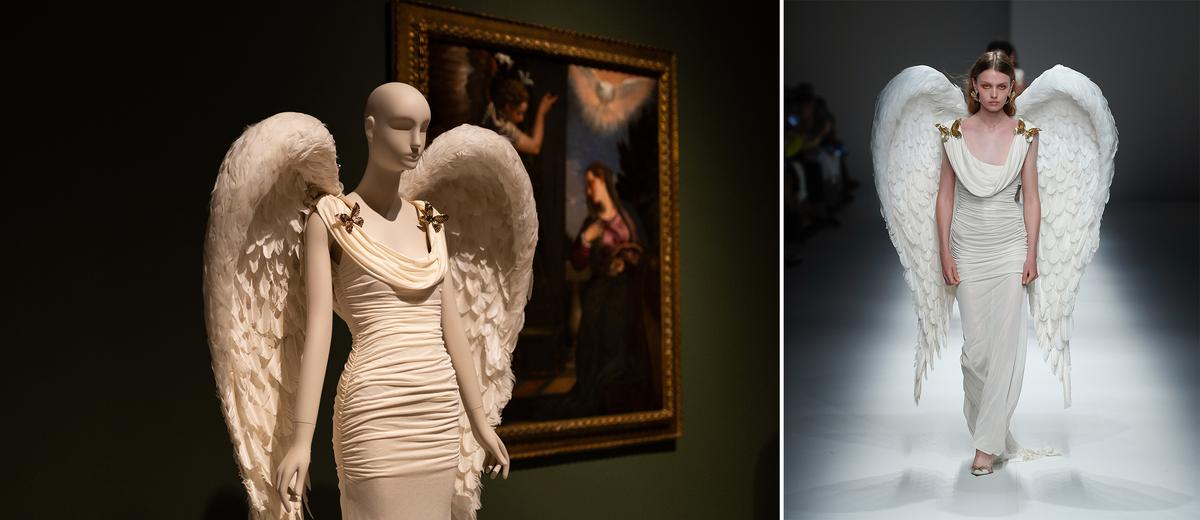
(L) Gallery view of "Renaissance to Runway: The Enduring Italian Houses" at the Cleveland Museum of Art. (Shelly Duncan/Cleveland Museum of Art) (R) Evening Dress and Wings, Spring 2024, by Nicola Brognana for Blumarine. Viscose, feathers, brass. Giovanni Giannoni / WWD via GettyImages. Copyright Getty Images
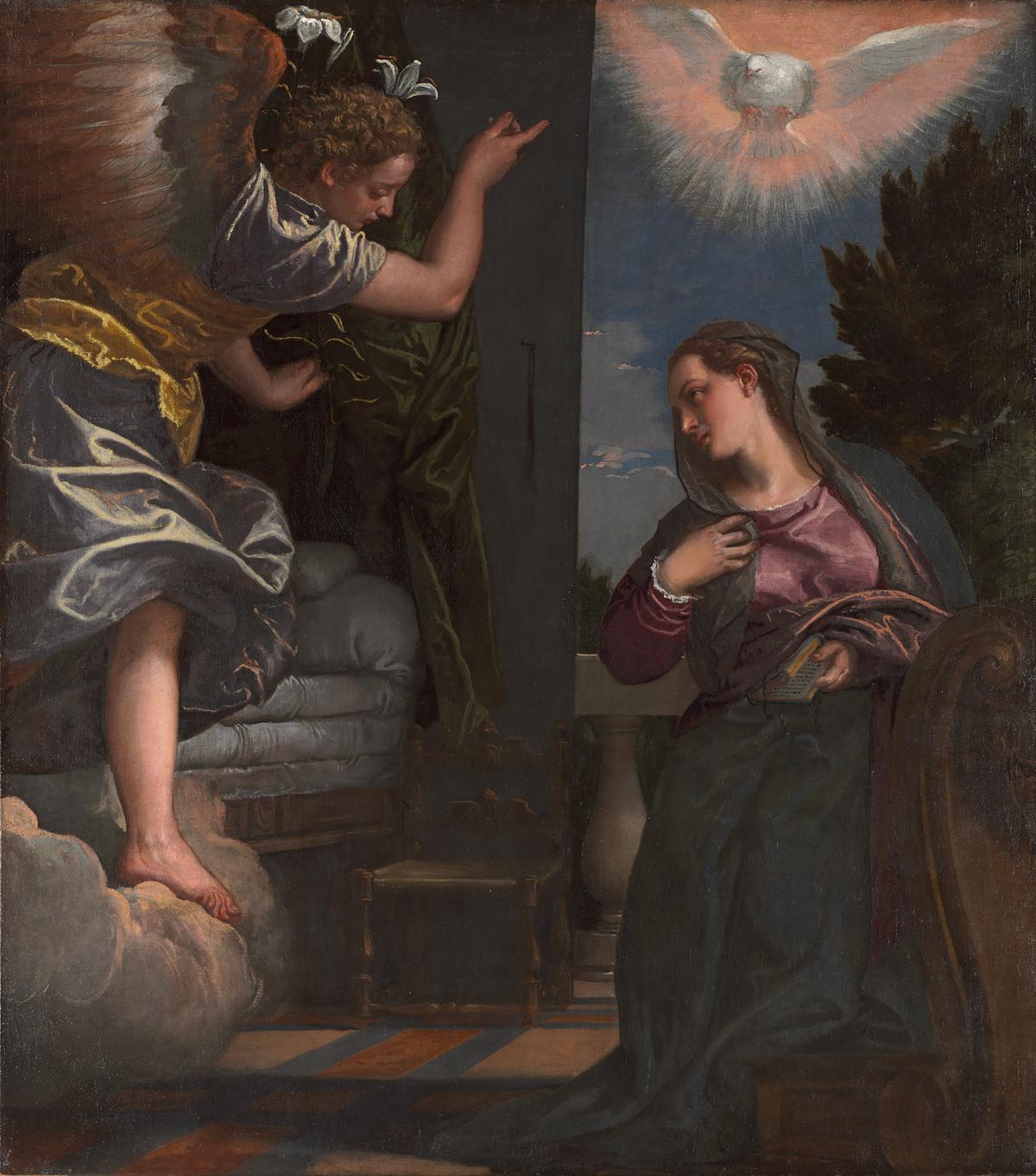
Another recent runway look is Nicola Brognano’s effervescent Evening Dress and Wings from Spring2024, which recalls angelic wings from Christian art. An example of such feathered accoutrements is found in the CMA’s “The Annunciation” by Paolo Veronese. Dated to circa 1580, it is an intimate composition showing the angel Gabriel’s announcement to the Madonna that she would bear the son of God.
"The Annunciation," circa 1580, by Paolo Veronese and workshop. Oil on canvas; 59 1/16 inches by 52 1/2 inches. Cleveland Museum of Art
Royal Textiles
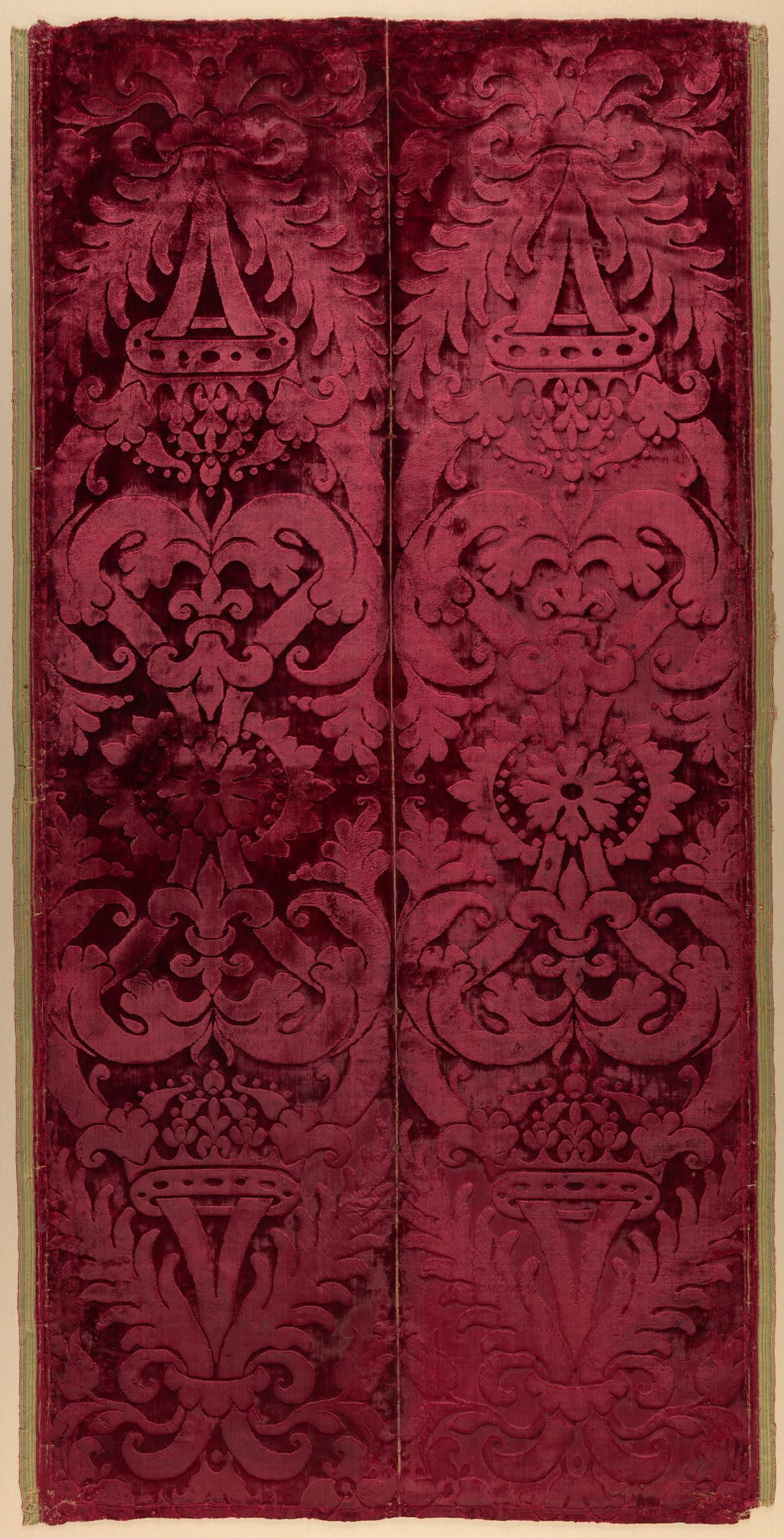
Historic cloths include a Venetian silk velvet stole from circa 1575–1600. At the time, the city’s laws required certain officials to wear specific-colored textiles. The high-level government official known as a Procurator was mandated to wear a red stole. The CMA’s is a rare surviving example of an entire, uncut loom. The line down the center would have been cut to make two items. The textile’s elaborate pattern is formed by its longer pile.
"Procurator’s Velvet Stole," circa 1575–1600, from Venice, Italy. Alto e basso silk velvet; 56 inches by 28 inches. Cleveland Museum of Art
Especially costly velvets were woven with metallic thread, heightened symbols of prestige. The exhibit includes a fragment from likely the back of a chasuble, a sleeveless ecclesiastical vestment. This silk velvet has gold metal thread and dates to circa 1450–1500. Like the show’s more contemporary clothing, there is immaculate attention to detail in this piece. It has lush, projecting pile and a pattern of large pomegranates, which were fashionable motifs during the period.
"Silk Velvet With Gold in Pomegranate Pattern," 1450–1500, likely from Florence, Italy. Silk, gold thread; velvet: cut pile in two heights, uncut pile loops, gold-thread loops; 46 3/4 inches by 23 7/8 inches. Cleveland Museum of Art
House of Jewels
The luxury Italian jewelry house Buccellati was founded in 1919 by Mario Buccellati. His descendants are still involved in the business. The legacy of the house continues its founding design principles, which drew on Renaissance goldsmith styles and techniques. The Violante Pendant Brooch from 2007 is made of amethyst, multicolored gold, and diamonds.
Violante Pendant Brooch, 2007, for Buccellati. Amethyst, yellow gold, white gold, pink gold, and diamond. Unica Collection. Copyright Buccellati
The CMA explained that “its symmetrical and rigid diamond setting, was inspired by the facade of Renaissance palaces, expanding the scope of references that Italian fashion houses and designers have interpreted.”
In addition to glittering threads and gemstones, a golden shoe is part of the exhibit. Jewel Sandal for the house of Ferragamo was featured in the Fall 2023 collection. It is a nod to an earlier sandal made by the company’s founder, Salvatore Ferragamo, for an American client in 1956. He was commissioned to create an 18-karat gold sandal. His design featured a vine-like floral engraved on the heel and straps, reminiscent of decorative themes in Renaissance art. He was enamored with Italian Renaissance art and often referenced the period in his work.
Jewel Sandal, Fall 2023, by Maximilian Davis for Ferragamo. Laminated leather. Salvatore Ferragamo Museum Archives. Copyright LucaStoppiniStudio
Maximilian Davis, the current Creative Director of Ferragamo, created Jewel Sandalnot in precious metal but in laminated leather, which the CMA cited as “fit for the comforts of contemporary fashion while extenuating the same elegance as the original design.”
Gallery view of "Renaissance to Runway: The Enduring Italian Houses" at the Cleveland Museum of Art. Shelly Duncan/Cleveland Museum of Art
Weaving together modern and contemporary Italian fashion with 15th- through 17th-century art from the peninsulareveals a foundational continuity of a specific, particularly Italian aesthetic. The textiles and the figures in historic artworks are brought to life by the ensembles and jewels inspired by the era, and as a result are reciprocally enhanced for the viewer. The incredible artistry of the fashions makes the case that such objects belong in museums and fulfill Lisby’s goal to show “how fashion is a conduit for understanding respective cultures across time.”
Gallery view of "Renaissance to Runway: The Enduring Italian Houses" at the Cleveland Museum of Art. Shelly Duncan/Cleveland Museum of Art
“Renaissance to Runway: The Enduring Italian Houses” exhibition at the Cleveland Museum of Art will run through Feb. 1, 2026. To learn more, visit clevelandart.org.
What arts and culture topics would you like us to cover? Please email ideas or feedback to [email protected]
Michelle Plastrik is an art adviser living in New York City. She writes on a range of topics, including art history, the art market, museums, art fairs, and special exhibitions.