The definitive images Frederic Remington (1861–1909) created of the American West shaped the nation’s perception of the region and popularized a new American folk hero, the archetypal cowboy. The prolific artist produced paintings, illustrations, sculptures, and fiction and nonfiction writings that romanticized the rugged region for an Eastern audience.
A Fascination With the West
Remington was born in Canton, New York, and attended Yale University, where he played football and studied drawing. Later on, he spent three months taking classes at the Art Students League in New York. This was his final formal art instruction.Remington traveled to the American West for the first time in 1881, spending time in the Montana Territory. He went on to explore Kansas, Missouri, and the Southwest. His first professional sketch was published in an 1882 issue of “Harper’s Weekly” and depicted a Wyoming cowboy. After he established a studio in Brooklyn, New York in 1885, Remington’s illustrator career flourished with vivid, even mythic black-and-white images of cowboys, Indians, and calvary campaigns. Much of his nostalgic narrative visuals chronicled an American West that was rapidly transforming and disappearing.
Remington moved his studio to New Rochelle, New York in 1890. He spent almost the rest of his career there, though he took frequent sketching trips to the frontier. In the early 1890s, Remington’s practice expanded to include paintings and sculptures of Western subjects. These works, like his illustrations, were immensely popular with the public.
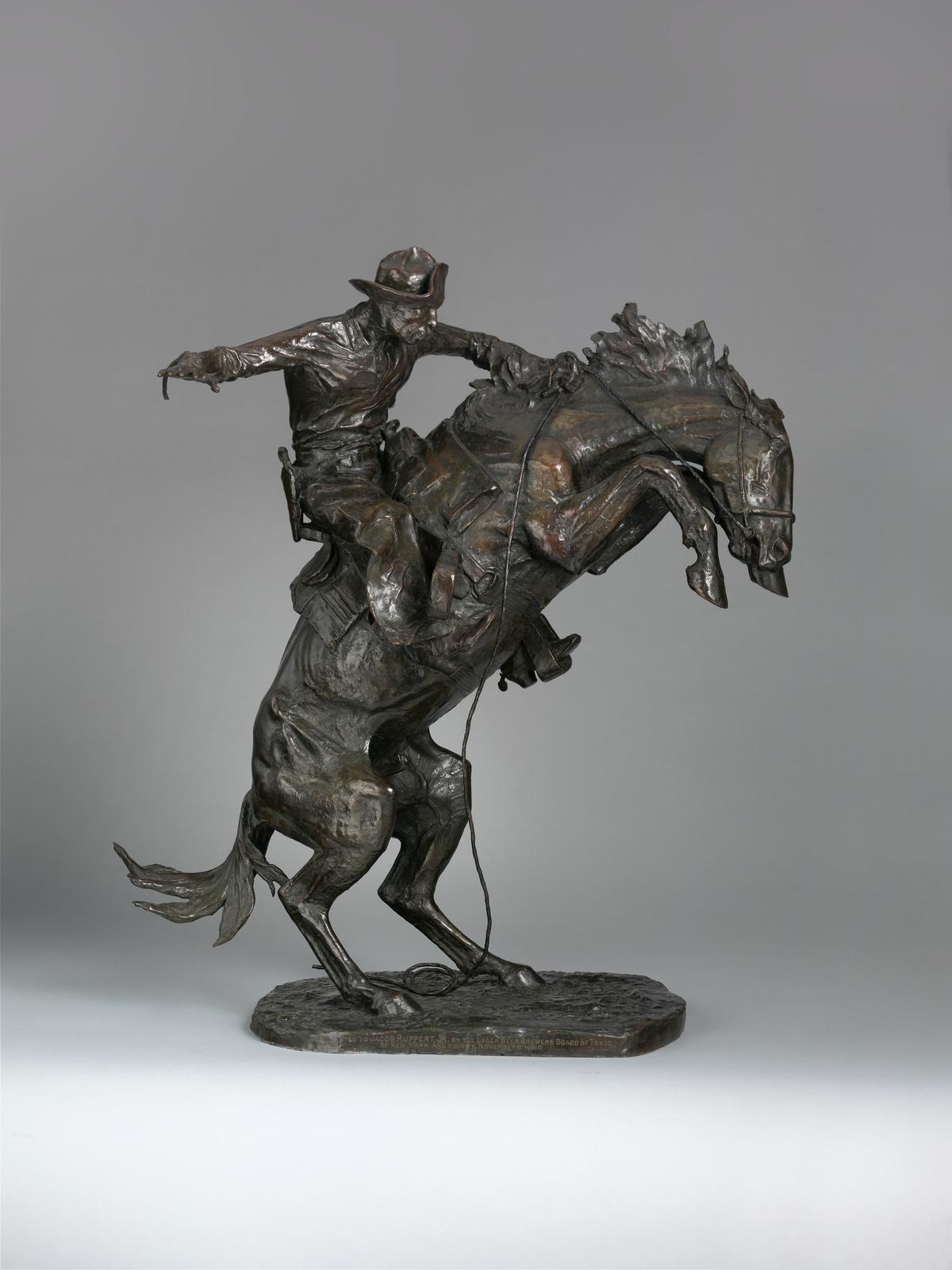
‘Off the Range’
The virtuosic “Off the Range (Coming Through the Rye)” is Remington’s most complex and daring sculptural group. Designed in his New Rochelle studio and fabricated by Roman Bronze Works, Remington and the foundry’s founder, Riccardo Bertelli, worked through immense challenges to push the limits of bronze and casting techniques.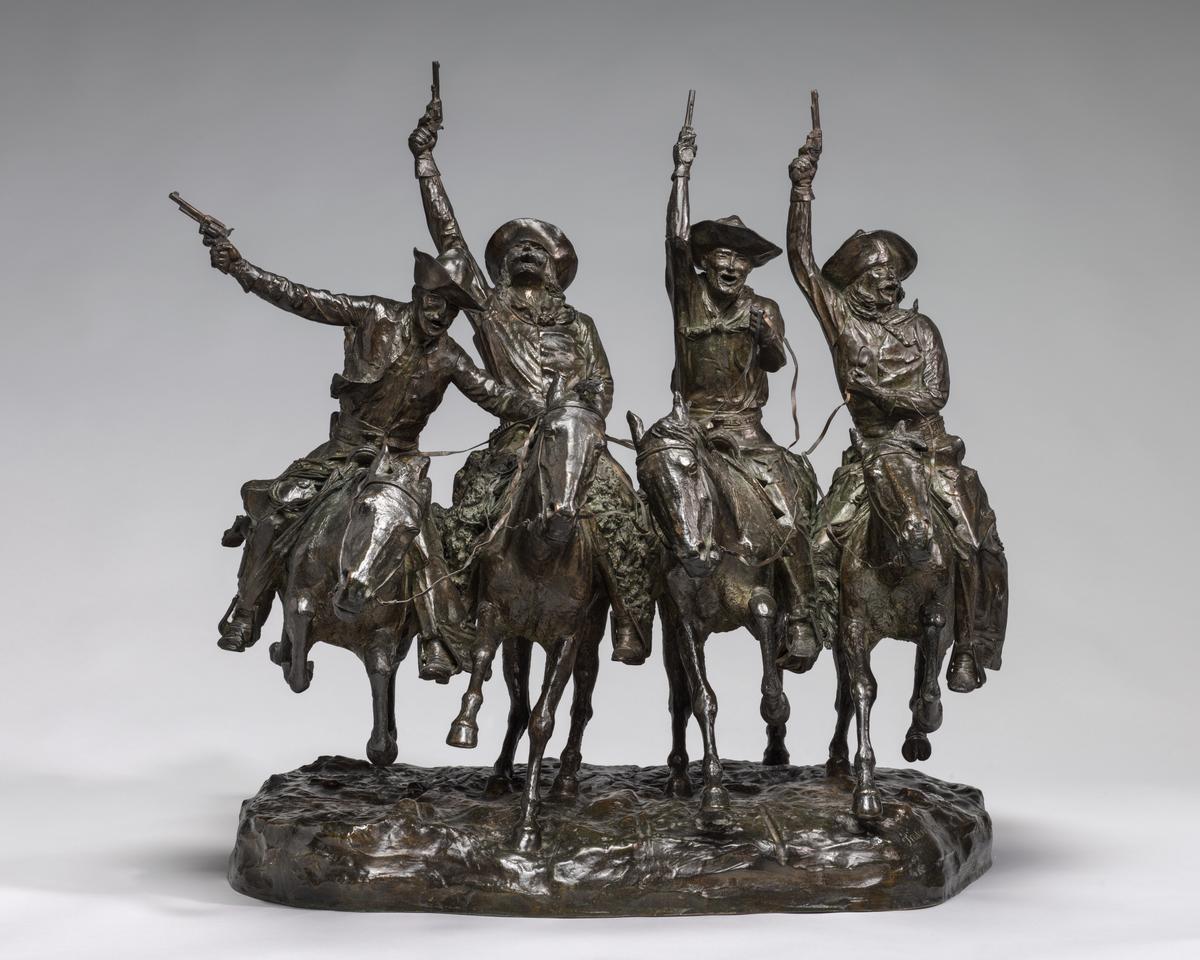
The tight composition shows four boisterous cowboys astride galloping horses, encapsulating the energy that reflected frontier living. Remington incorporates a high level of detail, including equine musculature, the reveling cowboys’ facial expressions, and their shooting pistols. By using head-on perspective, Remington immerses the viewer in the artwork’s dynamic action.
This image, conceived initially in 1902, is connected to two illustrations Remington made in the 1880s: “The Dissolute Cow-Punchers” published in Century Magazine and “Cowboys Coming to Town for Christmas” in Harper’s Weekly. In three-dimensional form, it is remarkable for its weightlessness. Remington wanted as many of the horses’ legs as possible to be elevated off the sculpture’s base. The final form features only six hooves touching the ground. A total of 10 are in the air, and astonishingly, all four hooves of the horse on the far left are suspended.
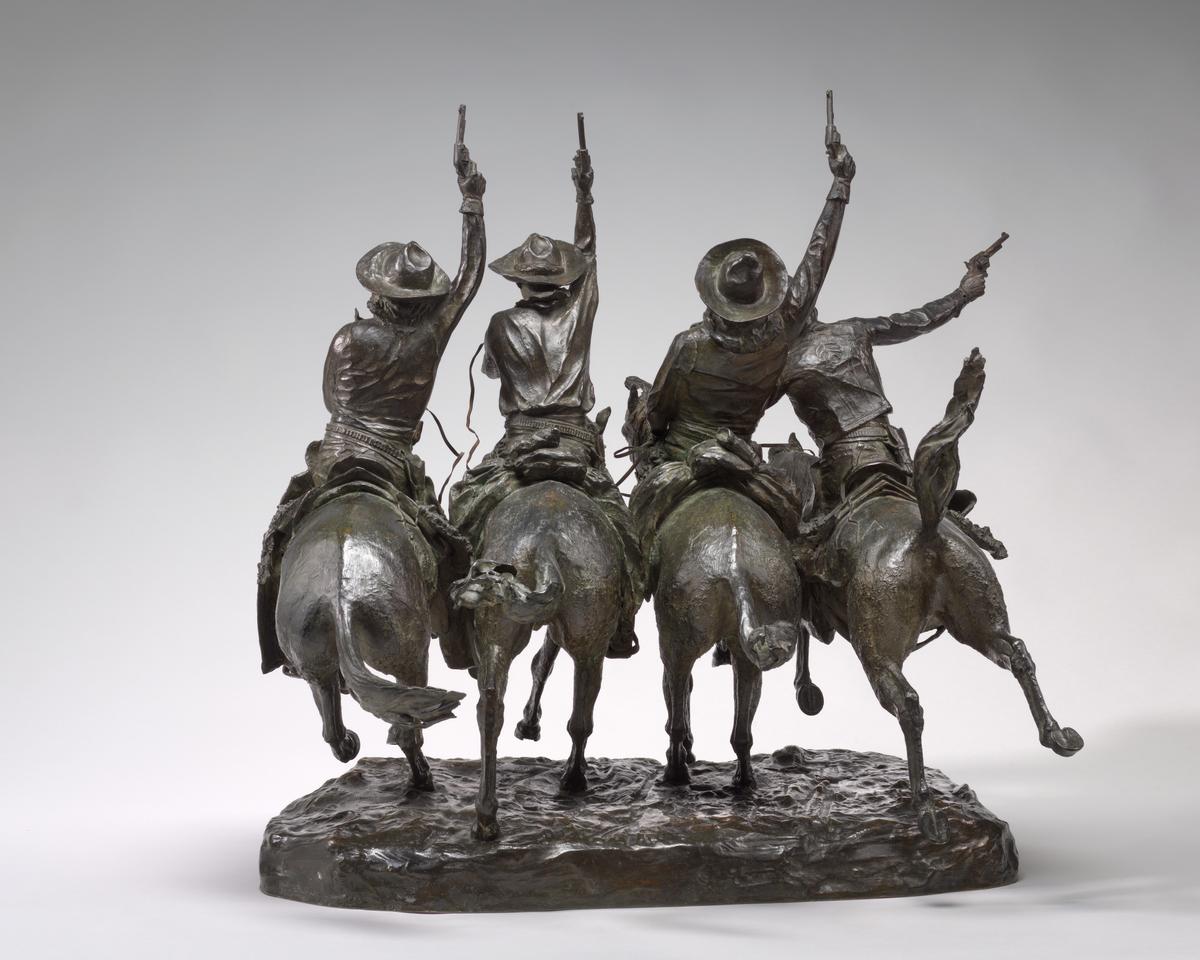
Only around 15 authorized casts of this work were made, as well as two unnumbered prototypes, one of which was purchased by the Washington Corcoran Gallery of Art in 1905. This made it the first museum to acquire a Remington bronze. Interestingly, the Corcoran did not like Remington’s copyrighted title of “Coming Through the Rye.” Remington offered what would become the additional name of “Off the Range,” which met with institutional approval. The Corcoran closed in 2014, and much of its collection was transferred to the NGA, including this bronze.
“He is, of course, one of the most typical American artists we have ever had, and he has portrayed a most characteristic and yet vanishing type of American life. The soldier, the cowboy and rancher, the Indian, the horses and the cattle of the plains, will live in his pictures and bronzes, I verily believe, for all time.”