The Peales rank among the most famous artistic families in American history. Patriarch Charles Willson Peale (1741–1827) is renowned for his portraits of George Washington, other integral figures in America’s independence, and his own family. The senior Peale was also a noted naturalist and innovative museum founder. Most of his 17 children were named after scientists, such as Charles Linnaeus, and Old Master painters, including Raphaelle, Titian, Sofonisba Anguissola, and Angelica Kauffman.
America’s Finest Portraitist

Unusual for the time, Rembrandt Peale traveled extensively throughout the U.S. East Coast and spent extended periods abroad for both study and work purposes. His early style reflects the English school of portraiture. Rembrandt Peale learned this style first from his father and later from his teacher Benjamin West. The U.S.-born West built a prominent career in London as president of the Royal Academy.
However, Rembrandt Peale’s style soon changed, influenced by his sojourns in France, where he responded to neoclassicism. This was considered a sophisticated style and factored in to his success with U.S. collectors.

Brother Rubens


No one thought that Rubens Peale, Rembrandt Peale’s brother, would become an artist, because he had extremely poor eyesight. As a result of his condition, his father didn’t give him art lessons. Instead, Rubens Peale was entrusted with operating the family’s museums—the one established by his father, his own institution, and the museum founded by Rembrandt Peale. Additionally, Rubens Peale was an accomplished gardener, farmer, and pioneering botanist.
In an inspiring turn of events, Rubens Peale did learn to paint—when he was 71 years old. He became accomplished in still lifes after his daughter, Mary Jane Peale, taught him how to paint. His work is reminiscent of that of his uncle James and brother Raphaelle; the latter is considered the first professional still-life American painter. A beautiful example in Rubens Peale’s small oeuvre is “Still Life with Watermelon,” dated to the year of his death at the age of 81.

Peale’s Double Portrait
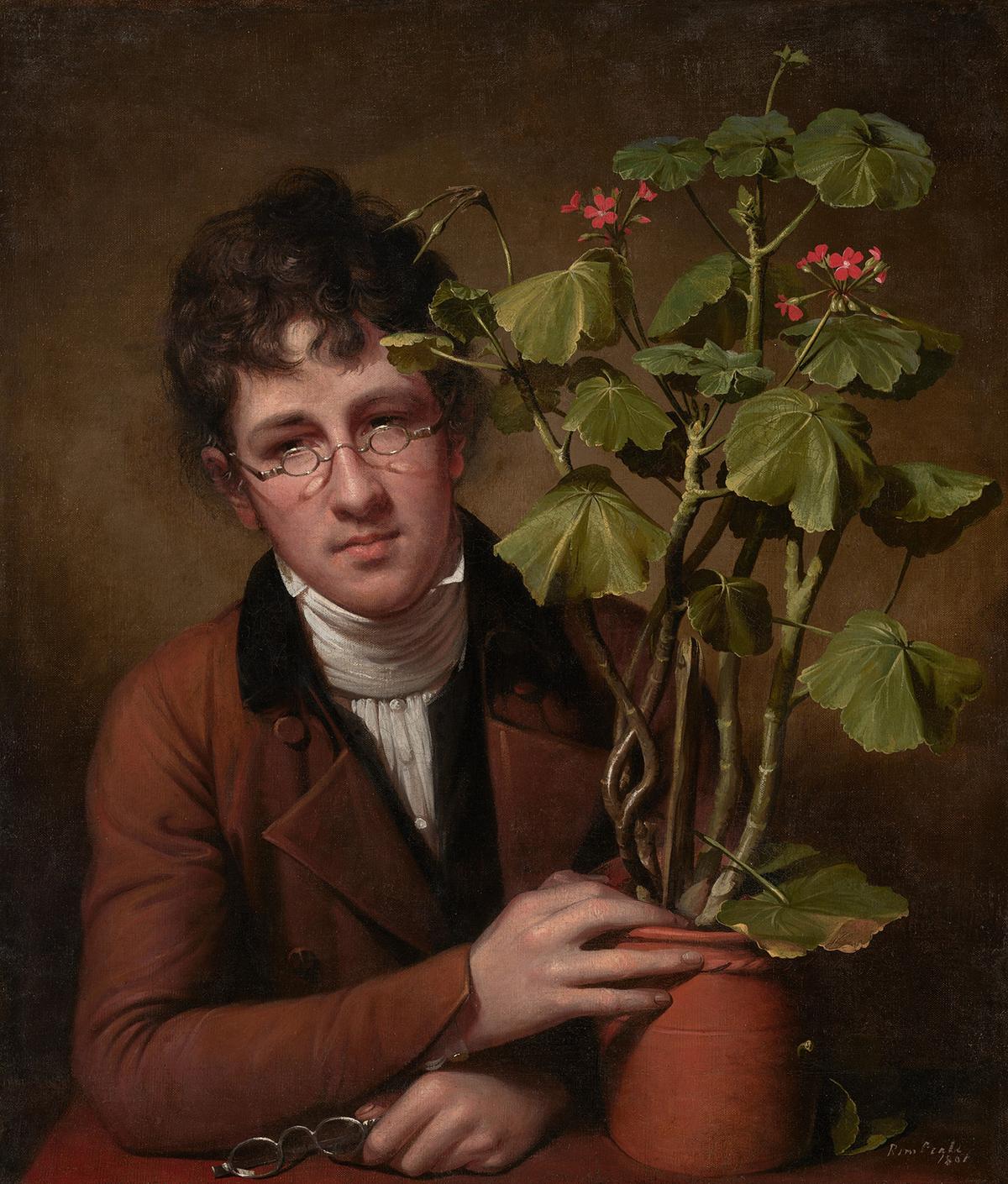
The artist was 23 and his sitter was 17 when Rembrandt Peale painted the picture in Philadelphia. The work may be considered a double portrait: It is a likeness of Rubens Peale as well as of an important geranium, long alleged to be the first specimen of the plant ever grown in America. The painting is an unparalleled example from Rembrandt Peale’s early career and reveals his great technical skill in conveying naturalism. Both plant and man seem alive, allowing the viewer to emotionally connect with the scene. The influence of Rembrandt’s study of the old masters and their rendering of flesh, light, and texture can be found in the picture, from Rubens Peale’s peachy skin to the terracotta pot.
The NGA stated that the artwork showcases “firm, clear drawing, carefully modulated color, and an intense devotion to detail.” Rubens is placed seated on the left side of the canvas. Intriguingly, he wears a pair of glasses and holds another set in his left hand, which rests on the table. The glasses allow Rembrandt Peale to display his adeptness at depicting illumination and reflection, especially visible under Rubens Peale’s eyes. The young man does not look at his plant and appears lost in thought. Rubens Peale connects with the geranium through touch: His right hand rests on the pot’s rim and two fingers press on the soil in a gesture to test for moisture. Both brothers are sensitive to their charges: Rembrandt Peale to his sitter and brother and Rubens Peale to his prized plant.
Mary Jane Peale, Rubens Peale’s only daughter, wrote accounts about the background and process of painting “Rubens Peale with a Geranium” that scholars have found invaluable. She explained that the work was first painted with her father just holding glasses, not wearing them. Rembrandt Peale decided that aesthetically it would be preferable to show them on his brother, but he kept the original depiction intact so as not to ruin the rendering of the hand. She also wrote that the plant was “the first one in this country.”
Art historians have concluded that there are nuances to this claim. Specifically, they believe that it did not mean that it was the first geranium in general, but rather of a particular variety. The hypothesized species is Pelargonium inquinans. An engraving of this plant was published in 1732 in “Hortus Elthanmensis” by German botanist Johann Jacob Dillenius and closely resembles Rubens Peale’s plant. Pelargoniums are endemic to South Africa, but they reached Europe by the early 1700s. Since they resemble geraniums, Europeans called them by that name. The nomenclature has remained to the present day, but pelargoniums and geraniums, while in the same family, have a different genus.

In the painting, this trait appears to be visible on the lowest leaf’s edges.
In the early 19th century, the horticultural ability to cultivate pelargoniums in the United States was considered a source of national pride. It is believed that while he was president, Thomas Jefferson grew Pelargonium inquinans at the White House. Rembrandt Peale’s inclusion of the scarlet geranium in this portrait “commemorated his brother’s horticultural triumph,” the NGA stated. According to Mary Jane Peale, the geranium was the intended true subject of the portrait.
The legacy of the Peale family remains relevant in today’s art institutions, illustrated by Rembrandt Peale’s beloved and popular “Rubens Peale with a Geranium.” In the contemporary era, it has even inspired a horticultural pot by the Connecticut-based Guy Wolff, who makes traditional pottery. His prized “Peale Pot” in terracotta has an 18th-century shape and is embellished with a simple and elegant rope rim. An appreciation of pelargoniums lives on with gardeners, and anyone at home can recreate an homage to this painting with their very own Peale pot.