When Cardinal Robert Francis Prevost was elected pope on May 8, 2025, he chose the papal name of Leo XIV. In the long line of Leos as head of the papacy, Pope Leo X is the most famous in terms of art history.
Leo X’s Papacy
Pope Leo X (1475–1521) was born Giovanni di Lorenzo de' Medici. A member of the illustrious Medici family, a banking dynasty that ruled Florence, he grew up in a milieu that valued the arts. His father, known by the sobriquet Lorenzo the Magnificent, was one of the great patrons of the Renaissance. He was a benefactor of Botticelli, Leonardo, and Michelangelo, amongst other giants. From Giovanni’s youth, Lorenzo intended for him to have a career in the church. He was appointed cardinal in 1489, when he was just 13 years old. In 1513, at the age of 37, he was elected pope.Leo X’s papacy focused on promoting culture in Rome, which cost a lot of money. He supported the likes of Raphael, prominent literary figures, the construction of St. Peter’s Basilica, the expansion of the Vatican Library, and other significant but extravagant projects. Within two years of the start of his pontificate, the treasury had been emptied.
To raise funds, one of the measures Leo X promoted was the Catholic Church’s historic practice of selling indulgences, an absolution of some sin in exchange for financial payment.
This angered German monk Martin Luther, inspiring him to write “Ninety-five Theses,” or “Disputation on the Power and Efficacy of Indulgences,” considered the founding event of the Protestant Reformation. Today, historians judge Leo X for not focusing enough on religion or taking Luther’s criticism seriously. In 1521, the last year of Leo X’s life, he excommunicated Luther and bestowed the title of “Defender of the Faith” on King Henry VIII.
The Prince of Painters
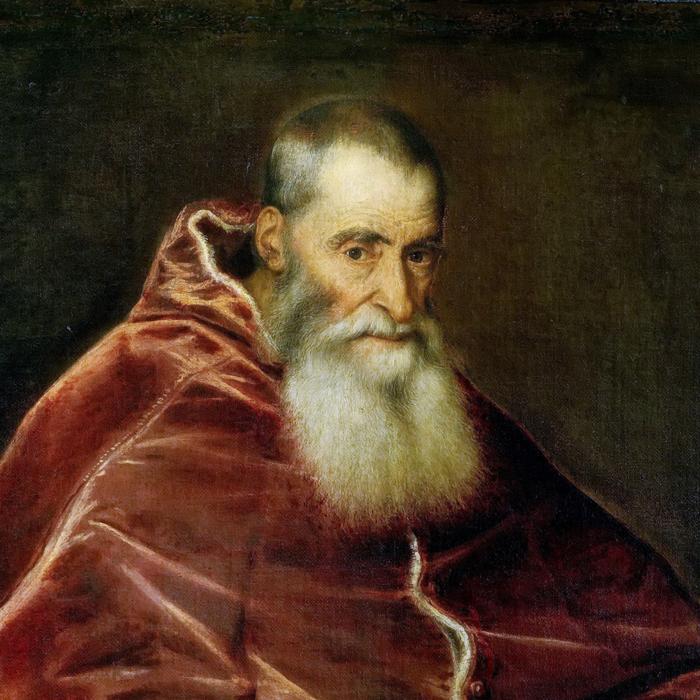
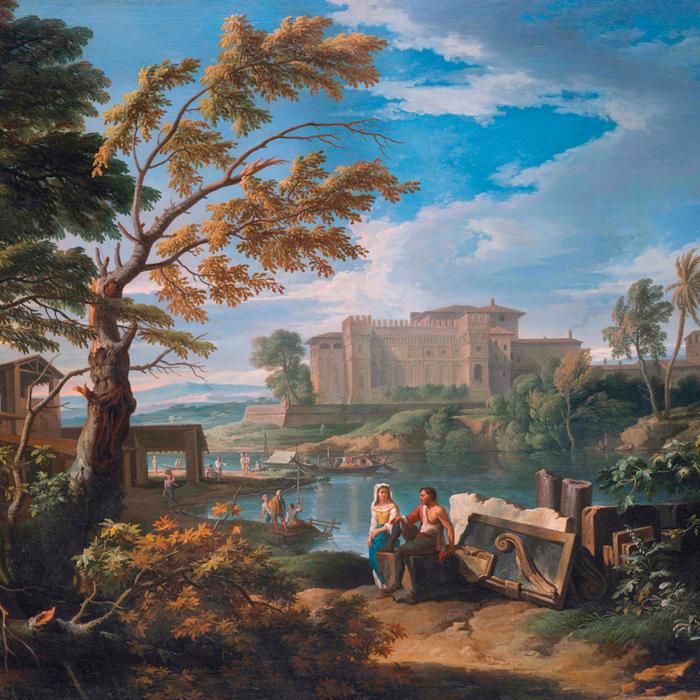

Raphael (1483–1520) has been called the “prince of painters” and was honored with burial in the Pantheon by Pope Leo X’s order. Although Raphael’s life was brief—he died at 37—his work cast a long shadow, inspiring subsequent European artists for centuries. He was born in Urbino, a cultural center during the Italian Renaissance that exposed him to artworks by the likes of Piero della Francesca, Andrea Mantegna, and Paolo Uccello. His father was court painter as well as his earliest teacher. At some point after his father’s passing, Raphael entered the workshop of Perugino, a respected artist who was soon surpassed by his gifted pupil.
By 1500, Raphael was an independent artist. His career took him throughout central Italy, with his time in Florence being the most significant. While there, he responded to the works of Leonardo and Michelangelo, who were of the older generation of High Renaissance artists. The paintings he created in Florence of the Madonna and Child are acclaimed for their harmonious perfection. During this time, he became a prominent portraitist, too.
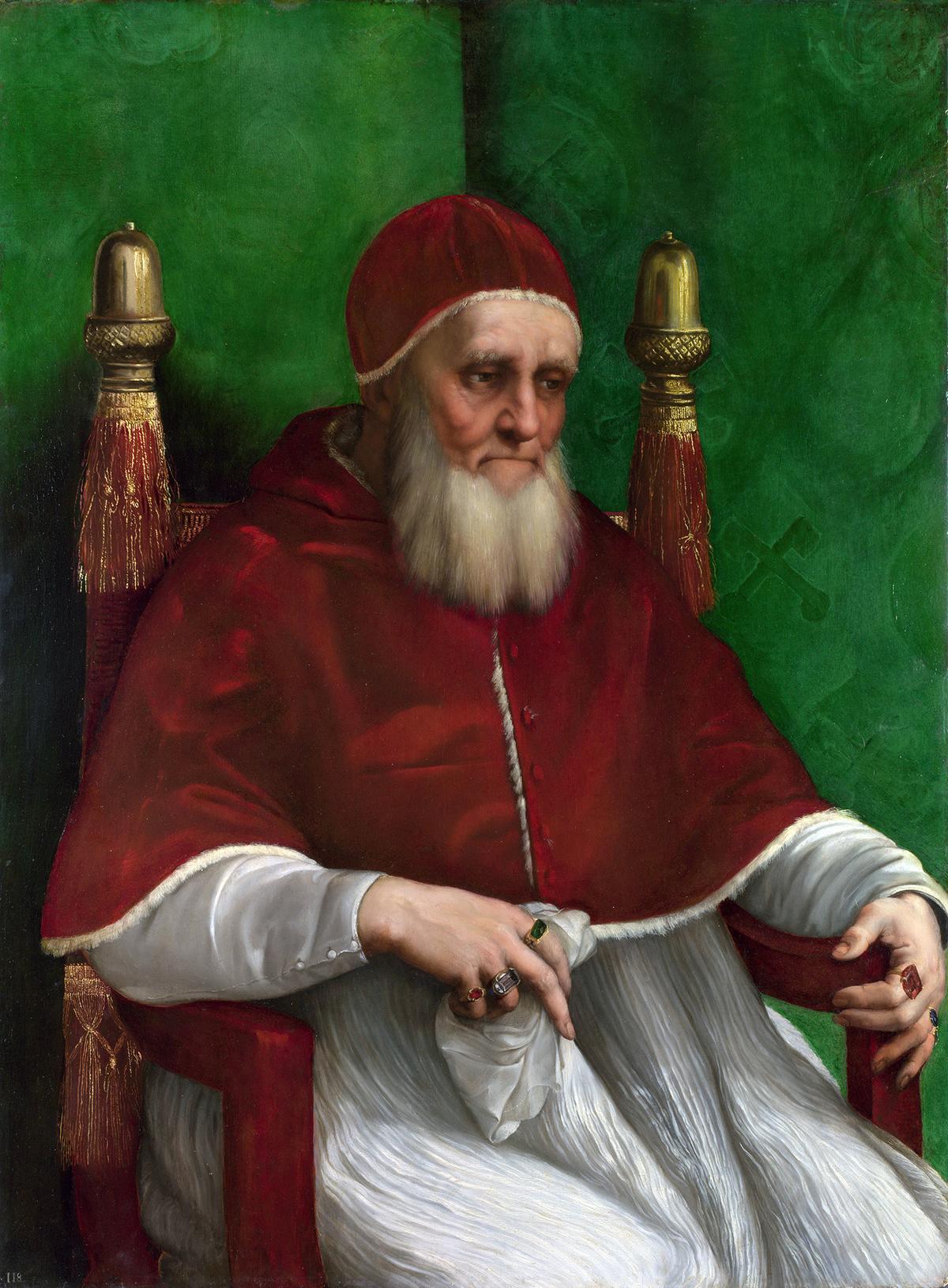
Summoned to Rome in 1508 to undertake commissions by Pope Julius II, Leo X’s predecessor, Raphael spent the rest of his life in the city. This was Raphael’s most productive period. He painted a famous portrait of Julius II, now part of the collection of London’s National Gallery, and his practice evolved to include tapestry design and history painting. The latter genre was put on full display in what are now called Raphael’s Rooms—four monumentally frescoed chambers on the second floor of the pope’s palace.
This project was not completed before Julius II’s death, so it was continued by Pope Leo X. Among the frescos in the Room of Heliodorus is one titled “Encounter of Leo the Great With Attila.” It was the last fresco completed in the space and dates to Leo X’s pontificate.
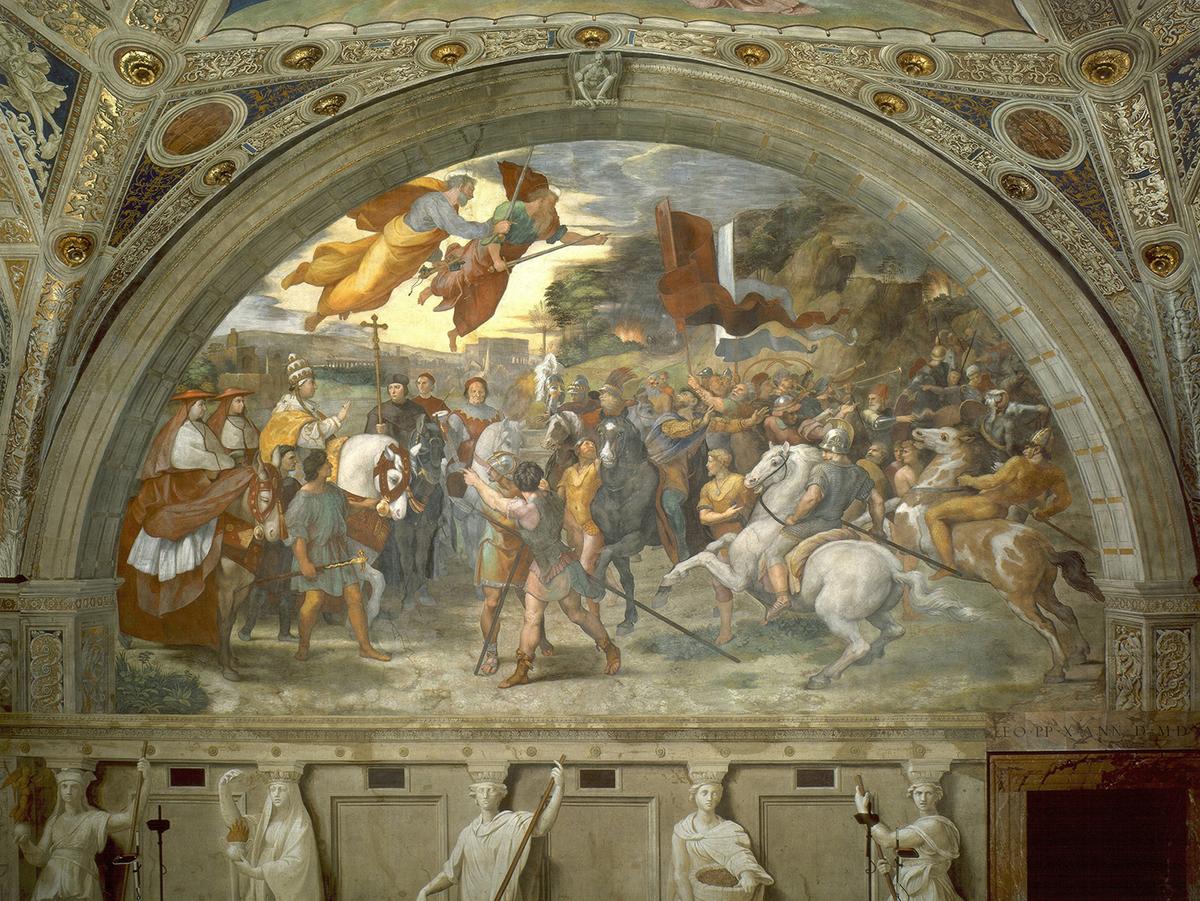
The subject commemorates the legendary meeting in 452 of Pope Leo I and Attila the Hun, in which the apparition of Saints Peter and Paul persuaded Attila to cease his invasion of Italy and spare Rome. Leo X was the model for both Pope Leo the Great and a cardinal.
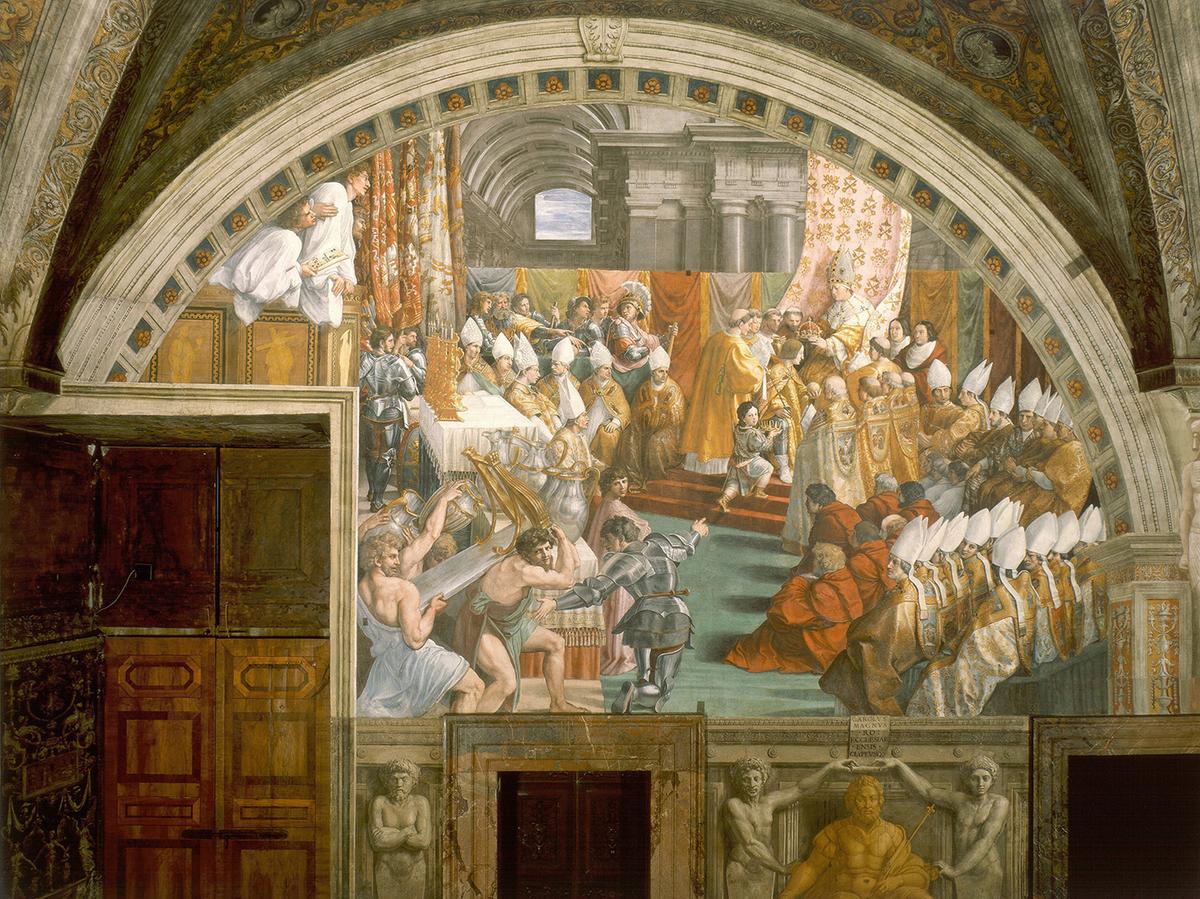
In the Room of the Fire in the Borgo, which was used as a dining room in Leo X’s era, every fresco episode includes an image of a pope with Leo X’s face. The room’s narratives revolve around scenes from the life of Pope Leo III, such as the “Crowning of Charlemagne,” and Pope Leo IV. Depicting them with Leo X’s features shows the pope’s historic aspirations. Much of the work in this room was completed by Raphael’s workshop.
Raphael’s Papal Portrait
Raphael’s eminent portrait of Leo X with Cardinals Luigi de’ Rossi and Giulio de’ Medici is in oil on panel. It is now owned by the Florentine Uffizi Gallery, which cites the painting as being completed by or in 1518, because in September of that year it was sent from Rome to Florence to oversee, metaphorically, the wedding of Leo X’s nephew, Lorenzo de’ Medici, Duke of Urbino, with Madeleine de la Tour d’Auvergne. The painting is a family affair, as both cardinals that flank Leo X are Medici cousins.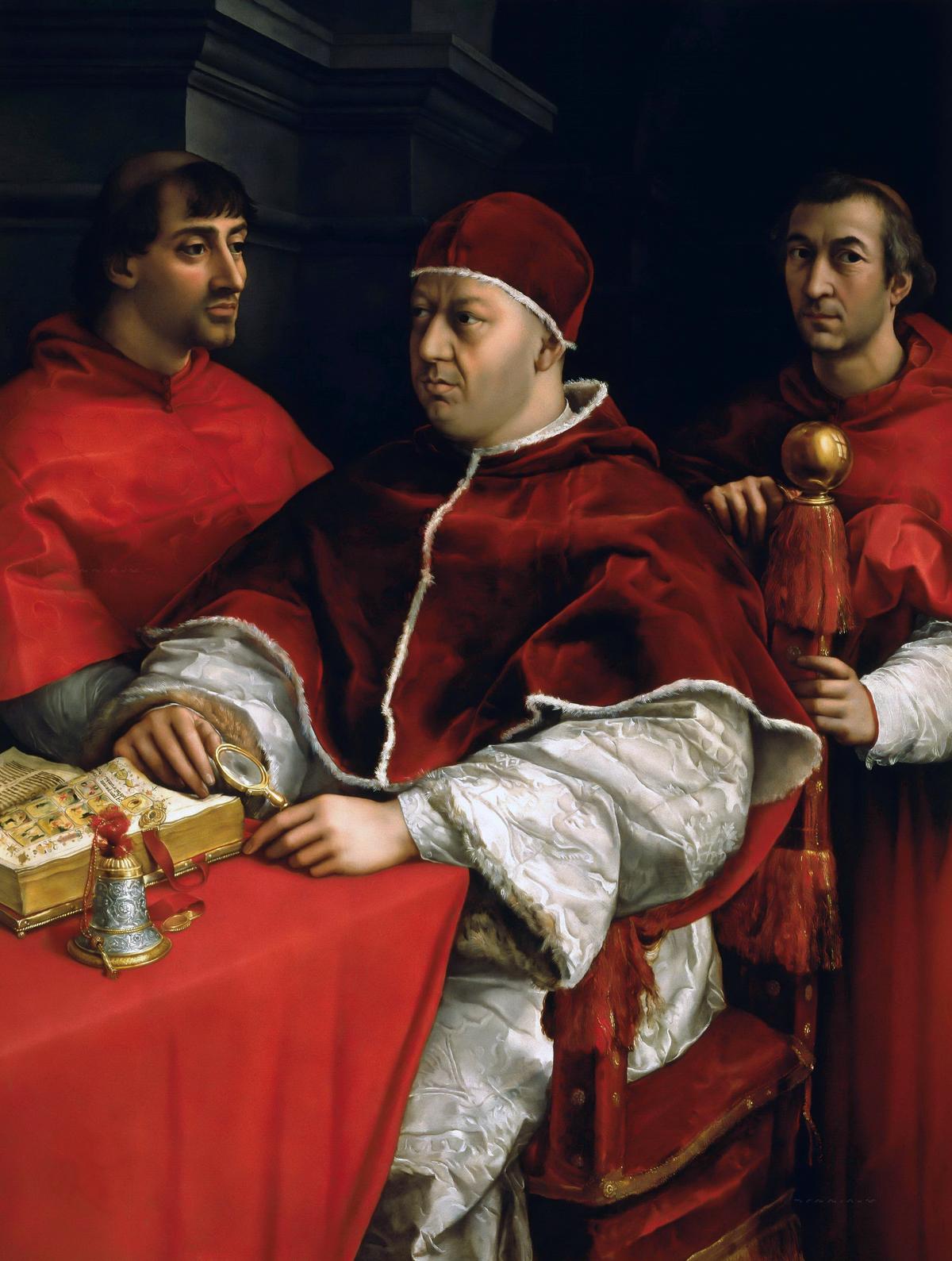
In portraits like this, Raphael dispensed with portraying idealized beauty and instead focused on communicating realism. The National Gallery of Art writes that he was, “creating penetrating psychological images that engaged viewer and sitter with a new intensity.
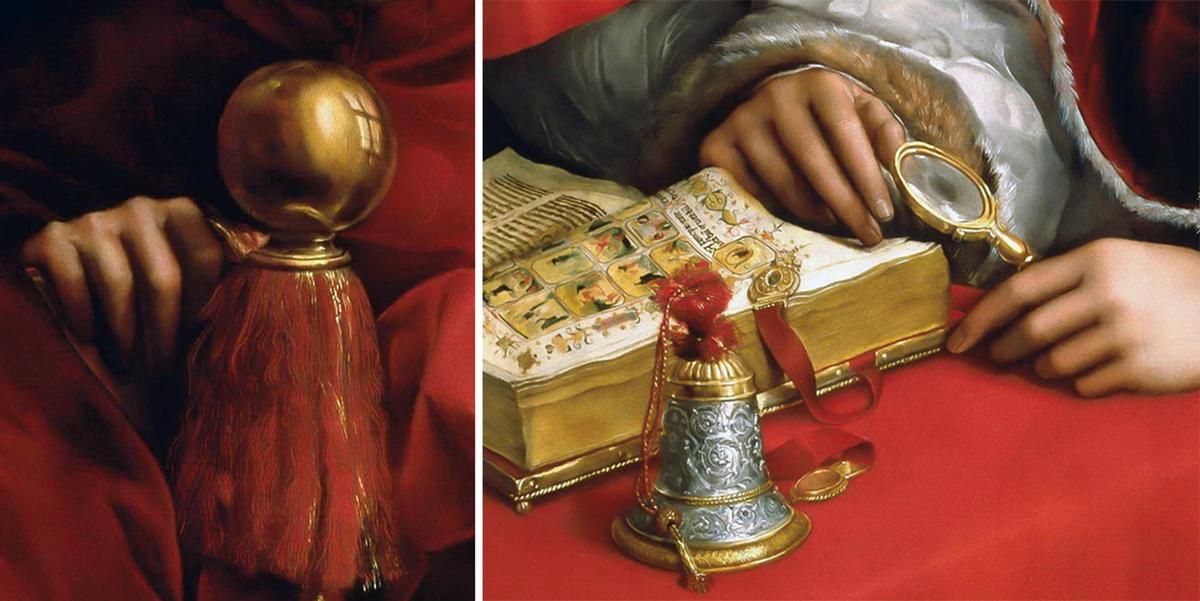
Leo X dominates this portrait’s composition. His prodigious form is shown seated in a three-quarter pose, overshadowing the two cardinals standing behind him. The red hue of their robes is echoed in the foreground table’s covering, encircling the pope’s darker red mozzetta and cap. The other principal hues are gold and silver, found in furnishings and objects. The chair’s finial reveals a reflection of the room’s interior—a great technical feat—that includes a window.
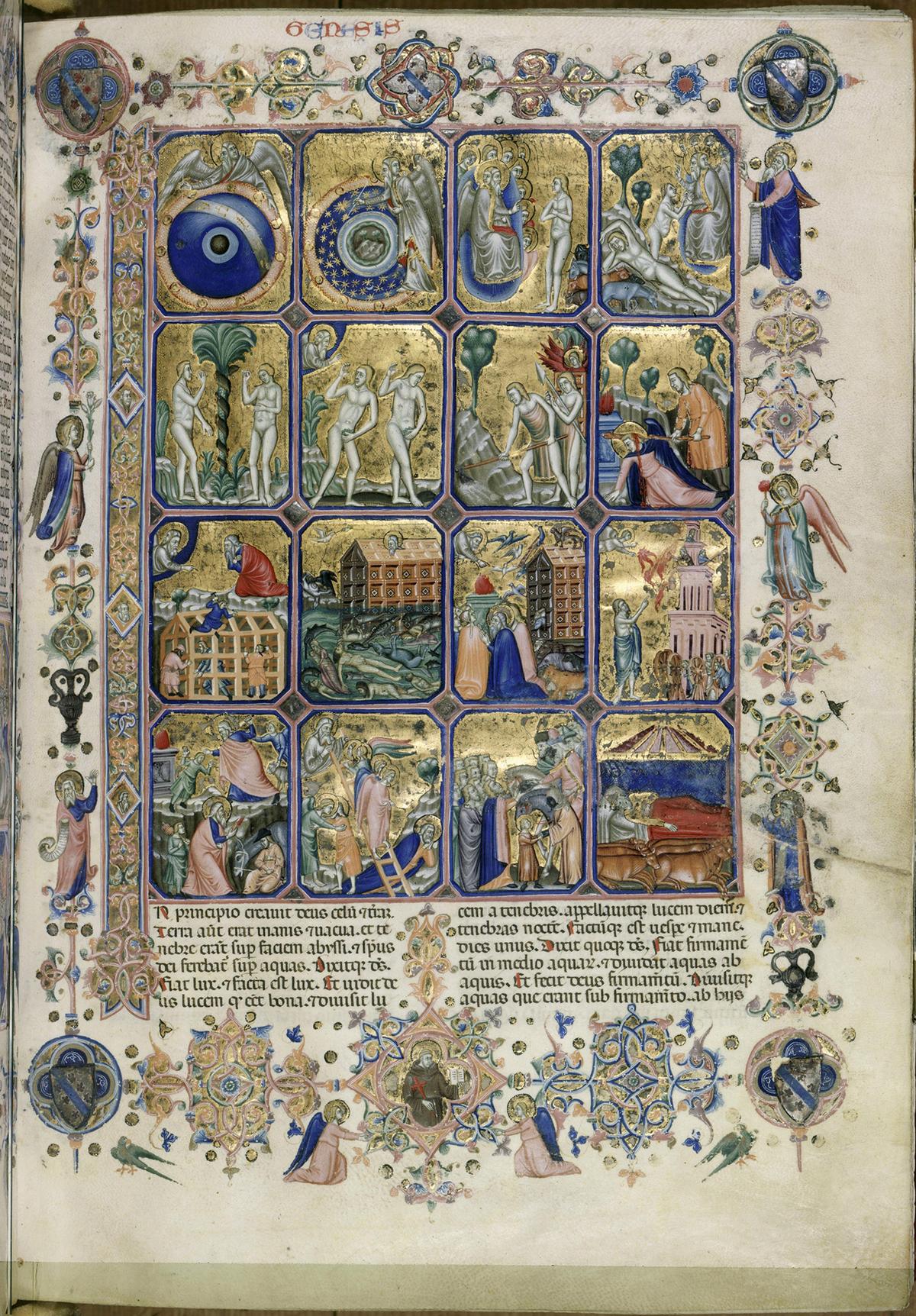
The pope’s intellectualism, faith, and connoisseurship are denoted by the book on the table. It is a sumptuously illuminated manuscript of the Bible opened to the first page of the Gospel of St. John. Scholars have identified the specific book—a renowned mid-14th century work by the Neapolitan illuminator Cristoforo Orimina that may have been commissioned by Queen Joanna I of Naples, Jerusalem, and Sicily.
The codex, considered one of the most important works of its kind in the world, made its way into the prolific collection of the Scottish Alexander Hamilton, 10th Duke of Hamilton (1767–1852), and is referred to as the “Hamilton Bible.” His descendant sold it in 1882, along with other treasures, to Berlin’s Museum of Prints and Drawings.
In the fall of 2017, a more than two-year restoration of the portrait of Leo X with Cardinals Luigi de’ Rossi and Giulio de’ Medici commenced because the Uffizi had made a critical discovery: Some areas of the original paint layers had lifted and revealed ridges that were compressed and shattered from earlier restoration attempts.
The 21st-century technology used in the recent restoration included x-ray, reflectographic inspection, and optical microscope investigation. These detailed analyses revealed important information about the creation of the painting: The artist utilized two different forms of underdrawing based on sketches of the sitters. The sketches were used to make cartoons that enabled him to transfer the drawings onto the panel. It was also determined that Raphael reworked the pope’s figure freehand, and the painting is a fully autograph work by Raphael. This last point dismisses definitively prior scholarly proposals that someone else added the cardinals to the picture at a later date.
This project has also restored the painting’s palette so its colors and meticulous details can once again be seen and appreciated by the viewer as the artist intended. The Uffizi writes that the work “has allowed us to rediscover the feeling of space and the architectural setting that previously appeared to be almost totally flat.” Furthermore, the artwork’s wooden support, which was starting to stiffen, was repaired. Just as the papal lineage of Leo continues, this painting has been preserved for the next generation.