In Pennsylvania, historic covered bridges are commonplace in rural farming areas. These mostly 19th-century wooden bridges were covered to protect them from inclement weather; they also became popular meeting spots for farmers.
Discover Lancaster’s tourism website offers pertinent information for a self-guided driving tour of the over 30 covered bridges in Lancaster County, Pennsylvania. Additionally, Berks County, Pennsylvania has a downloadable map that includes its five preserved covered bridges, including one called Pleasantville, which is on a pastoral road appropriately named Covered Bridge. However, this bridge is different from other Pennsylvania bridges in its design and the fact that a toll was once required to cross it.
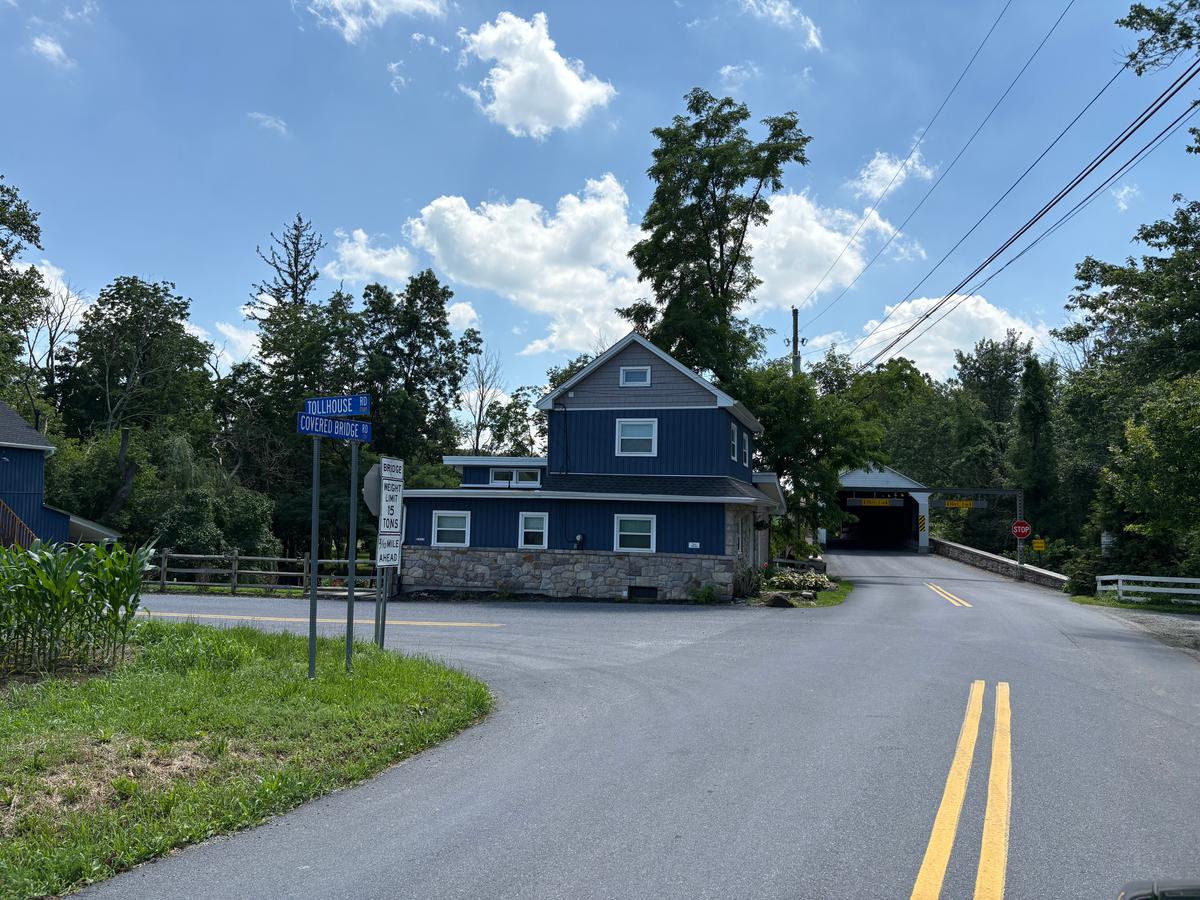
Covered Bridge Road directs visitors to this historical intersection, which is home to an old tollhouse and a white wooden covered bridge. Deena Bouknight
Typically, covered bridges in Pennsylvania were built using the patented Burr Arch Truss design that Theodore Burr invented in 1804. To bear the weight of horse-drawn carriages and oxen-drawn wagons (and later, motorized vehicles), the design featured a network of triangular beams with two long supporting arches on each side of the bridge’s cover.
The Pleasantville Bridge’s History
However, the 126-foot long Pleasantville Covered Bridge is different. The Library of Congress notes that it has “three sets of stiffening arches,” making it a “unique adaptation of Theodore’s Burr’s patented truss form.”The bridge was built by David Renno in 1852 over Manatawny Creek, which is surrounded by cornfields in Oley Township. The cover was added later—in 1856 due to a wood shortage in 1852. Jonathan Bitner was credited for building up the sides of the bridge and adding the roof. Instead of building one main arch on either side of the covering’s interior, indicating the class Burr Arch Truss design, he built three arches stacked smallest to largest.
Another unique aspect of the Pleasantville Covered Bridge is that a tollhouse stands on on side. It was once a tollkeeper’s residence and office. The keeper used the collected fee to maintain the bridge. Although the tollhouse is no longer in use, the building has been preserved. In records kept and shared by the Yoder family (farmers in the area for generations), the Covered Bridge Road was once referred to as The Great Road to Philadelphia. It’s just off Pennsylvania Route 73, which leads to Philadelphia.
Then, for a while it became a private turnpike, meaning a road on which a toll is charged. While it isn’t clearly documented when the tolls to cross the bridge stopped, Christopher K. Yoder shares on an online genealogy site that by 1869, it was a tollhouse:
“For every horse or mule, whether ridden, led or driven in any team of burden, sleigh, sled, cart or sulky - each mile traveled, one cent. For every single team of pleasure, market or spring wagon - for each mile traveled, two cents: the same vehicles with two or more horses - two and one-half cents for each mile or 12 cents for five miles. For every score of cattle, two cents for each mile. For every score of sheep or swine, one cent for each mile.”
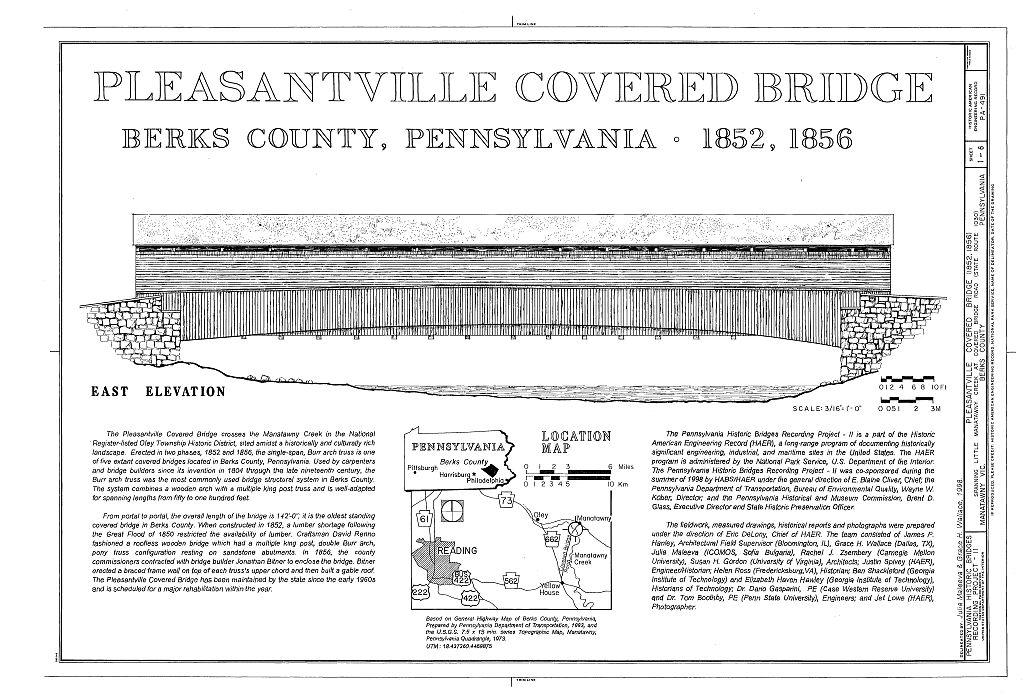
The title sheet to the architectural plans of the Pleasantville Covered Bridge provides clear schematics of the bridge's dimensions and style. Library of Congress. Public Domain
Listed on the National Register of Historic Places, Pleasantville Covered Bridge underwent a $2 million-plus restoration in the early 2000s by the Pennsylvania Department of Transportation. The bridge can be found on Covered Bridge Road. On a map, that road is also known as State Road 1030.
What arts and culture topics would you like us to cover? Please email ideas or feedback to [email protected]