This copy is for your personal, non-commercial use only. Distribution and use of this material are governed by our Subscriber Agreement and by copyright law. For non-personal use or to order multiple copies, please contact The Epoch Times Reprints.
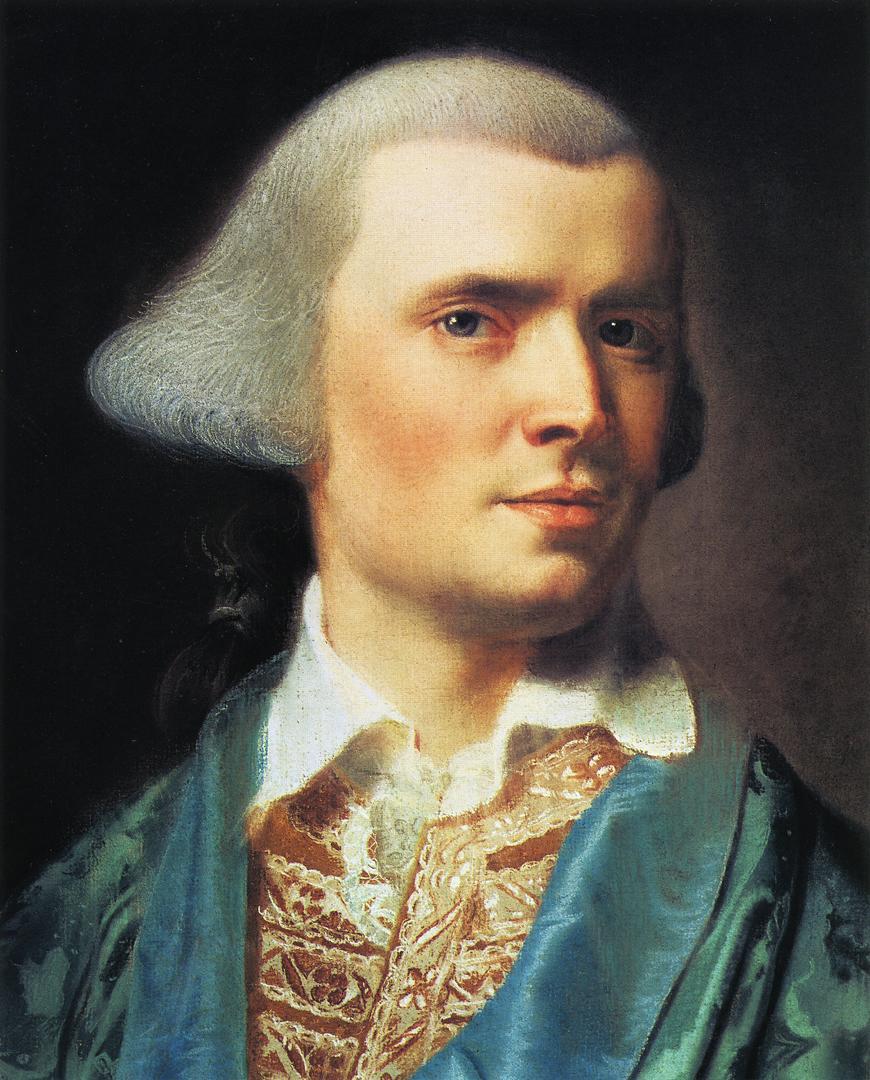
A detail from the portrait of Paul Revere, 1768, by John Singleton Copley. Copley's inclusion of Revere's teapot showcased both the artist's and artisan's skill. Museum of Fine Arts, Boston. Public Domain
Paul Revere’s legendary 1775 midnight ride from Boston to warn the Massachusetts residents of Lexington and Concord that British regulars were on the march earned him a revered place in American history. This courageous pre-revolutionary act by a member of the Sons of Liberty was later immortalized in an 1860 poem by Henry Wadsworth Longfellow.
In addition to his patriotism, Revere is known for being one of colonial America’s most prolific and talented silversmiths. Examination of his work reveals his artisanal skill, and analysis of his portraits shows the esteem in which he was held during his lifetime.
A Revolutionary Silversmith
Revere (1734–1818) was born the son of a French immigrant silversmith, Apollos Rivoire, who changed his name to Paul Revere. When his father died in 1754, the young Revere inherited his shop and quickly increased its business. During his career, he and his apprentices made over 5,000 silver objects. He worked in the latest styles—rococo before the Revolution and neoclassical afterwards—and produced a range of products, at least 90 different types in categories that included flatware, tableware, and personal accessories. In addition to selling his silver works, Revere supplied clients with imported textiles, hardware, and jewelry.
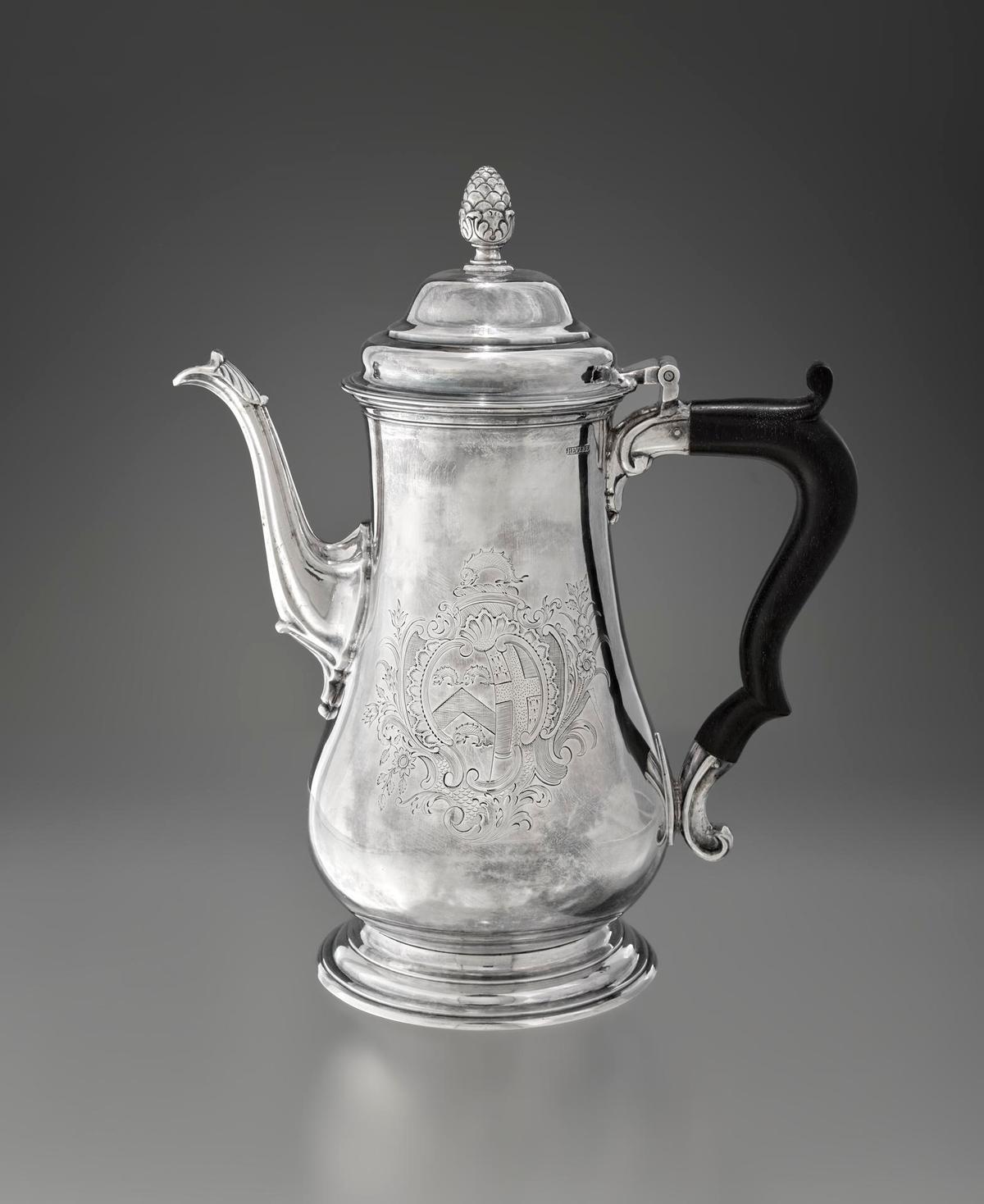
Rococo objects are among the most creative in Revere’s output. They are characterized by curvilinear forms, asymmetry, and elaborate decorative elements. An exceptional example from this period is Yale University Art Gallery’s tall and tapered coffeepot. Dated to 1769, it is a rare example of colonial silver that still has its original handle. The museum notes that Revere charged the client “four pounds for making the pot, sixteen shillings for adding the engraving, and four pence for sourcing and attaching the wooden handle.” The scrolling spout, pineapple finial, shell carving, and coat of arms are delightful details.
Coffeepot, 1769, by Paul Revere. Silver; 9 7/8 inches by 8 1/2 inches by 4 3/4 inches. Yale University Art Galley, Connecticut. Public Domain
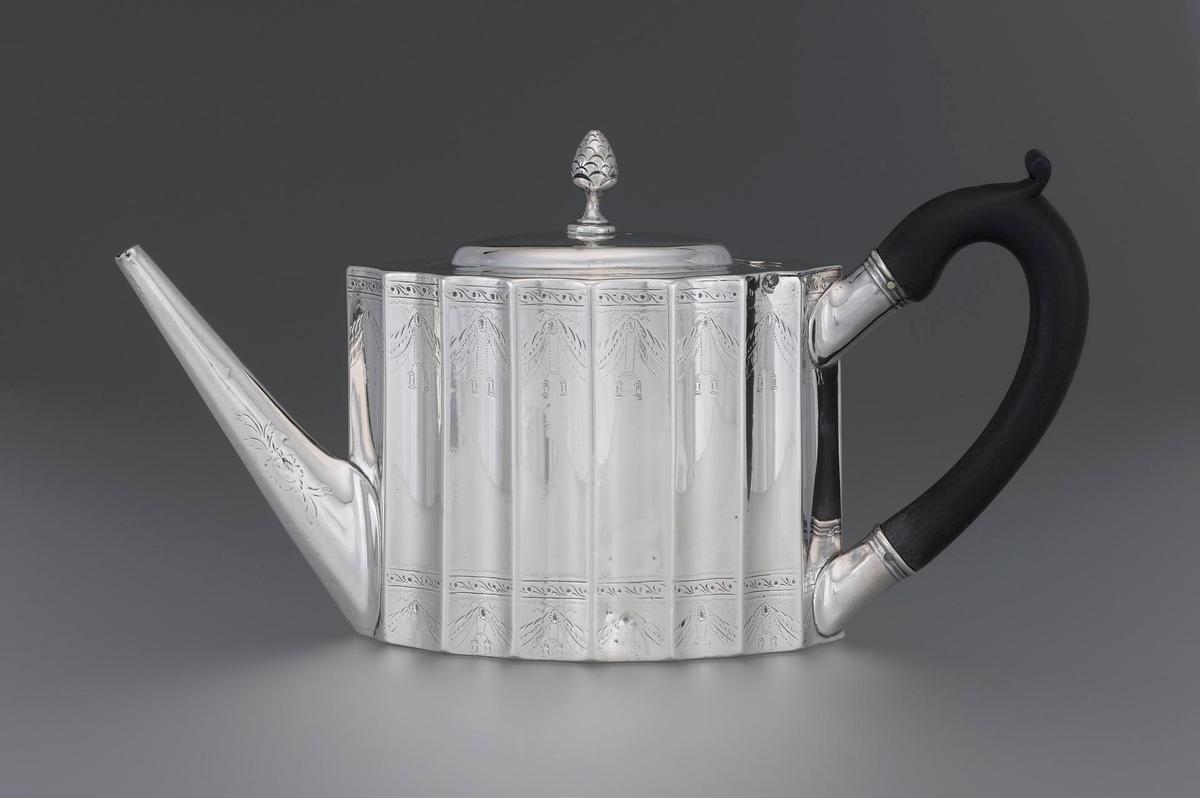
After the American Revolution, clients’ tastes shifted from the rococo to the neoclassical style. Furthermore, new production methods led to more standardized output. A more imaginative Revere piece from this period, also at Yale University Art Gallery, is a circa 1795 teapot. Its fluted form suggests a classical column and resembles fabric creases. Engraved tassels and swags adorn the teapot, though the simplified spout is straight.
Teapot, circa 1795, by Paul Revere. Silver; 6 inches by 3 1/2 inches by 11 3/8 inches. Yale University Art Galley, Connecticut. Public Domain
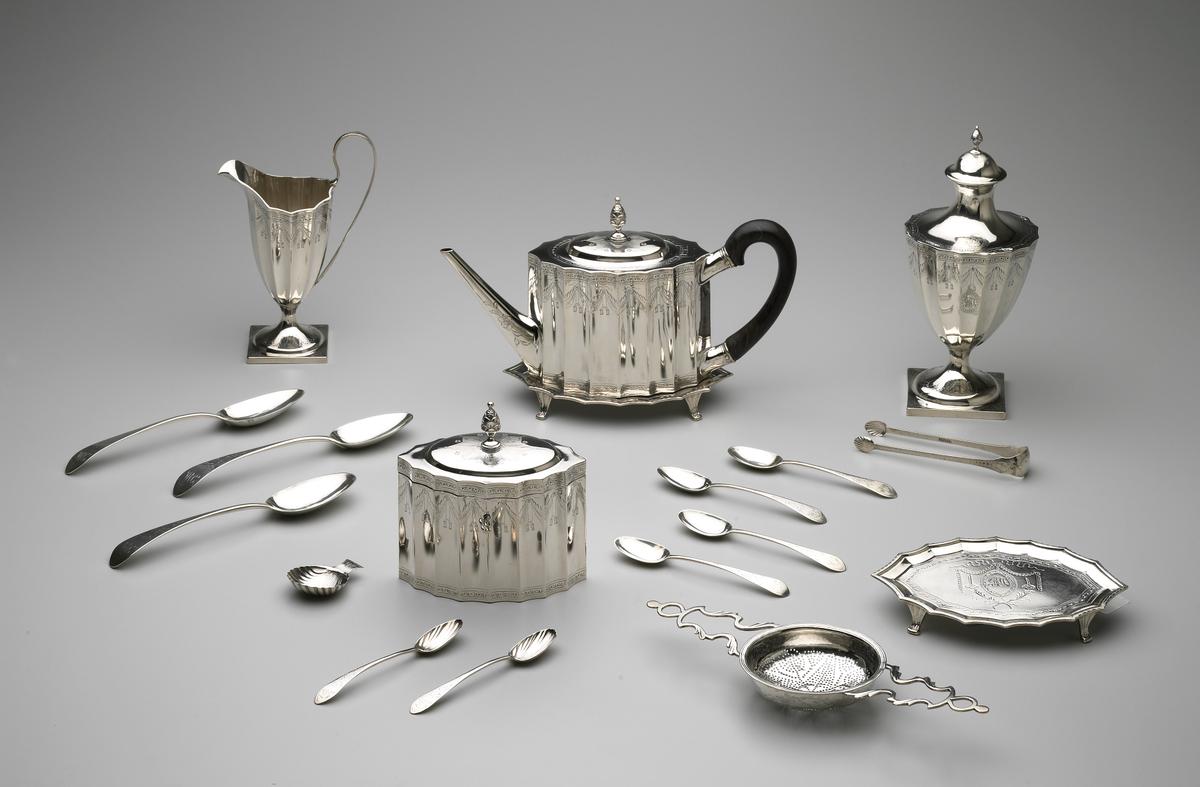
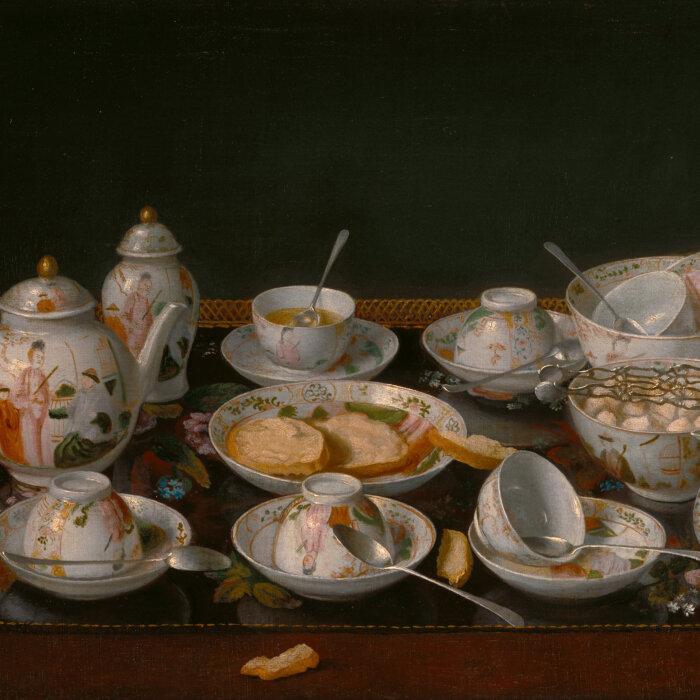
Coffee and tea played an important role in colonial America—socially, politically, and artistically. Introduced to the Western world in the 17th century, these libations gave rise to the coffeehouse, which became an important meeting place for conversation, as well as the ritual of afternoon tea. To accompany the new beverages, the prosperous commissioned special silver tableware in both Europe and America, whose silversmiths began making teapots by the start of the 1700s.In the beginning, tea vessels were globular or pear-shaped. During later decades of the 18th century, Neoclassical teapots were drum-like or oval in shape. The Minneapolis Institute of Art has the most complete Revere tea service known, made in 1792.
Tea service including teapot, teapot stand, tea caddy, tea caddy stand, sugar bowl, sugar tongs, creamer, tea scoop, and sieve, 1792–1797, by Paul Revere. Silver and wood. Minneapolis Institute of Art. Public Domain
An astute entrepreneur, Revere explored further fields of industry following the revolution. He cast church bells and cannons, engaged in copperplate engraving for printmaking, and drew political cartoons. He even made dentistry tools, and practiced the profession. Perpetually innovative, he was a pioneering businessman into his advanced years; at the age of 65, he opened the first successful copper rolling mill in North America. He married twice and was the father of 16 children. Both famous portraits of him—one preceding the Revolution painted by John Singleton Copley and the other following it done by Gilbert Stuart—were passed down in his family for generations.
The Artist and the Artisan
Boston-born into humble origins, Copley (1738–1815) primarily painted portraits of colonial New England’s elite. Along with being foremost in this field, he made miniatures and worked in pastels. Clients were keen to have pictures in the English style. Thanks to his artist stepfather, Copley had exposure to European prints for inspiration.
Although Copley paintedFounding Fathers and important patriots, such as John Hancock, Samuel Adams, and John Adams, he was not a revolutionary. His father-in-law was a Loyalist whose cargo was destroyed during the Boston Tea Party of 1773. As war brewed, Copley and his family emigrated to Europe. In 1774, he settled permanently in London and achieved acclaim there for his portraits and history paintings.
Self-portrait of the artist, 1769, by John Singleton Copley. Pastel; 23 3/4 inches by 17 1/2 inches. Winterthur Museum, Garden and Library, Delaware. Public Domain
Copley’s American portraits were often displayed in their wealthy sitters’ homes alongside fine furnishings, such as Rococo tea sets. Typically, Copley portrayed members of the merchant class and clergy, not artisans, which makes his 1768 portrait of Revere unusual for his oeuvre and American colonial painting as a whole.
The already established Revere is shown at work: Depicted in half-length behind a luminously polished table, engraving tools are at his elbow. Shown informally in white linen shirtsleeves, he holds his chin with one hand and has an undecorated teapot in the other. Contemplative, Revere looks straight at the viewer. The teapot and surface of the table allow Copley to display his skill in depicting light and reflection.
A portrait of Paul Revere, 1768, by John Singleton Copley. Oil on canvas; 35 inches by 28 1/2 inches. Museum of Fine Arts, Boston. Public Domain
This is an idealized image of an active craftsman. Revere would not have worn such clean clothing and gold buttons while working. The buttons, along with the teapot, may be a means of advertising Revere’s output. Furthermore, the table is not an accurate representation of a workbench. Copley imbued this painting with an elegance similar to his society portraits.
Revere and Copley knew each other before this portrait was made—the artist had purchased a gold bracelet, frames, and casesfrom the smith. However, the circumstances of this commission are unknown. After Revere’s death, the painting was stored in a family attic. His descendants’ interest in the painting was seemingly roused by the publication of Longfellow’s poem, with the artwork believed to have been restored 15 years later in 1875. The portrait was finally displayed in public in 1928. Two years later, Revere’s great-grandsons gifted it to the MFA.
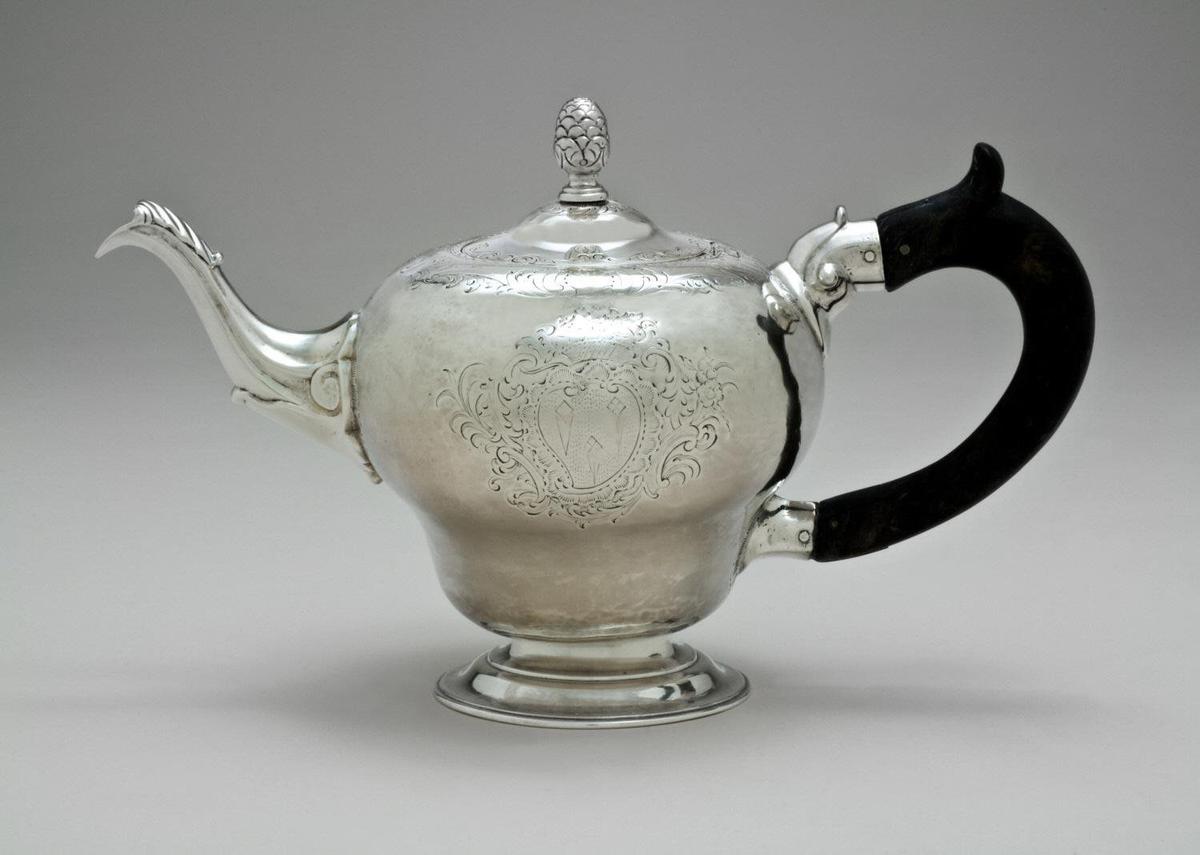
Teapot, 1760–1770, by Paul Revere. Silver, wood handle; 5 3/4 inches by 9 3/4 inches by 5 inches. Philadelphia Museum of Art. Public Domain
Copley’s inclusion of a teapot in the portrait is notable for several reasons. Teapots were among the most challenging objects that Revere made; he created only nine teapots between 1762–1773, as attested by his surviving account book. The teapot’s presence in the painting symbolizes his expert skill. However, by the time this portrait was made, his teapot production had declined due to the British government’s tax on tea through the Stamp Act of 1765 and the Townshend Acts of 1767. These were factors in the Boston Tea Party and the American Revolution itself.
The museum wondersif a Revere Rococo teapot in their collection, circa 1760–1770, is the same as in the Copley painting. Both have a low, domed cover and pinecone finial. A Revere teapot in this style with a wooden handle would have cost 10 pounds 16 shillings and 8 pence (nearly half the annual income of the average colonial American).
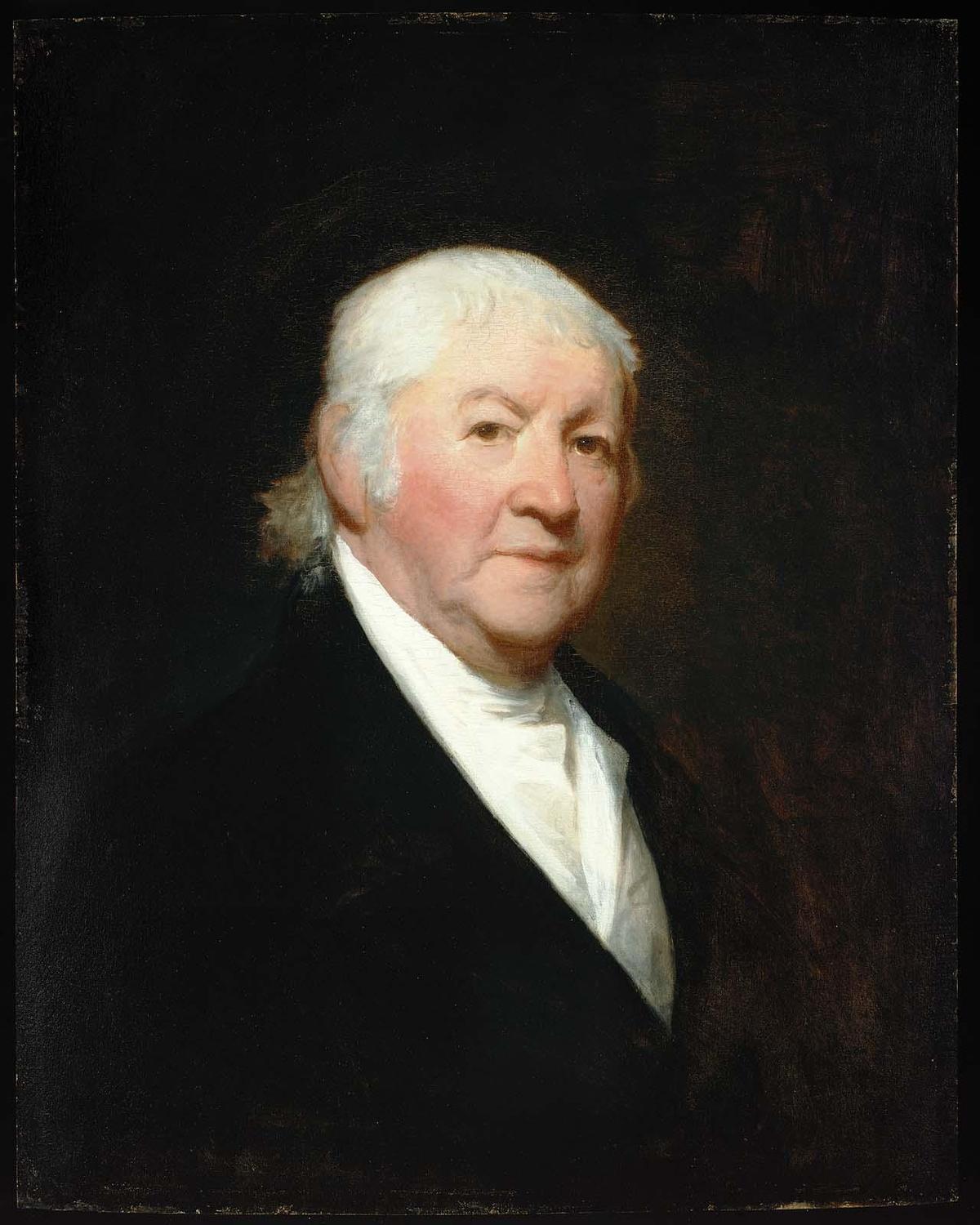
Revere ran his own shop from the age of 19 until he retired at 76 years old. Five years before his death, his son commissioned a portrait of him by Gilbert Stuart, an artist best known for his series of portraits of George Washington.
A portrait of Paul Revere, 1813, by Gilbert Stuart. Oil on panel; 28 1/4 inches by 22 1/2 inches. Museum of Fine Arts, Boston. Public Domain
The elderly Revere is celebrated as an affluent gentleman. Indeed, over the course of a long, prosperous, and varied life, this patriot embodied the entrepreneurial and independent spirit encouraged by the American Revolution.
What arts and culture topics would you like us to cover? Please email ideas or feedback to [email protected]
Michelle Plastrik is an art adviser living in New York City. She writes on a range of topics, including art history, the art market, museums, art fairs, and special exhibitions.