PG-13 | 1h 39m | Action, Courtroom Drama, Whodunit | 2025
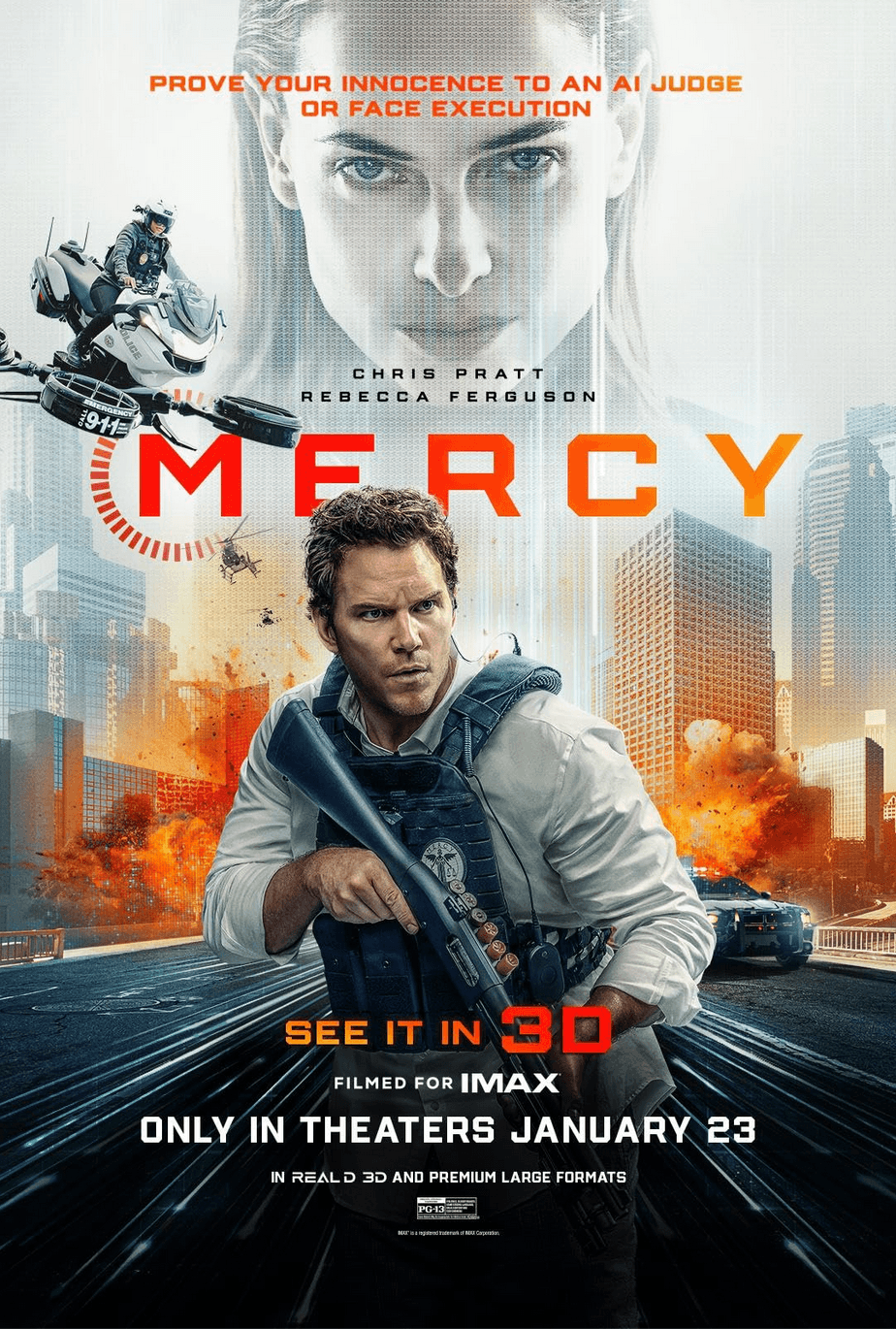
“Mercy” is basically a courtroom drama presided over by an artificial intelligence judge, but “RoboJudge” sounds better. And had “RoboCop’s” director Paul Verhoeven helmed “Mercy,” we might have been bequeathed a far more scathing, fun, but also sobering satire of our tech-addicted society.
Set in an unrealistic near future—just three years from now—“Mercy” tells of a Los Angeles that has turned over its legal system to AI. “Mercy” has nothing to say about this future LA’s cordoned-off “red zones,” in which the homeless and other “potentially dangerous” individuals are forced to live. That might make “Mercy” the first pro-dystopian science fiction movie.
What Happens When You Get the Chair
No, not that chair. Not yet, at least. Suspects are strapped to a chair in an area reminiscent of X-Man Professor Xavier’s Danger Room, and given 90 minutes to argue their case to an AI judge. If they can’t reduce their likelihood of guilt below 92 percent, they are summarily and immediately whacked via massive electrical pulse.This AI-run, judge-jury-executioner legal system was initially championed by detective Chris Raven (Chris Pratt), who now, of course, has wound up sitting in the hot seat. AI-generated Judge Maddox (Rebecca Ferguson) has accused him of murdering his wife.
‘Mercy’
A new take on the detective procedural is welcome, and “Mercy” initially scores points for attempting to update the genre. However, there’s a nonstop barrage of silly plot twists, stereotype characters, and that particular cyber visual we’ve seen all too often—of someone sitting amid a holographically-3D rendered computer screen, sorting through files, folders, and photos of body-cam and surveillance footage.

It’s all a bit headache-inducing, and it reminded me of certain gatherings, where, when someone runs their mouth for too long, someone will call out, “Mercy!” As in, “have mercy and shut up already.”
The action swirls around Raven as he uses his detective skills to prove his innocence. Anyone who’s watched a “Parks and Recreation” blooper-reel knows that keeping the hilarious, frenetic, and charismatic Chris Pratt strapped to a chair playing a cop with alcohol issues and a dead partner, for a whole movie, isn’t the best use of Pratt’s talents.
It also looks as if “Mission Impossible”-regular Rebecca Ferguson recorded her head-and-shoulders-only performance on an iPhone between takes while working on another movie. “I was not designed to feel,” she says. Ferguson does a decent job of conveying, similar to “RoboCop,” that computer glitches, when harnessed to law enforcement and the legal system, could cause an irreversible chain of events with lethal consequences.
At first, director Timur Bekmambetov seems to be sending the message that it’s only a matter of time before AI kills us. It’s safe to say many people would agree that’s likely the logical outcome. Everyone has seen “The Terminator” by now.
However, the film’s original point-of-view—that humanity, though imperfect, is superior to artificial intelligence— inexplicably shifts to a more AI-sympathetic position. It’s a pretty polarizing topic. The film disappointingly chooses slick, high-octane spectacle over an interesting (and consistent) opinion on the ethics of AI, and the far-reaching impact it will have on humanity.