This copy is for your personal, non-commercial use only. Distribution and use of this material are governed by our Subscriber Agreement and by copyright law. For non-personal use or to order multiple copies, please contact The Epoch Times Reprints.
The neoclassical Virginia State Capitol in Richmond reflects ancient Roman architecture with an American flair. Between 1904 and 1906, the east and west wings were built for the House of Delegates and the Senate Chamber, respectively. They flank Jefferson’s original 18th-century building and reflect the original Capitol’s classical style. Felix Lipov/Shutterstock
European architecture informed many important early American buildings, and European architects helped Thomas Jefferson and others design buildings with a distinctive American flair.
America’s Founding Fathers created the nation using classic and Christian philosophical principles. When Jefferson was George Washington’s secretary of state, he wrote to the French architect Pierre Charles L’Enfant (who planned the city of Washington) that the Capitol’s architecture should be based on “the models of antiquity, which have had the approbation of thousands of years.”
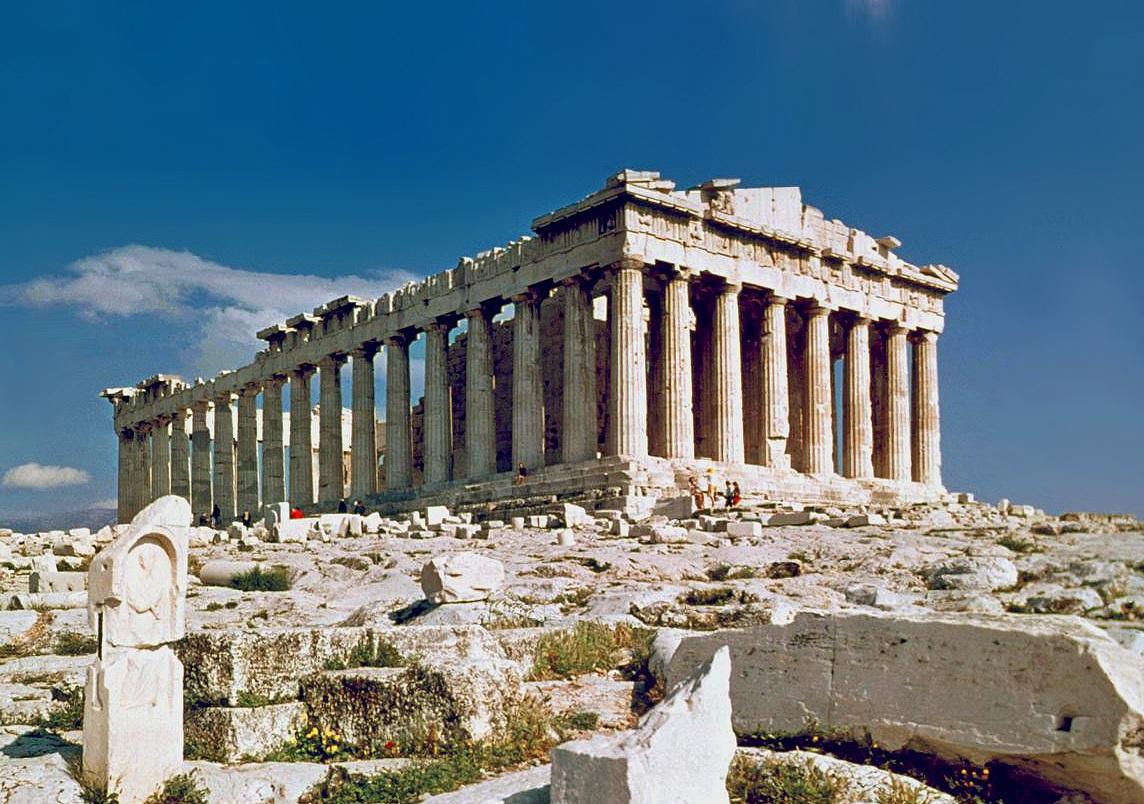
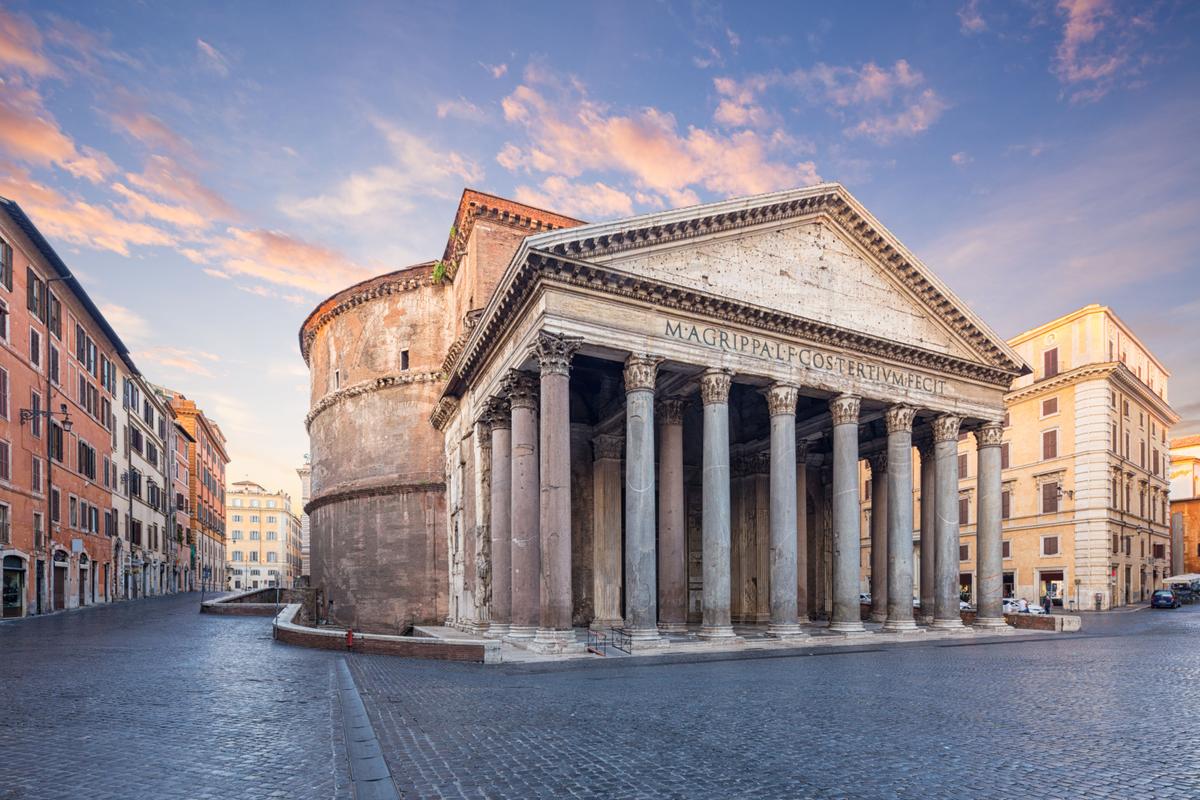
Experts universally agree that the Parthenon in Athens stands as the finest surviving example of ancient Greek architecture, and that the Pantheon in Rome is a perfect reflection of ancient Roman architecture.
The Parthenon in Athens, Greece, is considered the best surviving example of ancient Greek architecture. Dimboukas/CC BY 2.0
The Pantheon in Rome is considered the best surviving example of ancient Roman architecture. Phant/Shuterstock
Jefferson, while ambassador to France, studied classical architecture firsthand, delighting in centuries-old Roman architecture. But he never saw Rome’s Pantheon. He garnered most of his knowledge from Venetian architect Andrea Palladio.
The Renaissance architect Palladio brought the ancient Roman architecture of Marcus Vitruvius Pollio to light in his 1570 treatise “I Quattro Libri dell'Architettura (The Four Books of Architecture).”
Vitruvius and Palladio died centuries ago, but the heart of their classical works lives on in European and American architecture. For instance, their influence, via the Pantheon, can be seen in Jefferson’s Monticello and the academic village—the University of Virginia—he created with Benjamin Henry Latrobe in Charlottesville, Virginia, especially the Rotunda.
Monticello, Thomas Jefferson’s home and plantation in Charlottesville, Va. Rome’s Pantheon inspired Jefferson’s design for the building. (Corkythehornetfan/CC SA-BY 3.0)
Thomas Jefferson designed the Rotunda at the University of Virginia in Charlottesville, Va. He based the design on a sketch of the Pantheon in a 1720 edition of Andrea Palladio’s “Four Books of Architecture.” Public Domain
Three interesting examples of American architecture also influenced by ancient designs are the Virginia State Capitol in Richmond, the Washington Square Arch in New York City, and the Thomas Jefferson Building of the Library of Congress in Washington.
The Republic’s First Statehouse
Since 1788, representatives have met in the Virginia State Capitol in Richmond, making it the oldest English-speaking representative assembly in the country.
Much American history has been, and continues to be, made at the Capitol. In December 1791, for instance, the assembly ratified the U.S. Bill of Rights. And between 1861 and 1865, it was the Confederate Capitol, from which Robert E. Lee commanded Virginia forces and where Jefferson Davis was inaugurated as Confederate president.
Set atop Shockoe Hill, the majestic Capitol was the first public building in the New World to be based on a classical temple, and the first neoclassical public building in America.
Thomas Jefferson and French architect Charles-Louis Clérisseau designed the building based on Maison Carrée, an ancient Roman temple in Nîmes, in the south of France. Jefferson spent hours admiring the temple.
The ancient Roman temple of Maison Carrée, in Nîmes, in the south of France, inspired the neoclassical design of the Virginia State Capitol in Richmond. (Krzysztof Golik/CC BY-SA 4.0)
According to “The Oxford Companion to Art,” Jefferson was “the first American architect to reject the English tradition in favour of a style more appropriate to the ideals of the democracy he had helped to shape.”
The original Virginia State Capitol pictured in a photochrome postcard by the Detroit Photographic Company, circa 1897–1924. Construction of the brick and stucco Capitol began in 1785 and was completed in 1798. Public Domain
In their design, Jefferson and Clérisseau replaced the ancient temple’s Corinthian columns and pilasters (columns integrated into the wall) with the simpler but no less elegant Ionic equivalent, which were far easier for local craftsmen to re-create. Doric pilasters, the oldest classical order, frame the first-floor windows. Inside, the Capitol’s architects mirrored the interior plan of colonial Williamsburg’s Capitol.
Washington’s Centennial Arch
In 1889, a century after the Republic’s first statehouse, architect Stanford White made a wooden triumphal arch for New York City’s Washington Square Park to celebrate the centennial of George Washington’s inauguration at the city’s Federal Hall. The temporary arch, topped with a wooden sculpture of the first president, was decorated with classical motifs made of papier-mâché and plaster.
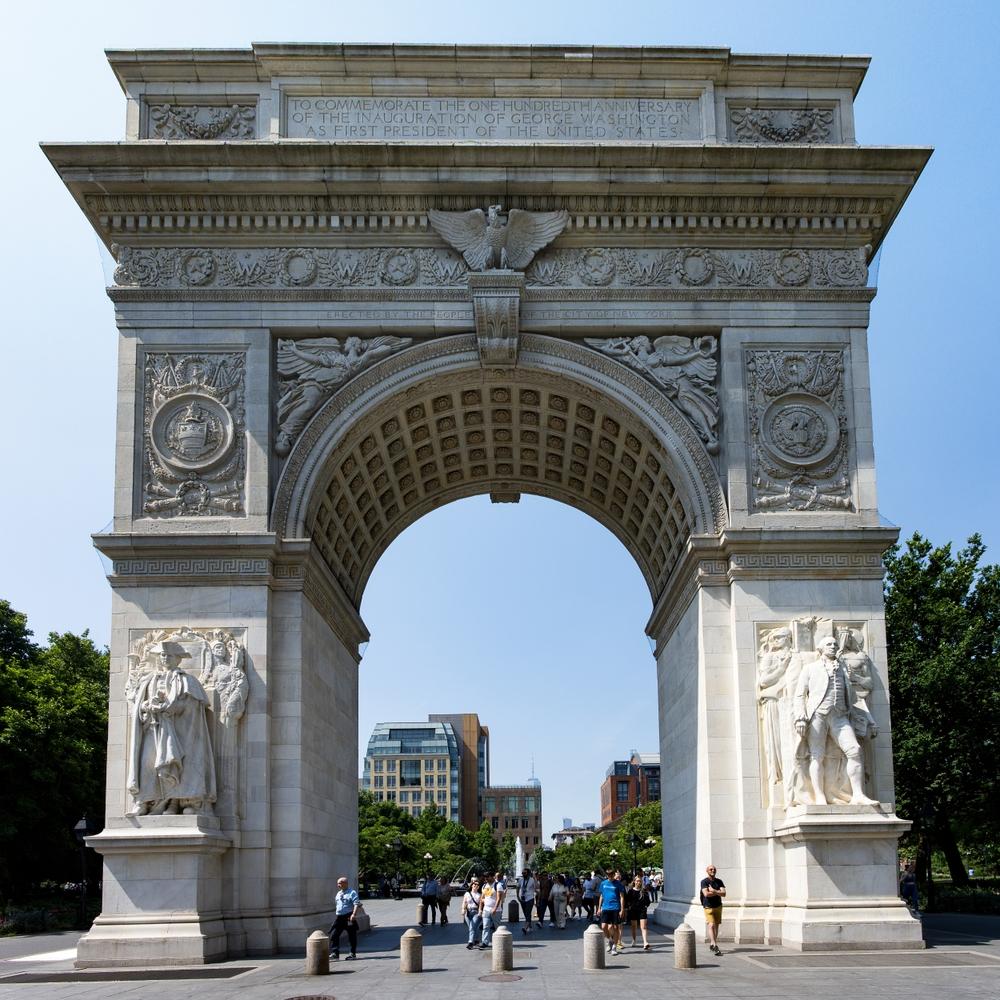
The centennial arch was deemed so impressive that White was commissioned to make a permanent monument in the park. Dedicated on May 4, 1895, the permanent Washington Square Arch, made of marble, stands 73 feet, 6 inches tall.
The north façade of the Washington Square Arch in Washington Square Park, New York City. The marble arch commemorates the 100th anniversary of George Washington’s inauguration. Its design is based on ancient Roman triumphal arches. Ed Ruth Photo/Shutterstock
White adorned the arch with sculptural reliefs of allegorical figures and classical motifs. His design harks back to ancient Roman triumphal arches and Napoleon’s Arc de Triomphe in Paris.
A French national treasure, the Arc de Triomphe de l'Étoile stands a colossal 164 feet high, 148 feet wide, and 72 feet deep. It is dedicated to the armies of the Republic and Empire. (Paris 16/CC BY-SA 2.0)
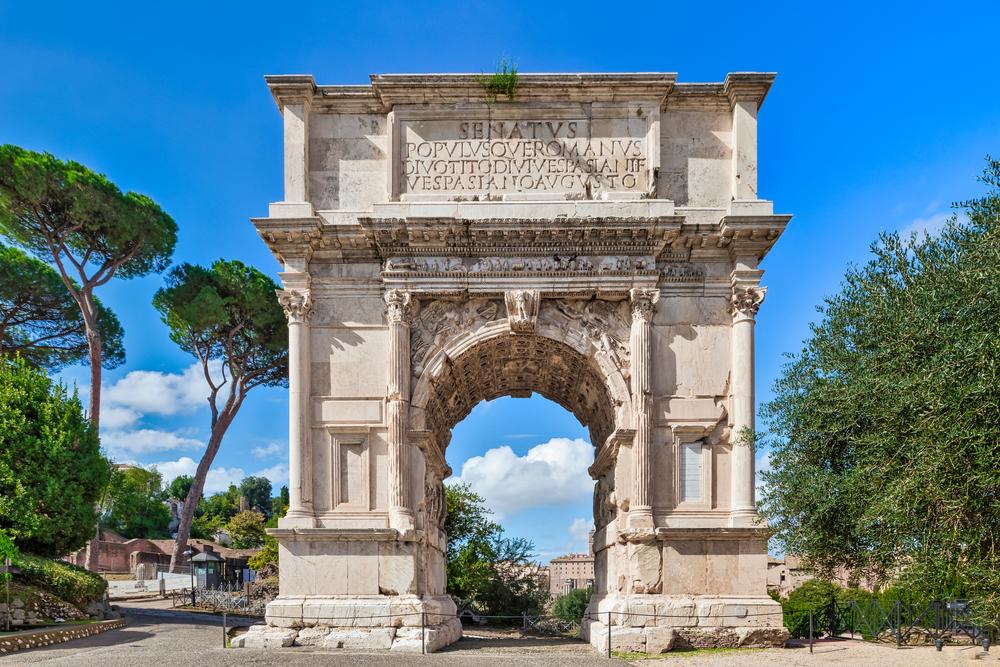
As a great admirer of the fine arts of antiquity, Napoleon Bonaparte had charged architect Jean-François-Thérèse Chalgrin to draw on classical architecture for inspiration when designing the triumphal arch. Chalgrin looked to the Arch of Titus (A.D. 81) in Rome for his design, although the Arc de Triomphe has no columns.
Rome’s ancient Arch of Titus inspired architect Jean-François-Thérèse Chalgrin’s design for the Arc de Triomphe. Wiesdie/Shutterstock
Paris’s 164-foot neoclassical arch shows scenes of dynastic life as well as battle scenes, which differ from the classical tradition of triumphal arches that depict military victories only.
The Thomas Jefferson Building
“Not until I stand before the judgment seat of God do I ever expect to see this building transcended,” a visitor proclaimed of the new Library of Congress building in Washington, which opened on Nov. 1, 1897.
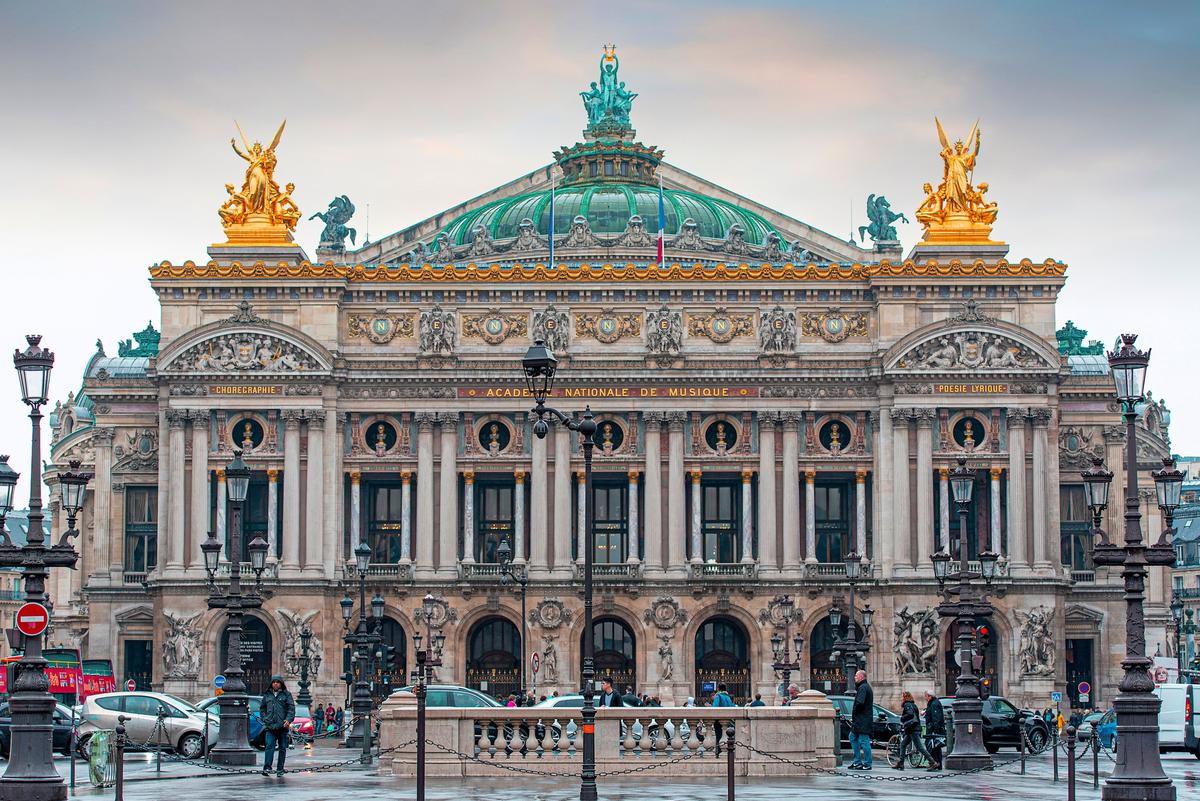
The Palais Garnier (built to house the Paris Opera) inspired the library design. It is considered the best example of the Napoleon III style of late-19th-century architecture. The style combines elements of historical architecture with innovations. French architect Charles Garnier incorporated baroque, Palladian, and French Renaissance architecture into the Palais Garnier, along with the modern invention of the iron framework.
Charles Garnier designed the Palais Garnier for the Paris Opera between 1861 and 1875 at the request of Napoleon’s nephew, Napoleon III. The façade displays busts of composers, including Rossini, Mozart, and Beethoven, as well as of librettists. Savvapanf/Shutterstock
The Library of Congress building is an exquisite example of the Beaux Arts architectural style, in which ornate decoration and functional design meld with theatrical appeal. Corinthian columns and portrait busts of famous writers adorn the façade. And at the entrance itself, three bronze doors are graced with allegories of “Tradition,” “Writing,” and “Printing,” as if announcing the treasures inside.
The west façade of the Thomas Jefferson Building faces the Capitol, in Washington. It echoes the façade of the Palais Garnier in Paris, which inspired its design. Public domain
On March 31, 1898, The New-York Evangelist newspaper wrote of the building: “For examples of the finest taste and highest beauty, Americans are no longer compelled to go over seas; they can find one latest achievement on Capitol Hill and rest assured that the edifice of our new ‘Congressional Library’ is one of the world’s noblest structures. Its treasures of beauty and its wealth of books are open to the whole people; and it is the pride of our Congress to call it the property of the nation.”
In 1980, the Library of Congress building was renamed the Thomas Jefferson Building, honoring the Founding Father’s contribution of 6,487 books after a fire during the War of 1812 destroyed much of its holdings.
Vitruvius, Palladio, Jefferson, and other great architects who adhered to classical design principles blessed the nation with beauty and set a precedent for future architecture.
Their influence can also be seen in the fabric of American life, in traditional church architecture, and even in the cornices, baseboards, and ceiling moldings of homes. Architects and builders wrote classical pattern books for American carpenters and the like, including “The Country Builder’s Assistant” by Asher Benjamin in 1797, and “The Young Carpenter’s Assistant” by Owen Biddle in 1805.
What arts and culture topics would you like us to cover? Please email ideas or feedback to [email protected].
Lorraine Ferrier writes about fine arts and craftsmanship for The Epoch Times. She focuses on artists and artisans, primarily in North America and Europe, who imbue their works with beauty and traditional values. She's especially interested in giving a voice to the rare and lesser-known arts and crafts, in the hope that we can preserve our traditional art heritage. She lives and writes in a London suburb, in England.