The idea that the eyes are a window to the soul has appeared across cultures and artistic traditions for centuries. As artistic and spiritual traditions evolved from the Medieval through the neoclassical periods, the eyes remained a vital bridge between a painting’s inner and outer worlds. How mysterious, then, that the artist of German Romanticism most synonymous with evoking a state of deep, soulful reflection did so by turning his subjects’ eyes away from the viewer to face landscapes beyond them.
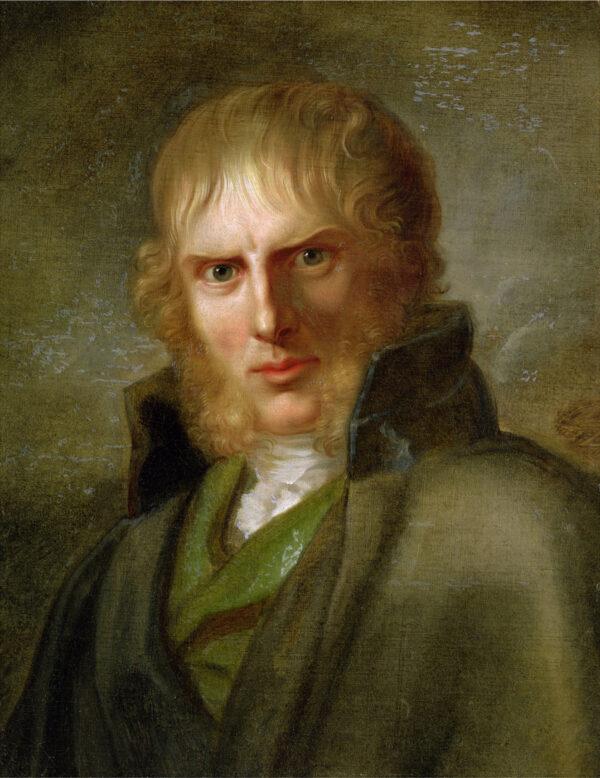
Caspar David Friedrich (1774–1840) aspired to much more than wealth or fame with his paintings. He pioneered the concept of art as an immersive experience.
In the same year Friedrich of birth, 1774, Johann Wolfgang von Goethe published the first novel to be widely recognized as an international best-seller. “The Sorrows of Young Werther” created such a frenzy across Europe that countless illustrations, porcelain, perfume, and fashion trends accompanied its branding. Napoleon so cherished the book that he carried a copy during his military campaign in Egypt, and later invited Goethe to a private meeting in which he lauded the book’s genius.
The novel’s deeply personal epistolary or journal-entry narrative, combined with its protagonist’s inconsolable grief speaks to the cultural appetite of Europe. A product of the formative years of the “Sturm und Drang” or “Storm and Urge” movement in German literature and music, “Werther’s” beautifully articulated melancholy unified a generation’s dissatisfaction with the bleak industrialization and empty promises of Rationalism promoted by the Enlightenment. The novel’s impact was clear across all art forms for the next century.
An Underdog’s Genre
One of Goethe’s ventures in stepping away from “Werther” was in organizing and judging the Weimar Friends of Art Competition from 1799 through 1805. The final year was the first time Goethe awarded first prize for two landscape drawings rather than classical subjects. Until that time, landscapes along with still lifes were categorized as lesser works of art. Caspar David Friedrich’s masterful sepia drawings so compelled Goethe that the two remained lifelong friends.Friedrich’s inclination to capture dramatic landscapes likely came from his upbringing on the Baltic coast where he hiked through frozen forests and mountains, appreciating nature’s beauty in its raw, unpolished beauty.

His inclination to imbue his landscapes with a Werther-like sense of withdrawn melancholy likely came from suffering the early deaths of his mother, two sisters, and his brother, whom he was unable to save from drowning after falling through the ice of a frozen lake. This traumatic event that reportedly affected him throughout his life offers a possible explanation for his recurring compositional choice of distant, minuscule figures being dwarfed or swallowed up by massive surroundings. Two of his early works in Dresden proved controversial enough in this regard to establish his reputation as an eccentric, controversial genius.
“The Cross in the Mountains” (1808) designed as an altar piece, was called blasphemous for its depiction of a religious theme in the context of a landscape. Crucifixes placed atop mountains, known as summit crosses, had always been a common tradition in Germany. But Caspar’s placement of the cross as a distant focal point interconnecting a steep mountain and a vast cloudscape permitted the grandeur of the natural setting to deliver the emotional impact rather than the image of Christ. The public debate that followed ensured a cold reception for the painting in Dresden but eventually earned Friedrich the attention of the Prussian nobility.
“The Monk by the Sea” (1810) has been unfairly labeled as a precursor of abstract art for the sense of vast emptiness that dominates the scene. A closer examination of Friedrich’s process demonstrates his thematic intentions. All painters and photographers will be familiar with “the Rule of Thirds,” a term coined by John Thomas Smith in 1797. Friedrich’s balancing of his foregrounds and backgrounds, and the precise placement of his tiny subjects at the focal points between horizontal and vertical thirds, exemplify the potential of this technique to create tension within its proportions and drama through the resulting perspective.
The ‘Rückenfigur’
Friedrich defined his approach to painting as follows:“The task of a work of art is to recognize the spirit of nature and, with one’s whole heart and intention, to saturate oneself with it and absorb it and give it back again in the form of a picture.”
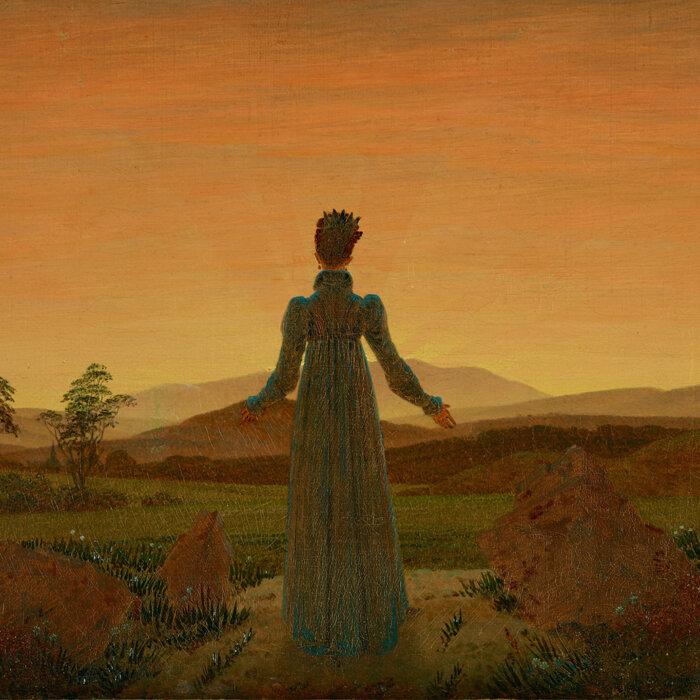
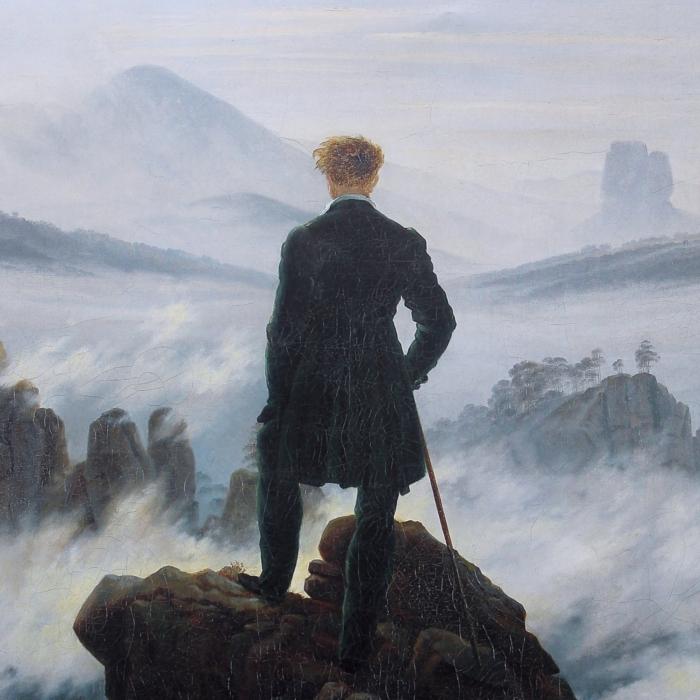
His early drawings reveal that he had no difficulty with portraits and was entirely capable of capturing energy and essence in the eyes of his subjects. It was his conscious choice to focus on landscapes and to include human figures only in diminished proportions, never looking directly out of the canvas. He utilized the back-facing figure, or “Rückenfigur,” as an avatar for his viewers, compelling them to feel as if they were transported directly into his landscapes. They served as shortcuts to the end of the long journeys required to achieve states of profound isolation and reflection that only nature can provide.
With the subject lacking a prominent pair of eyes, the viewer’s gaze naturally extends to the horizon, creating a stronger connection than an empty landscape alone could achieve.”
Friedrich’s “Wanderer Above the Sea of Fog” (1818) is regarded as his greatest achievement in this dynamic, with its blending of both melancholic and victorious sentiments. Interpretations place the figure deep in the Elbe Sandstone Mountains between Dresden and Prague, where Friedrich hiked and sketched often.
An Innovator’s Genre
Friedrich’s ambition to inspire in his viewers a state of spiritual immersion went far beyond the “Rückenfigur.” His experimentation with transparent paper led him to a new approach with lighting, coloring, and positioning a work in a room in such a way as to create a completely immersive experience for the viewer. Unlike the massive, circular panoramic paintings of the late 18th century, these settings, incorporating dim, shifting light and slowly changing colors, were meant to mimic the gradual transformations between day and night, and thereby inspire a similar sense of deepening reflection.In 1830, Grand Duke Alexander, son of Tsar Nicholas I, commissioned four such transparent works from Friedrich. Only one of these works survives today, whether lost to the same ephemeral nature that allowed for such an effect, or to fire and theft, as happened to many of Friedrich’s works.
After suffering a stroke in 1835, his provocative, introspective style and reputation dwindled into obscurity. Not until the symbolist movement of the early 1900s was his work rediscovered and celebrated. His intuition in drawing the viewer into a deeper, all-encompassing experience was both a clear product of his time. Yet his most enduring impact can be felt today in the visionary filmmaking of directors from David Lynch and Roland Emmerich to Werner Herzog and Andrei Tarkovsky, who have all cited Caspar David Friedrich as a vast landscape of inspiration.