The circle is the simplest of forms. It has no beginning or end and no hierarchy of sides. It suggests perfection, unity, and eternity. On Pi Day, when the mathematical constant π briefly enters popular conversation, it is worth recalling that artists have long understood what mathematicians formalized: The circle is not merely a figure; it is a system of thought.
Geometry as Devotion
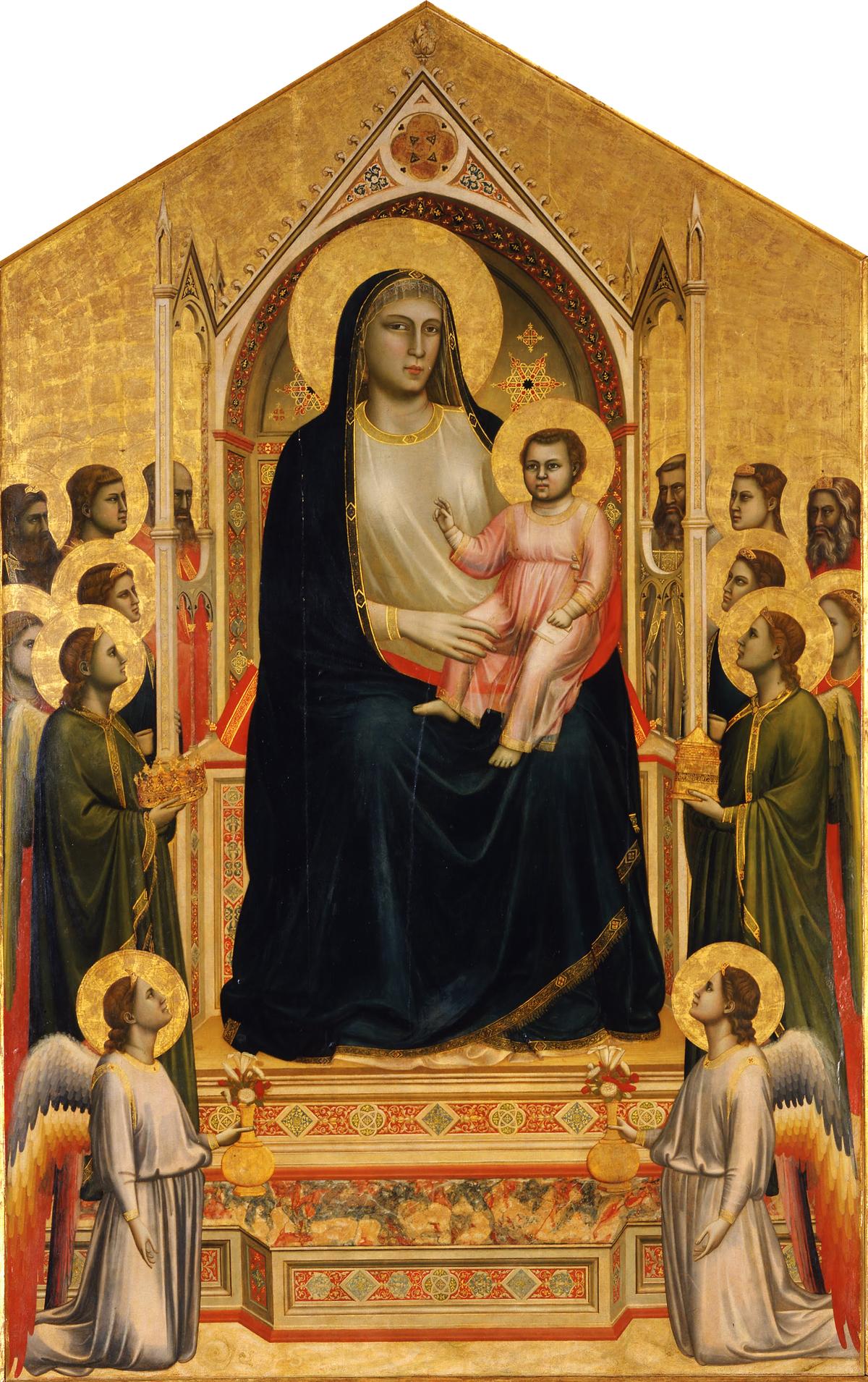
In the 14th century, when Pope Benedict XI sought proof of Giotto di Bondone’s skill, the painter responded by drawing a perfect circle freehand. Whether legend or not, the anecdote captures a truth about Giotto. His work moves away from the flat, stylized look of Byzantine art toward something that feels more three-dimensional. In “Madonna and Child,” the virgin’s throne and halo rely on circular geometry to stabilize the composition. Geometry here is both devotional and structural.
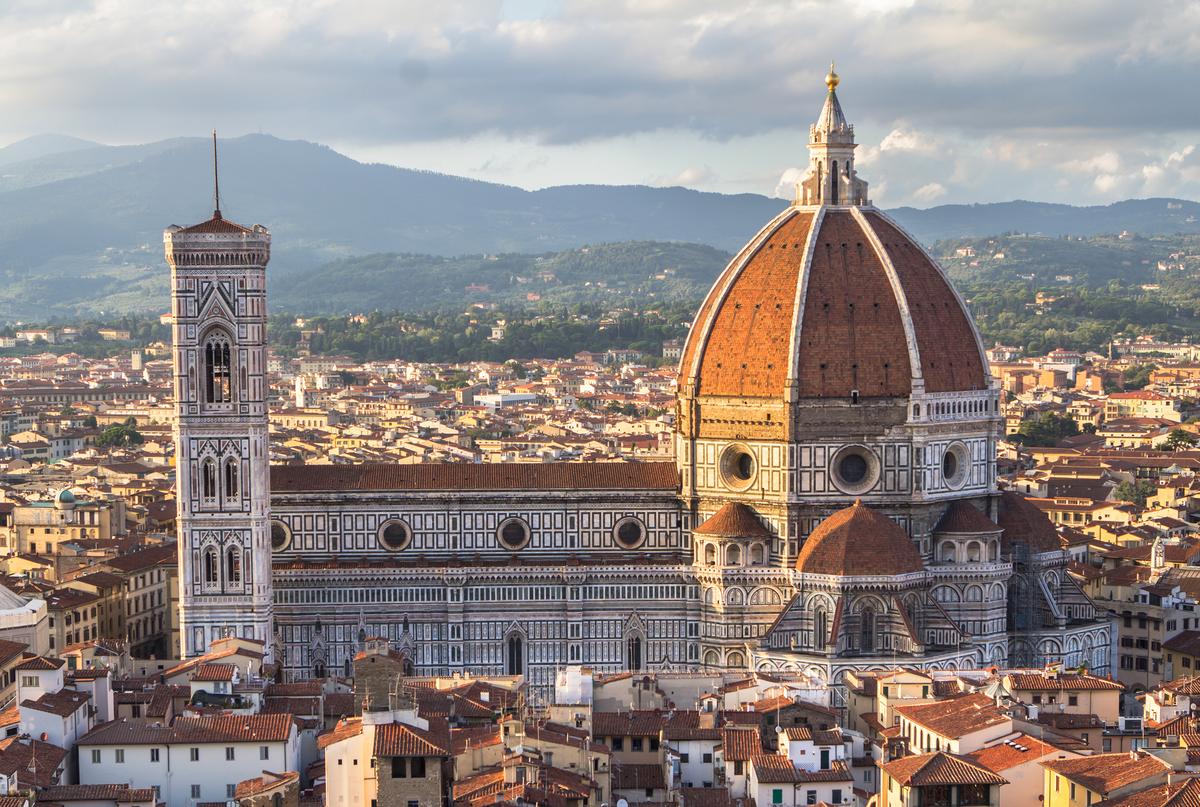
By the early 15th century, artists in Italy were studying perspective and proportion with unprecedented intensity. They treated painting as a science of vision. The architect Filippo Brunelleschi is credited with developing linear perspective. He is perhaps best known for designing the Duomo, the self-supporting dome of the Cathedral of Santa Maria del Fiore in Florence. The polymath Leon Battista Alberti then turned it into a teachable, mathematical technique for painters.
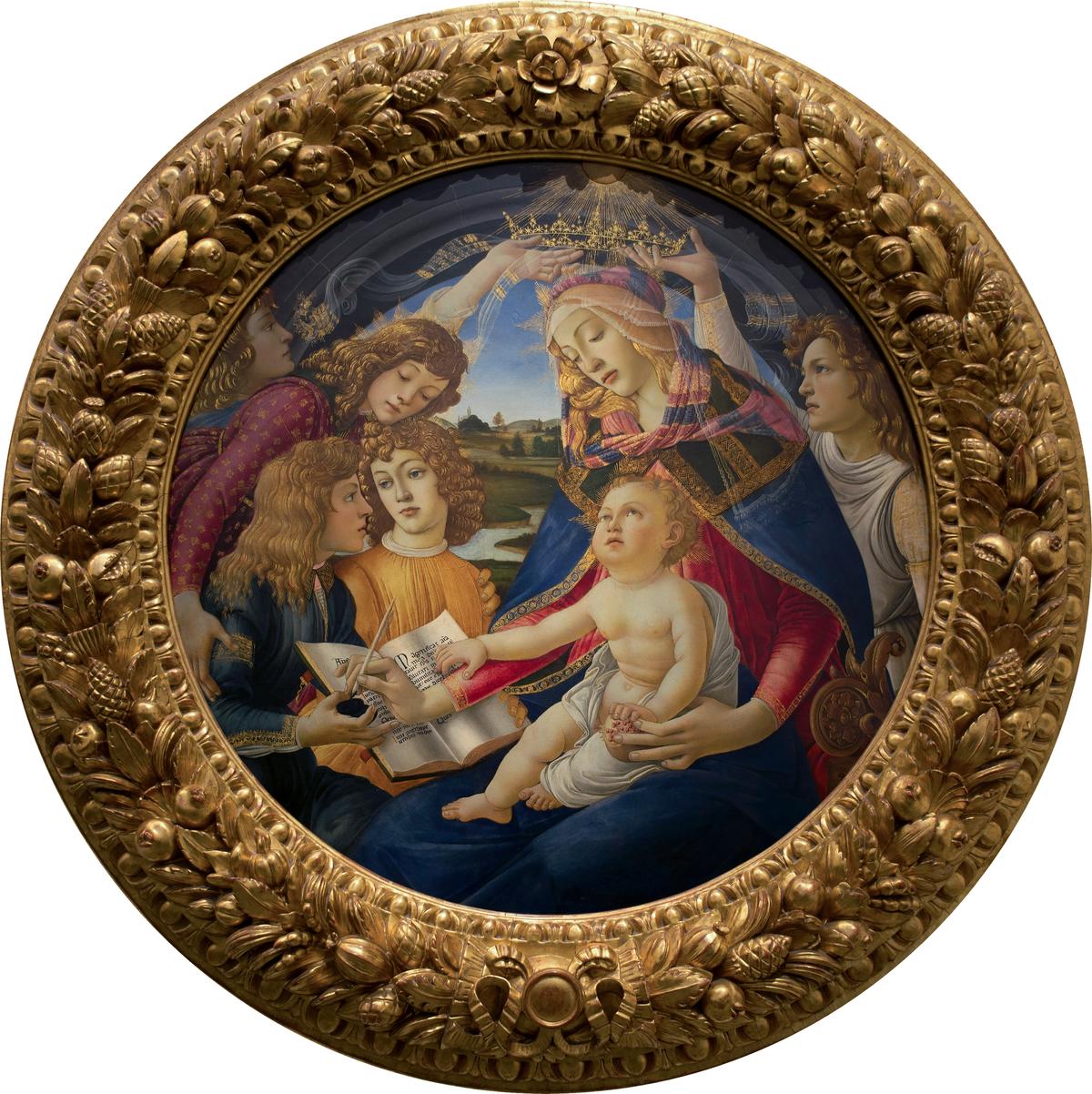
If Brunelleschi intellectualized geometry, Sandro Botticelli infused it with lyrical devotion. In “Madonna of the Magnificat,” painted in the 1480s, the composition unfolds within a tondo, a circular format popular in the Renaissance. In this work, the circle reinforced ideas of purity and eternity. The viewer is drawn into a closed yet tender universe, in which the Virgin and Child are encircled by angels, their bodies arranged in rhythmic arcs that echo the painting’s perimeter. Hands, halos, and draperies trace subtle curves that guide the eye.
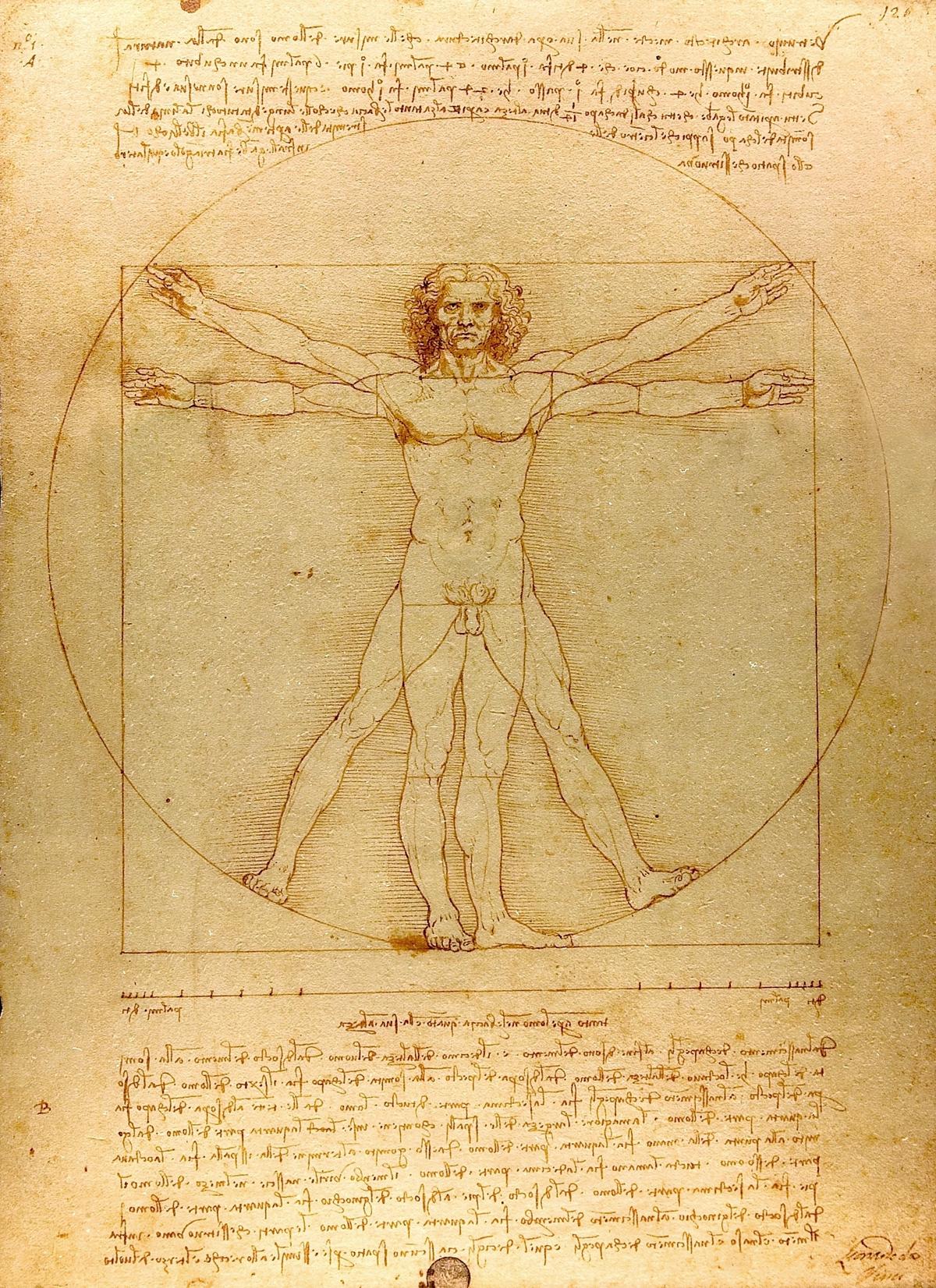
The circle’s capacity for devotion, however, was only one of its Renaissance possibilities. Leonardo da Vinci explored its geometric potential as a key to understanding the human form itself. His famous drawing, “Vitruvian Man,” made around 1490, inscribes the human body within both a circle and a square. Based on the Roman architect Vitruvius’s writings, the image proposes that ideal human proportions correspond to geometric perfection. The navel becomes the center point from which a circle radiates. Standing with arms outstretched, his limbs define a square. Renaissance humanists believed the body was a mirror of the universe. By studying its ideal proportions, Leonardo hoped to glimpse the rules governing all of creation.
The Circle Distorted
By the 16th century, artists were moving away from Renaissance naturalism and harmony, drawn instead to artifice, technical skill, and personal expression. This shift gave rise to what we now call Mannerism, a movement that stretched proportion and distorted perspective.
Girolamo Francesco Maria Mazzola, commonly known as Parmigianino, offered one of the most striking examples in his “Self-Portrait in a Convex Mirror,” painted around 1524. Gifted to Pope Clement VII in hopes of attaining a commission from the Vatican, young Parmigianino depicts himself as reflected in a barber’s convex mirror. The circular format dominates the composition. His hand, enlarged by optical distortion, looms in the foreground while the room curves and warps at the edges—the whole scene bending to the logic of the mirror. The painting demonstrates a sophisticated understanding of optics and what happens to space when it passes through a curved surface.
Illusion and the Edge of the Frame
By the 19th century, artists had grown increasingly fascinated with perception and illusion, spurred in part by scientific advances in optics and physiology. The circle, once a symbol of divine order, became a tool for playful experiments with reality. The Spanish painter Pere Borrell del Caso captured this shift in “Dos Niñas,” painted in 1880.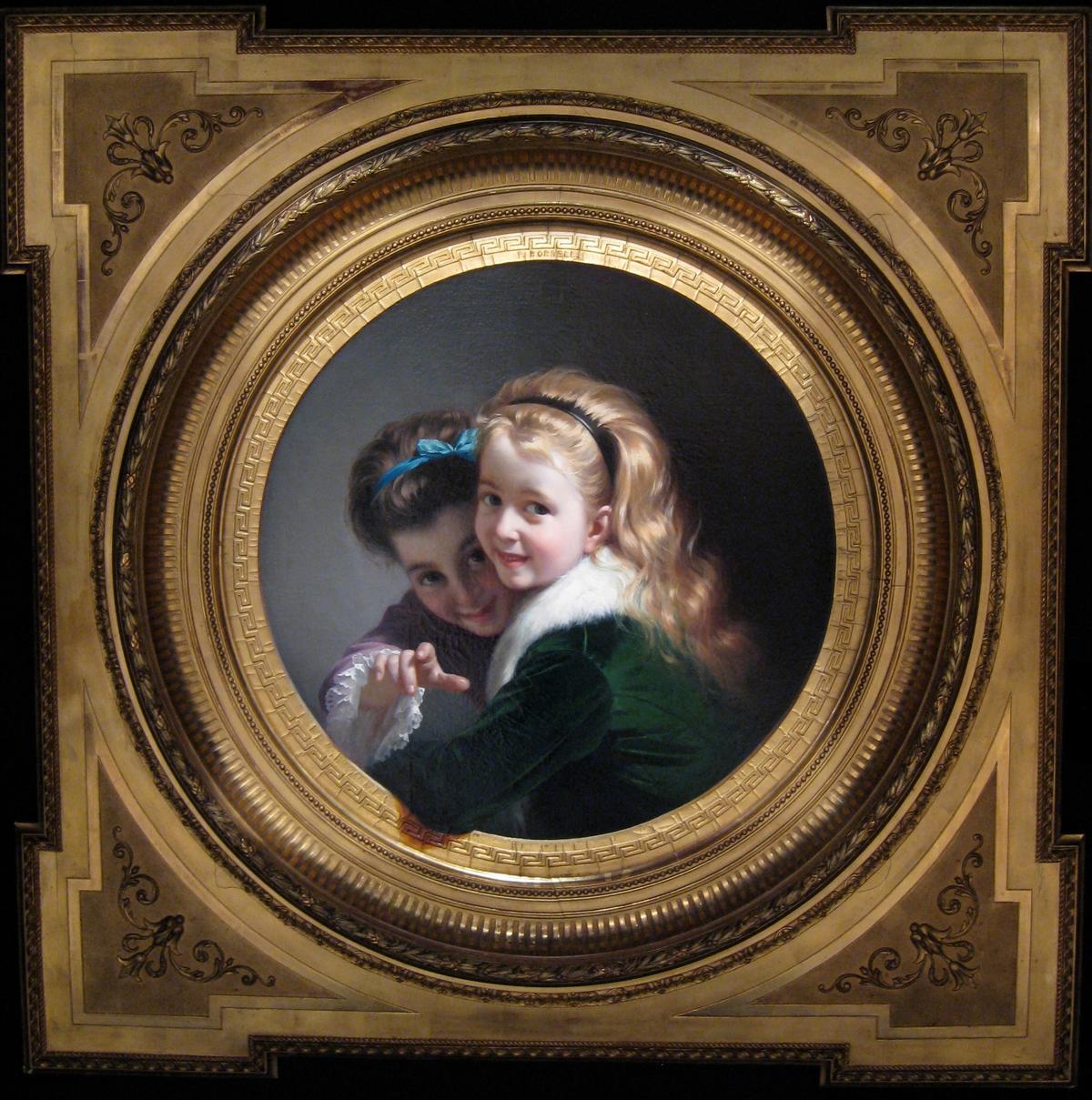
A masterwork of trompe l'oeil, a French term meaning “deceive the eye,” the painting uses a circular frame to stage a carefully constructed illusion: a young girl appears to reach outward across the boundary between painted and real space. Though the composition is not circular in format, it depends entirely on geometric precision. Every perspective line and proportional relationship is carefully calculated. The arc of the frame, the positioning of the figure’s limbs, and the shadows all pull together to make it feel as though the painted world is spilling into our own. The viewer is left aware of the painting as both object and window at once.
Across six centuries, the circle evolved from a theological symbol to a perceptual experiment, yet its intellectual function remained remarkably consistent. For premodern artists, geometry was not separate from aesthetics. Workshops were their laboratories, and perspective grids, proportional compasses, and mirrored surfaces were their tools of inquiry. Like pi itself, the circle is infinite, and no single era exhausted its possibilities. That very inexhaustibility made it the ideal symbol for artists who argued that the visible world could be measured, yet never fully circumscribed.