In the spring of 1783, two women walked into the Académie Royale de Peinture et de Sculpture on the same day and gained full membership on merit alone, something that had never happened before. One of them, Élisabeth Vigée Le Brun, would become a household name. The other deserves to be.
An Education in Precision and Light
Largely independent in her artistic development, Labille found instruction and encouragement within the vibrant community surrounding her childhood home on the rue Neuve des Petits-Champs. Lined with boutiques, offices, and bourgeois residences, the street benefited from its proximity to the Palais Royal, a renowned center for theater, music, and dance. This lively cultural environment exposed her to a wide network of artists and patrons.As a teenager, she began studying with her neighbor, the Swiss miniaturist François-Élie Vincent. Under his guidance, she developed the technical precision that would remain a hallmark of her work throughout her career. In 1769, she married Louis-Nicolas Guiard and became known as Adélaïde Labille-Guiard. Although the marriage eventually ended, she retained the name under which she had established her professional reputation.
In 1774, she began studying under Maurice-Quentin de La Tour, the celebrated pastelist whose command of that delicate medium made him one of the most sought-after artists in France. With La Tour, Labille-Guiard developed a feel for how tone builds gradually, and those lessons shaped her approach to oil painting when she eventually turned to it.
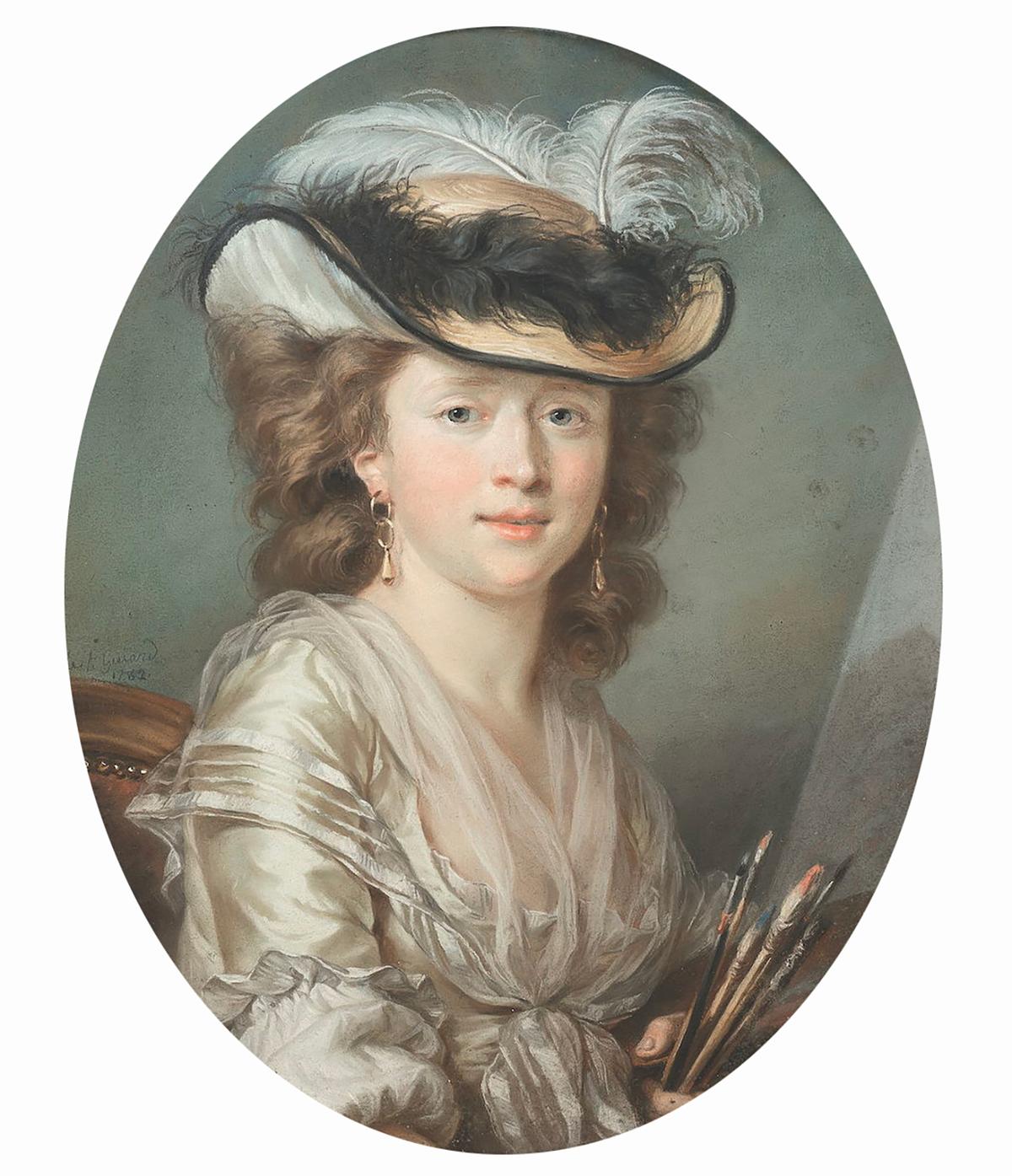
In the early 1780s, Labille-Guiard opened her own studio, attracting royal and aristocratic patrons for her pastels, oil paintings, and miniatures. She also took on nine women students, a decision that reflected both her dedication to her craft and her belief in advancing women within the artistic profession.

The Art of Seeing People

She continued teaching and exhibiting into the turn of the century. In 1785, she exhibited a self-portrait now considered one of the defining images of her career, depicting herself at her easel, brushes in hand, dressed in the fashionable silvery-grey and soft rose of her era. She maintains the structured elegance of French court fashion, while behind her, two of her students watch as she works. The compositional choice is deliberate, functioning as a statement of professional pride.
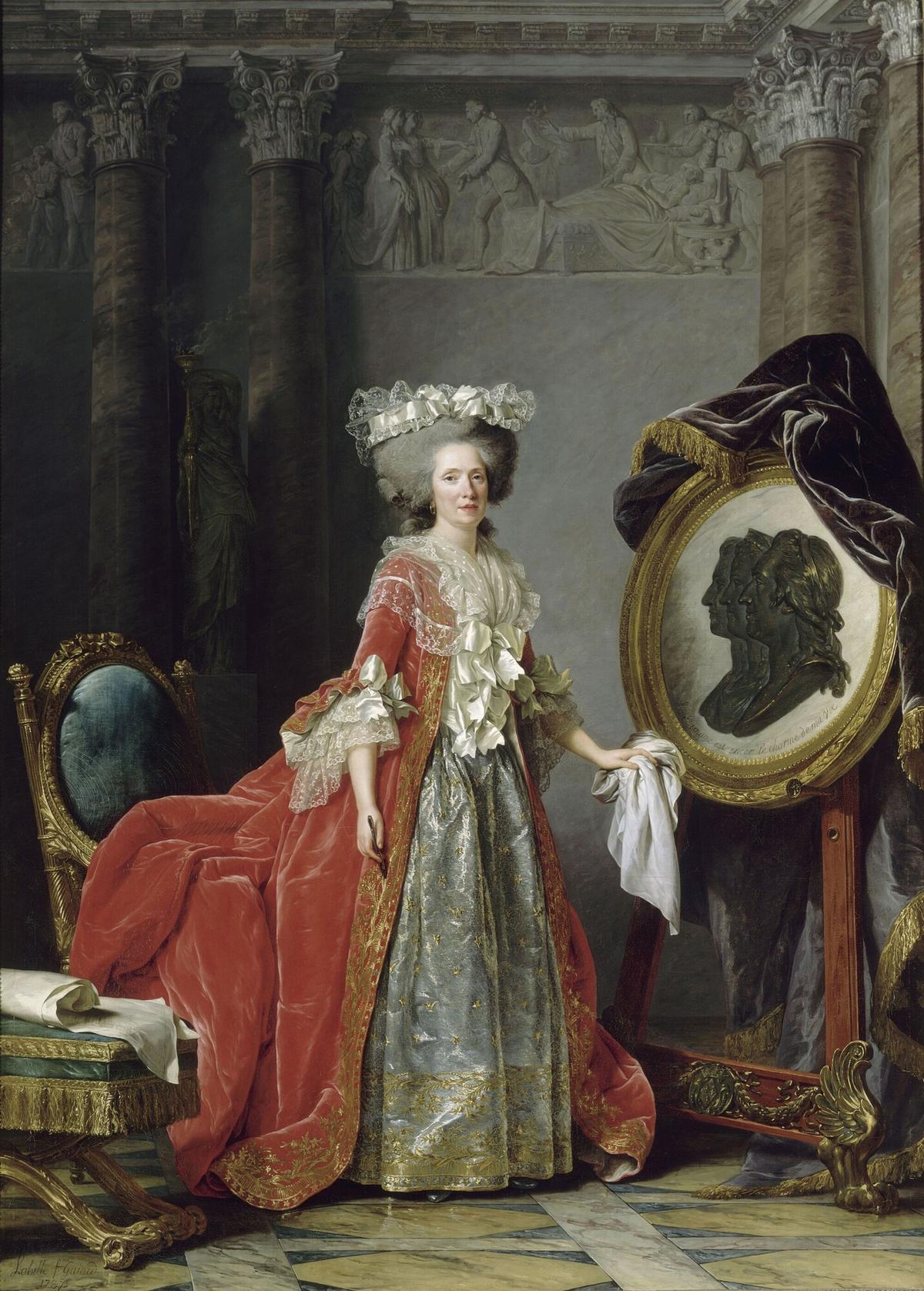
Labille-Guiard’s reputation grew steadily through the 1780s, and she enjoyed especially loyal patronage from Louis XV’s daughters, Mesdames Adélaïde and Victoire.
Madame Adélaïde’s large portrait, now in the Palace of Versailles, commands attention at nearly 107 inches high by 76 inches wide. She is depicted with a composed, alert presence, wearing a richly woven silk court gown layered with a red velvet mantle typical of mid-18th-century French aristocracy. The dress is structured with wide panniers and finished with fine embroidery, lace, and carefully arranged folds. The elaborately constructed clothing operates as a clear marker of rank and privilege in court culture.
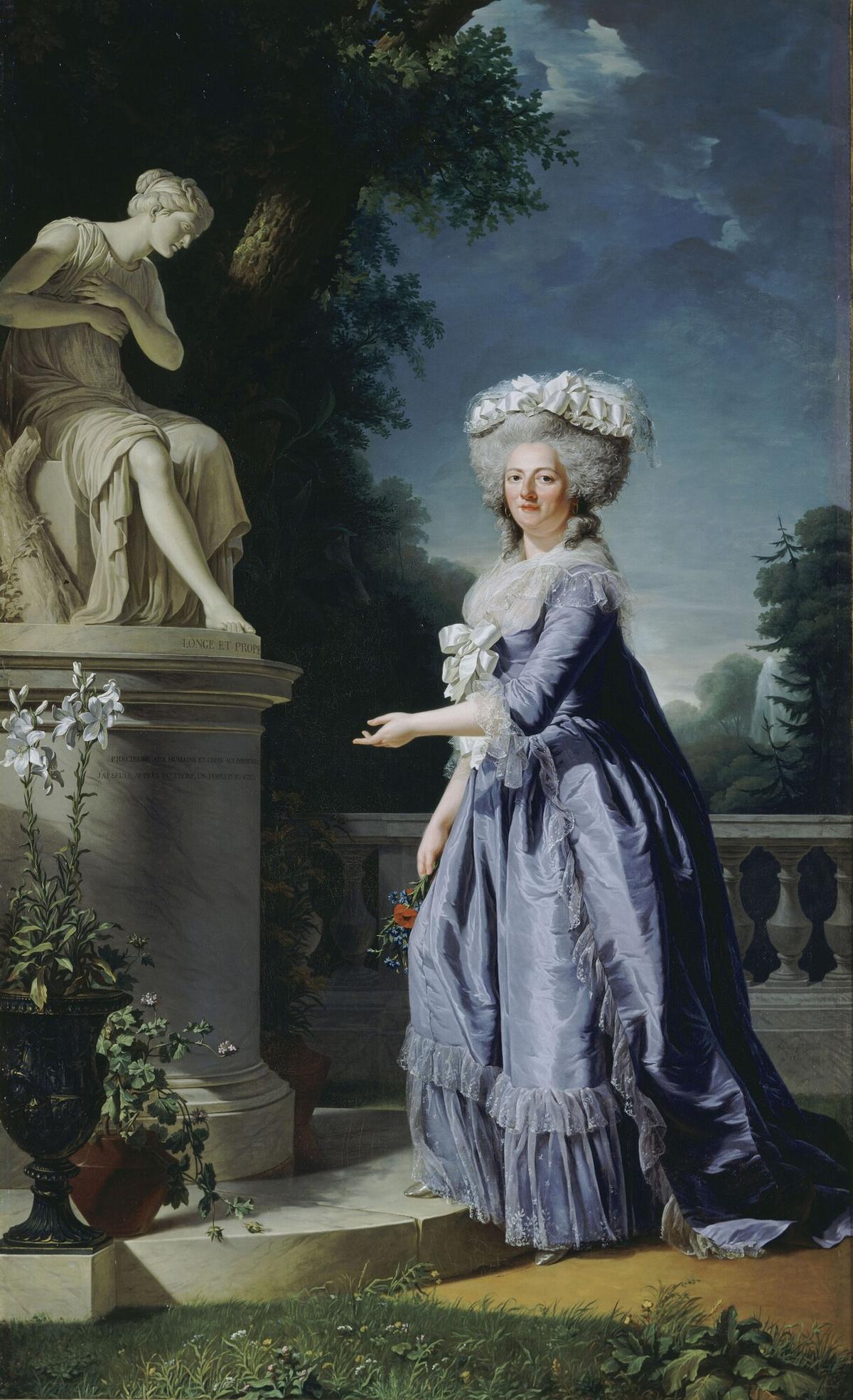
The tone of Madame Victoire’s portrait is softer, though it is similarly monumental at approximately 107 inches by 65 inches. She is shown outdoors in a pale blue dress, holding flowers. Behind her stands a classical statue, likely Venus, the Roman goddess of love and beauty. The portrait, like that of Madame Adélaïde, is now in the Palace of Versailles. Together, the portraits present the sisters as figures of intelligence, poise, and refinement. Labille-Guiard’s sitters were never reduced to emblems of status: They were people first and courtiers second.
Much of what distinguished her work from official portraiture of the period was the quality of presence she achieved. In the years leading up to the French Revolution, society was acutely focused on appearances. Clothing, wigs, posture, and even the surroundings were carefully deployed to signal social standing and lineage. Labille-Guiard knew this world from within, and her canvases convey its sumptuous textures with striking accuracy, from the heavy folds of silk and the softness of lace to the elaborate forms of powdered wigs.
Over the course of the decade, her oil technique matured considerably. She learned to construct form through successive layers of glaze, lending her paintings greater depth and dimensionality. The influence of her pastel training is legible throughout her work: a luminosity in the skin tones, a particular attentiveness to reflected light, that speaks of years spent working in a medium where translucency is the governing principle. Pastel remained an equally important and accomplished part of her practice.
Survival and Resilience
Then came the Revolution, and with it a complete transformation of the world she had spent her career inhabiting. Her aristocratic clientele vanished almost overnight. Unlike Vigée Le Brun, who emigrated and spent years painting in the courts of Europe, Labille-Guiard chose to remain in France. She navigated the new political reality with considerable skill and pragmatism. She destroyed several of her royal portraits before they could endanger her. She reoriented her practice toward the figures of the new order, producing a notable portrait of Maximilien de Robespierre and several other early-Republic politicians. She continued to teach, exhibit, and encourage her students to apply to the Academy.In 1800, she married François-André Vincent, who had guided her transition into oil painting two decades earlier. Vincent had climbed steadily through official positions in the intervening years, serving as master of drawings to Louis XVI in 1790, becoming a professor at the Académie royale in 1792, and joining the founding membership of the Académie des Beaux-Arts in 1795. In his later years, declining health caused him to paint less, though official recognition continued to find him.
Labille-Guiard died in 1803, yet her work still endures. Her mastery across media and her unflinching devotion to the individual render her portraits vital more than two centuries later, and secure her place among the finest portraitists of her age.