This copy is for your personal, non-commercial use only. Distribution and use of this material are governed by our Subscriber Agreement and by copyright law. For non-personal use or to order multiple copies, please contact The Epoch Times Reprints.
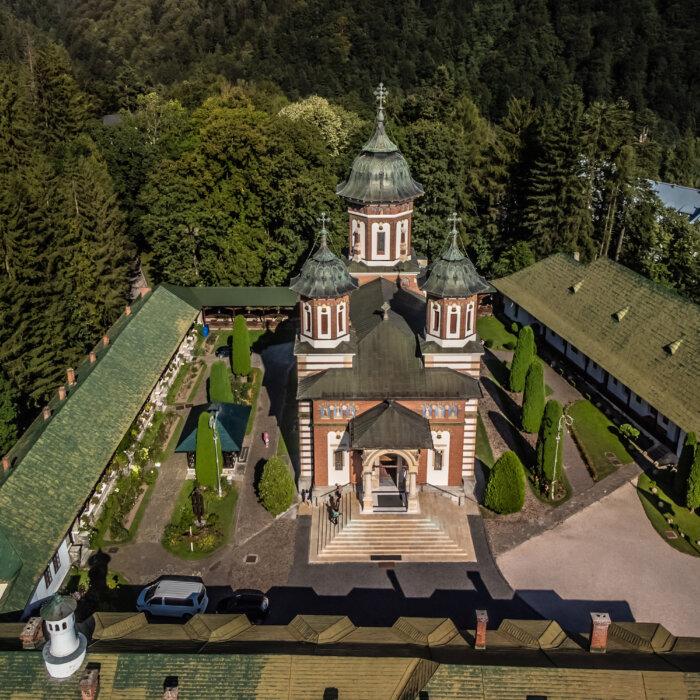
The cathedral’s facade is framed by two imposing bell towers. Decorative niches and a balustraded balcony offer moments of ornament, while three clocks on the right side display the time, day, and date, lending a note of practicality to the otherwise austere exterior. The restrained design reflects the architect’s military training as much as his architectural vision. Artush
/Shutterstock
Rising from the fortified streets of Valletta like a sentinel of stone, St. John’s Co-Cathedral commands attention as one of the Mediterranean’s most extraordinary religious monuments.
Dedicated to St. John the Baptist, the cathedral was commissioned in 1572 by Grand Master Jean de la Cassière, the 51st Grand Master of the Order of Malta and supreme leader of the Knights of St. John. Construction lasted from 1573 and 1578, and the church was completed by 1577, at which point it replaced St. Lawrence’s Church in Birgu as the principal ecclesiastical institution of the Order.
From its earliest years, the cathedral served not merely as a place of worship but as the ceremonial and spiritual headquarters of the Knights, hosting state rituals and commemorating generations of its most distinguished members. Over the following centuries, through phases of ambitious construction and decoration, the cathedral evolved into a monument of extraordinary artistic and historical complexity, drawing visitors and scholars from far beyond the island.
The cathedral was designed by the Maltese architect Girolamo Cassar, whose background as a military engineer shaped the building’s exterior. The symmetrical limestone facade is framed by two bell towers. Unadorned Doric columns support an open balcony from which Grand Masters once addressed the public below.
The austere exterior offers little indication of the richness within, where the Italian artist Mattia Preti transformed the interior with an ambitious baroque decorative program in the 1660s. In the nave, Preti covered the walls and vaulted ceiling with elaborate carved ornament and illusionistic paintings depicting scenes from the life of St.John the Baptist, creating an intensely theatrical space defined by dramatic contrasts of light and shadow.
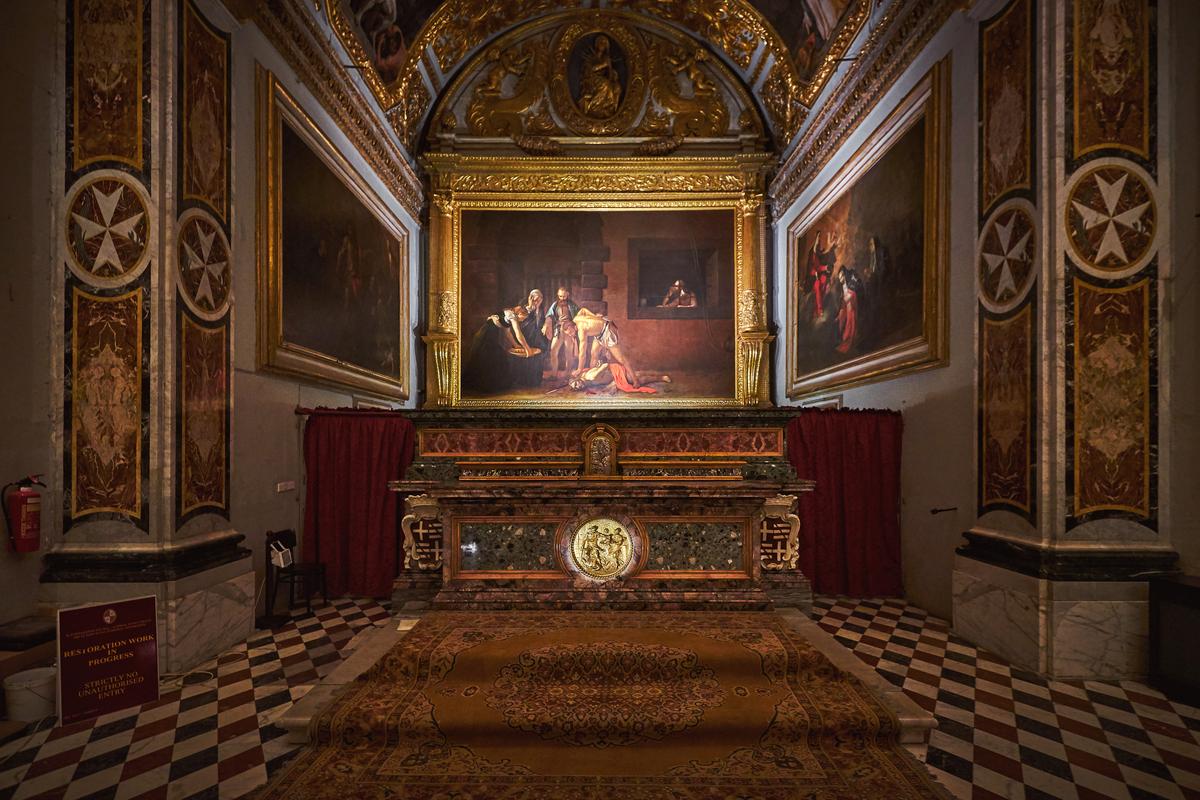
Notably, the decorative carving was worked directly into the Maltese limestone walls rather than applied as separate stucco elements, a technically demanding achievement that distinguishes the interior from comparable baroque churches elsewhere in Europe. The oratory, added between 1598 and 1604, houses Caravaggio’s monumental canvas “The Beheading of Saint John the Baptist,” the largest painting the artist ever produced and the only known work bearing his signature.
Eight side chapels within St. John’s Co-Cathedral were dedicated to the Langues (linguistic or national divisions) of the Order: France, Italy, Aragon (including Catalonia and Navarre), Provence, Auvergne, Castile (including Leon and Portugal), England (later Anglo-Bavarian), and Germany.
Following the French occupation of 1798, the cathedral gradually transitioned from the Order’s private, conventual church into a shared civic and religious institution, and in the 1820s, it was formally granted co-cathedral status alongside the bishop’s cathedral in Mdina. The cathedral museum also houses one of the largest and finest surviving collections of Flemish baroque tapestries, some woven from wool and pure silk.
St. John’s Co-Cathedral remains a testament to the ambition, piety, and patronage of the Knights of St. John, whose collective identity is inscribed into every surface of the building.
Preserved within the fortified city of Valletta, itself a UNESCO World Heritage Site, the cathedral remains a living monument, inspiring awe through the same devotion and ambition that shaped its creation more than four centuries ago.
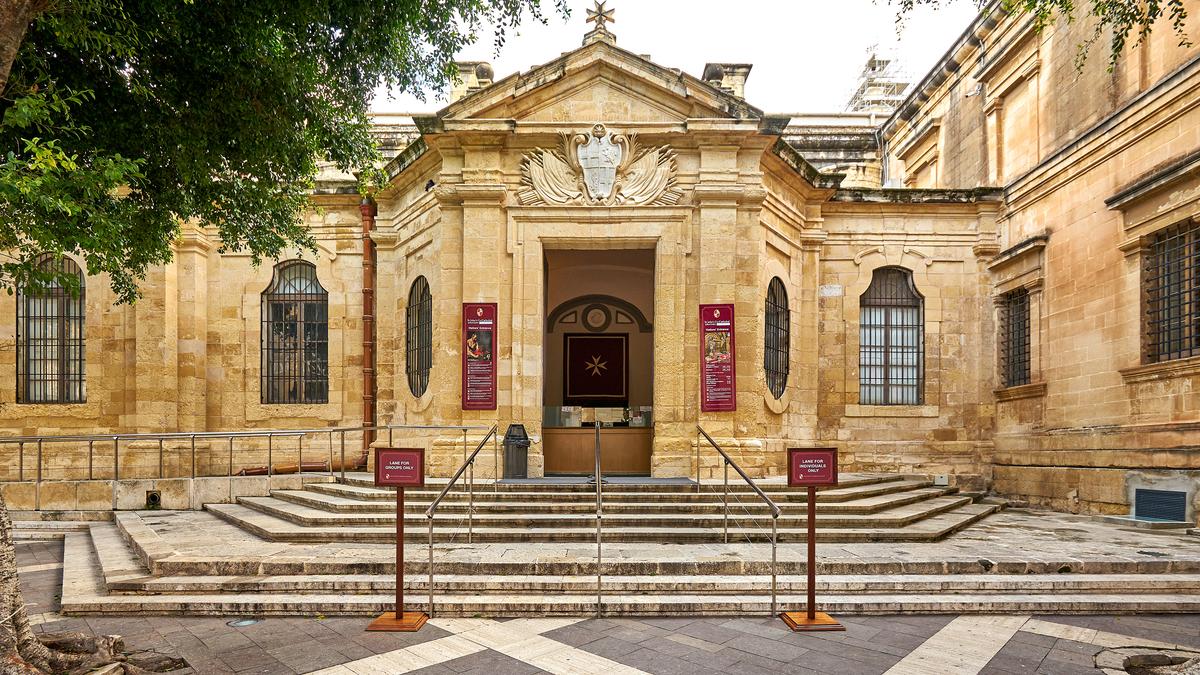
The main entrance of St. John’s Co-Cathedral is set within a Maltese limestone façade, approached by a short stairway and framed in smooth ashlar with restrained sculptural detail. It is surmounted by the heraldic escutcheon of the Order of St. John, marking its status as a conventual church. Vladimir Zhoga/Shutterstock
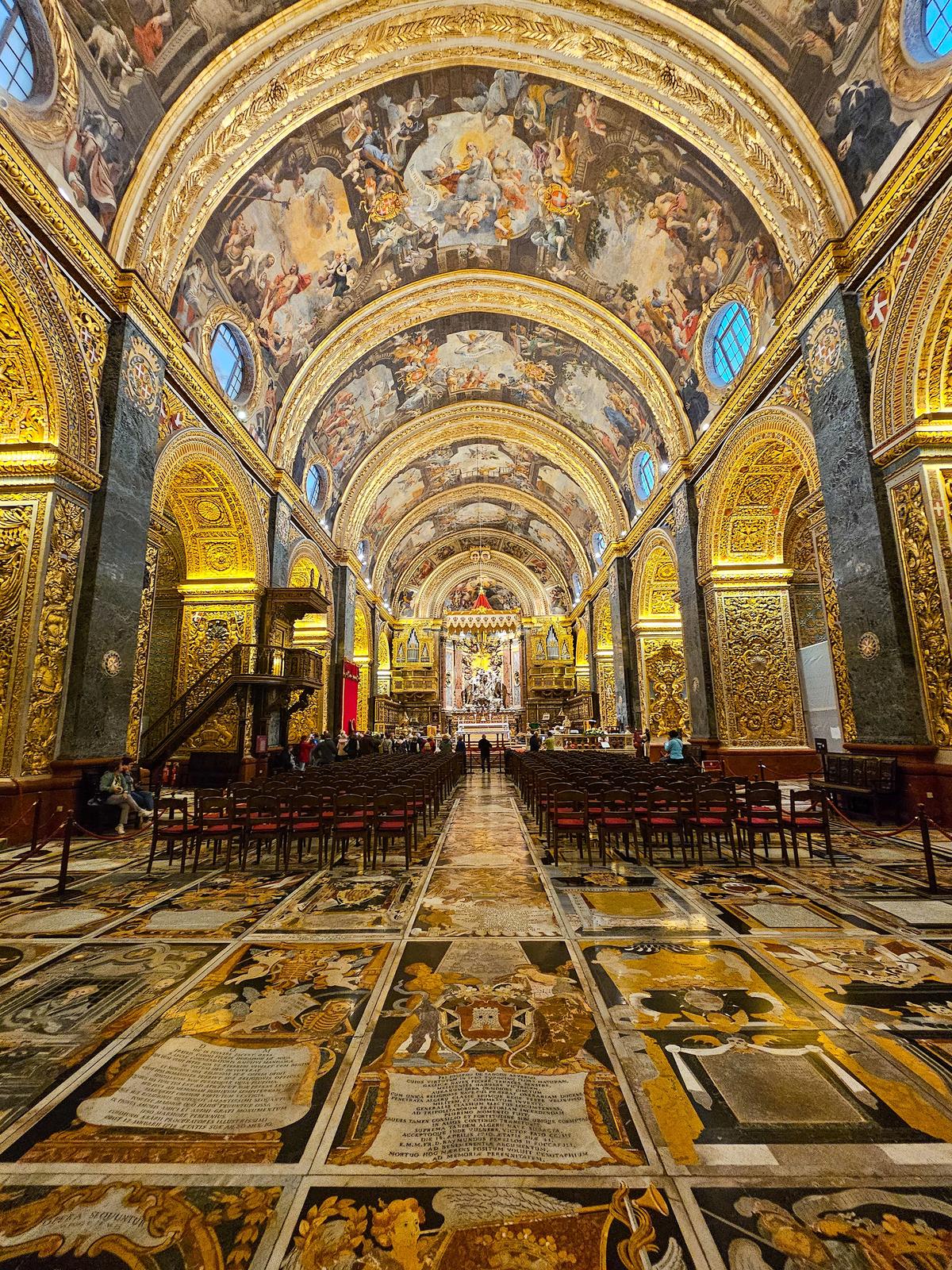
The nave was decorated by Mattia Preti, whose paintings of scenes from the life of John the Baptist adorn the vaulted ceiling. Equally remarkable is the floor, composed of nearly 400 inlaid polychrome marble ledger stones marking the graves of knights and officers. Their coats of arms and heraldic imagery combine to create one of Europe’s most elaborate and visually striking funerary floors. Sujin Krishnan/Shutterstock
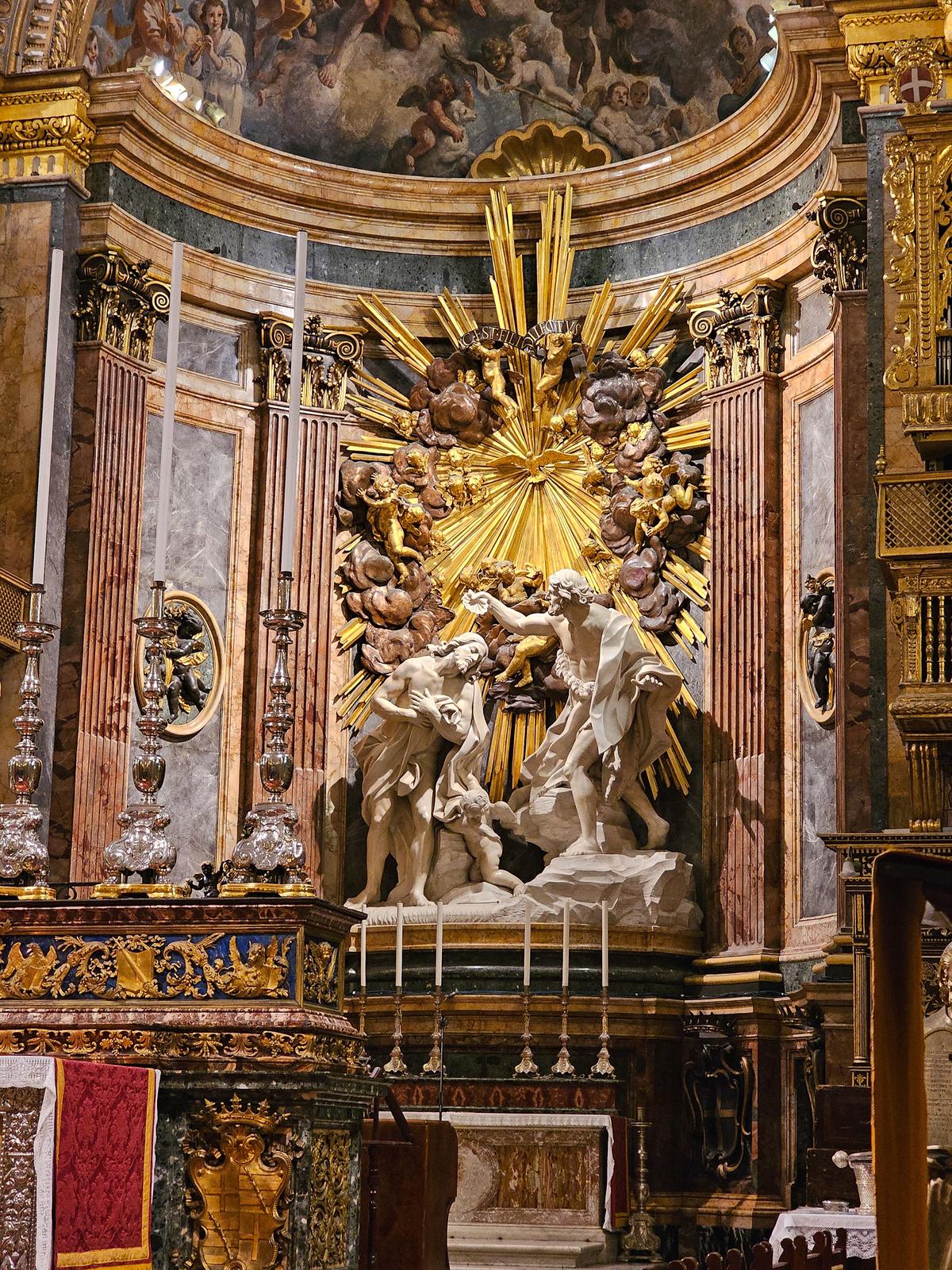
Installed in 1689, the high altar combines marble, gilded bronze inlay, semi-precious stones, and lapis lazuli to create a richly luminous focal point within the sanctuary. Beyond it, in the apse, stands Giuseppe Mazzuoli’s monumental Carrara marble sculptural group depicting the Baptism of Christ, one of the cathedral’s most impressive artistic achievements. Sujin Krishnan/Shutterstock
Completed in 1605, the Oratory served as a place of devotion and meditation for the Order’s novices and as a ceremonial setting for brotherhood gatherings, including the induction of new Knights. It houses Caravaggio’s "The Beheading of Saint John the Baptist." In the 1680s, Preti further enriched the space with elaborate gilt carving and a Venetian-style gilded soffit spanning the vault and apse arch. Vladimir Zhoga/Shutterstock
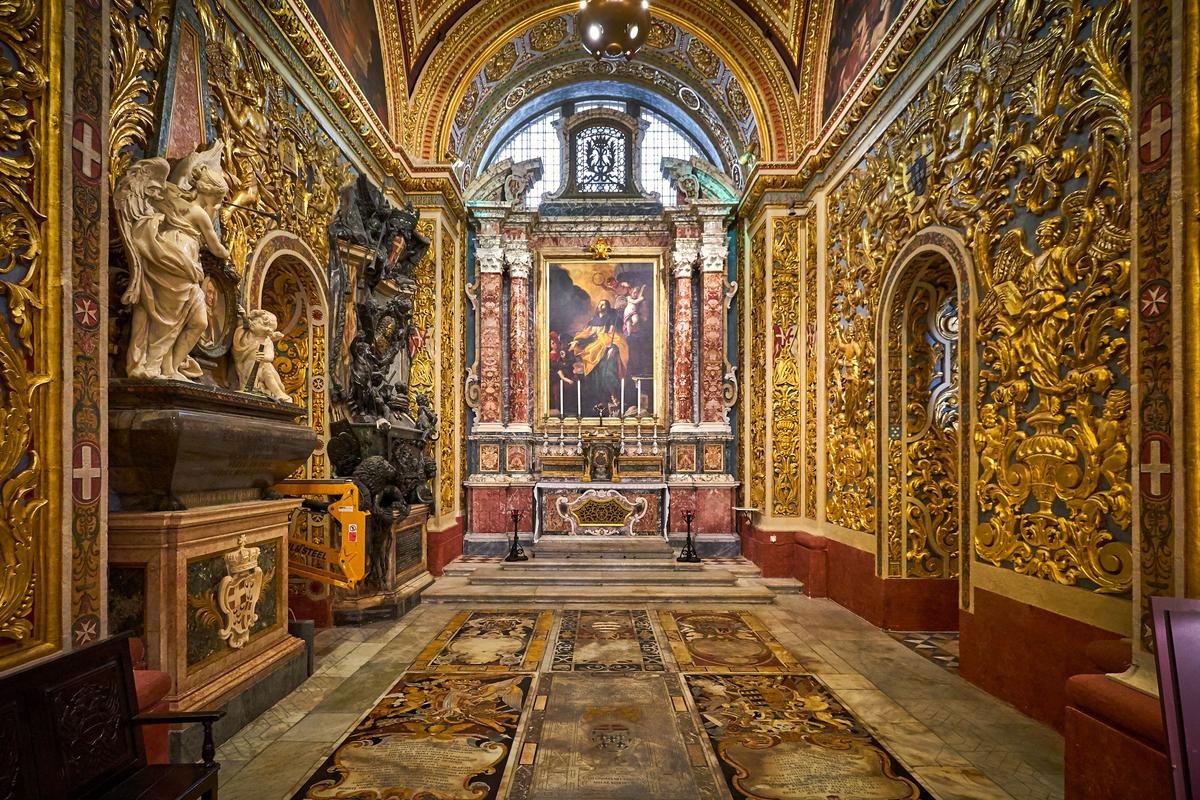
Dedicated to St. James the Apostle, the Chapel of the Langue of Castile, León, and Portugal is centered on Mattia Preti’s expressive altarpiece depicting the saint. Its walls are covered with intricate high-relief gilded carvings of scrolls, foliage, and floral motifs. The chapel also serves as the burial place of Grand Masters António Manoel de Vilhena and Manuel Pinto da Fonseca. Vladimir Zhoga/Shutterstock
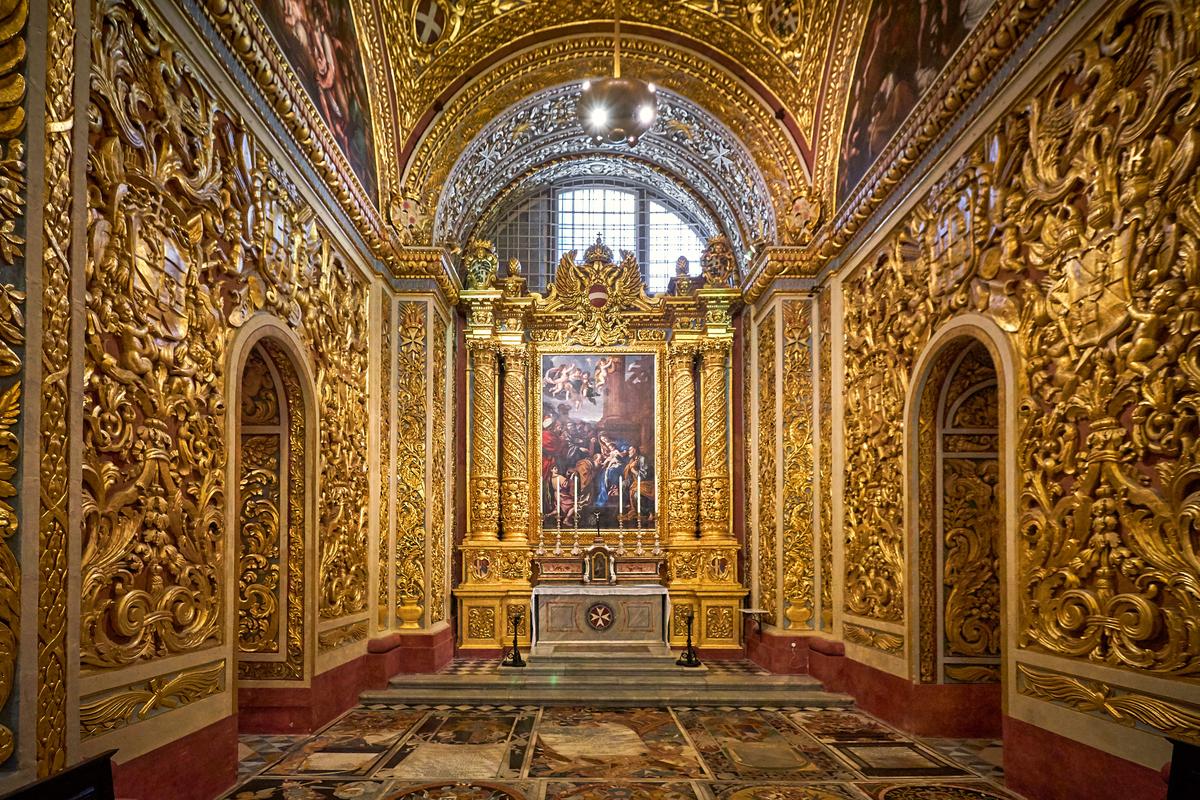
Dedicated to the Epiphany of Christ, the Chapel of the Langue of Germany is the only chapel in the cathedral without a Grand Master’s funerary monument. Its devotional focus is expressed in the central altarpiece, "The Adoration of the Magi," by the 17th-centyry Maltese artist Stefano Erardi, and in carved heraldic stonework featuring the double-headed eagle of the German Langue. Originally assigned to the English Langue, it passed to the Germans after the Reformation. Vladimir Zhoga/Shutterstock
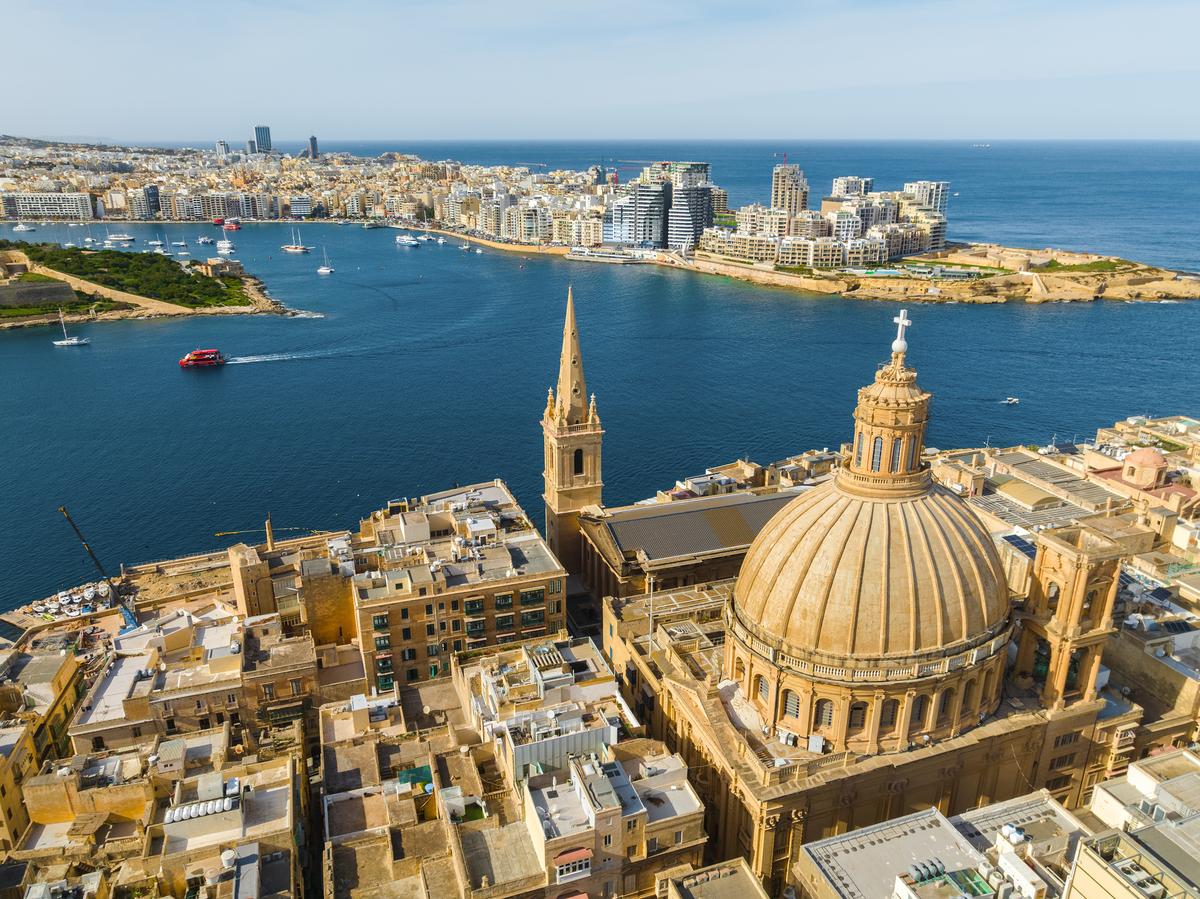
St. John’s Co-Cathedral occupies a singular place in Maltese cultural and political history as the former conventual church of the Knights of St. John. Widely regarded as one of Europe’s most complete baroque interiors, it remains a national symbol of Maltese identity, uniting military history, religious devotion, and baroque artistic achievement within a continuously active sacred site. Karina Movsesyan/Shutterstock
What arts and culture topics would you like us to cover? Please email ideas or feedback to [email protected].
Sarah Isak-Goode is a writer and art historian rooted in the Pacific Northwest. Her name—pronounced EYE-zik-good and meaning "good laugh"—hints at the warmth she brings to everything she does. Equal parts scholar and storyteller, Sarah brings the past to life through a distinctly human lens, exploring what connects us across the centuries. Away from her desk, she feeds her curiosity through traveling, painting, reading, and hiking with her dog, Thor.