Frederic Chopin (1810–1849) composed almost exclusively for the piano. Every work written by this Polish-born son of a French father and Polish mother featured the piano in some way. It was presented most often as a solo instrument but also as an accompaniment for cello and voice. Chopin assisted, more than any other single composer apart from Beethoven, in the piano’s transformation from parlor companion to powerful venue for romantic expression. Nowhere is this more evident than in his four ballades for piano.
Exile and the Parisian Years
Chopin was raised in a cultured family outside Warsaw, showed great early talent, and attended the Warsaw Conservatory in his teens. Following Poland’s failed rebellion in 1830, when imperial Russia reasserted its rule, Chopin, whose sympathies lay with the rebels, fled to Paris, never to return to his beloved homeland. The composer’s brief adulthood there was spent primarily teaching rich students.Chopin’s output before 1835 was divided between large-scale works in traditional, classical forms—like sonatas and rondos—and smaller genre pieces, such as mazurkas and waltzes, where he flexed his melodic instincts. Starting in 1835 with the first of his four “ballades,” Chopin combined the structural complexity of those larger classical forms with the expressive, free gestures of his shorter works. In these extended musical essays, melodic freedom is wedded to formal integrity.
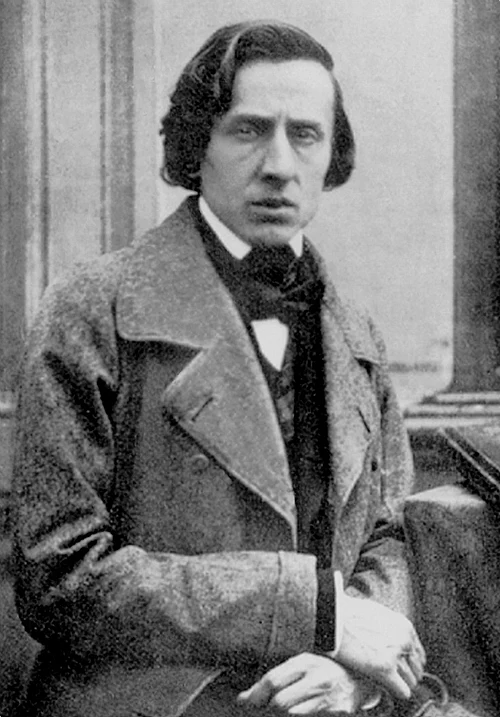
Chopin's four piano ballades are seen as masterpieces of the Romantic era. Many think they were inspired by the poetry of Adam Mickiewicz, who dedicated his life to the struggle for Polish independence. Public Domain
James Huneker’s flagship Chopin biography reports that Chopin, upon presenting fellow composer Robert Schumann with a copy of the first ballade in G minor, confessed he had been enticed to create the ballades by the poetry of fellow Polish patriot Adam Mickiewicz.
Mickiewicz’s poems were dramatic narratives aimed against Russian occupation. As solo piano works, Chopin’s ballades lack words, yet in them one hears stories of struggle and courage that reflect Mickiewicz’s poems. Schumann’s famous remark about Chopin’s music seems especially apt as regards the ballades: “The works of Chopin are cannons concealed amidst flowers.”
The very name attached to all four scores—ballade—sends a distinct signal that here are stories told in music. Chopin was the first composer to use that word to label an instrumental work. Before that, “ballade” referred to a Renaissance vocal composition.
In starkest outline, sonata form presents contrasting musical ideas that are developed and transformed. From the form’s beginnings onward, this transformation was a synthesis of the previous elements. Scholar Jim Samson notes that in the ballades, Chopin repurposes sonata form to result in “apotheosis rather than synthesis.” Drama has replaced dialogue.

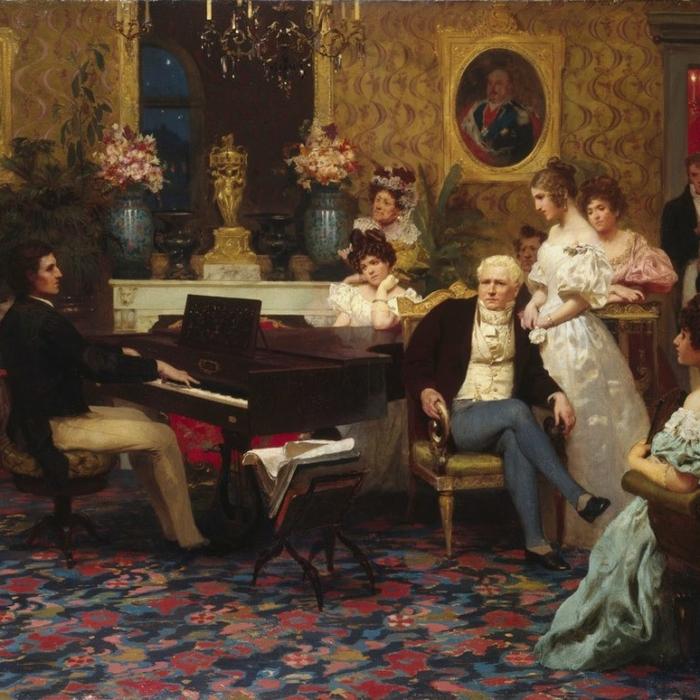

Chopin’s piano ballades combined classical forms with expressive, Romantic-era styles. Public Domain
Inside the Scores: Four Paths of Musical Drama
Here is the great Sviatoslav Richter playing all four ballades: (Listen)Ballade No. 1 in G Minor, Op. 23 (1835—36) is marked by extremes of tempo, dynamics, and texture. After a brief, slow introduction, the first subject is introduced (0:33), a searching melody marked moderato. This grows into a waltz-like transition (1:28) that swirls toward hints of virtuoso fireworks until a second, distinctive subject is introduced, pianissimo (2:08), becoming faster and faster until it bursts into a heroic, hymn-like third and final subject (3:02). Closing materials bring the exposition to an end but without a full stop.
At 4:10, the development starts with a memory of the first subject. Shortly, the heroic third subject reinserts itself, now fortissimo and in strident octaves (4:41). This sets off an extended virtuoso climax that results in a sardonic paraphrase of the second subject (5:28).
We hear the third subject one last time, quietly at first, then rising in waves. At 6:41 begins a foreshortened recapitulation. The first subject is dutifully repeated, then succeeded by a coda of fiery virtuosic scales and octaves, bringing the first ballade to a shockingly dramatic conclusion.
Each remaining ballade is distinctly different from the first and from one another. Here’s a general guide:
Ballade No. 2, Op. 38 (1839), begins in a barcarolle rhythm that gently rocks a lyrical theme in F major. But the key of A minor is buried deep within the theme, and the working-out of the score is all about bringing round the theme’s restatement in that key, at the very end.
Ballade No. 3 in A-flat, Op. 47 (1841) is nearly monothematic, its central, songlike melody interlaced with countermelodies throughout.
Ballade No. 4 in F minor, Op. 52 (1842–43), illustrates the harmonic scheme of delaying the dominant chord—the chord that defines the key—until the moment of climax. In this case, the dominant is voiced in a hushed pianissimo right before the steely blast of octaves and chromatic runs that ring down the curtain.
What arts and culture topics would you like us to cover? Please email ideas or feedback to [email protected]