This copy is for your personal, non-commercial use only. Distribution and use of this material are governed by our Subscriber Agreement and by copyright law. For non-personal use or to order multiple copies, please contact The Epoch Times Reprints.
Belmond Hotel Monasterio: A Peruvian Andes Adventure
In this installment of ‘Larger Than Life: Architecture Through the Ages,’ we visit a 16th-century former seminary turned resort in an ancient Incan city.
Belmond Hotel Monasterio’s stone-block construction is married with whitewashed and smoothly finished façades. Among the stone walkways of the courtyard are flower beds and potted plants. From the courtyard is a view of the surrounding two stories of arcades presenting countless classical arches seamlessly situated atop stone ionic columns. Eleni Mavrandoni/Shutterstock
Many centuries-old structures are preserved for posterity as museums. Belmond Hotel Monasterio in Cusco, Peru, is one of those special historic sites that showcases interior elegance as well as exterior beauty. The public can also experience its distinct Spanish colonial-style architecture and elaborate artwork by staying in rooms once occupied by Catholic priests.
Saint Anthony the Abbot Seminary was established in the late 1500s and is considered one of the oldest in the Americas. Shortly after its founding, a vast seminary complex was constructed with an expansive courtyard, which currently boasts a 300-year-old cedar tree. The site’s pièce de résistance is a Baroque-style, elaborately apportioned chapel.
By the 1960s, a newer seminary was constructed in Cusco. Then, the 16th-century site was renovated into a hotel with 117 rooms and suites by Peruvian entrepreneur Lorenzo Sousa Debarbieri. Inaugurated in 1995, the structure was named Monasterio, meaning monastery—a Catholic place of residence, work, and worship. The Orient-Express Hotels, Ltd., assumed the hotel management in 1999, and the company added Belmond to its name in 2014.
Designated as a historical landmark by Peru’s National Institute of Culture, the site now offers guests a chance to meander the arched cloister arcades surrounding what was once a monastic garden. Guests can appreciate colorful 18th-century religious oil paintings that adorn the walls or saturate themselves in the extreme ornamentation of the San Antonio de Abad Chapel.
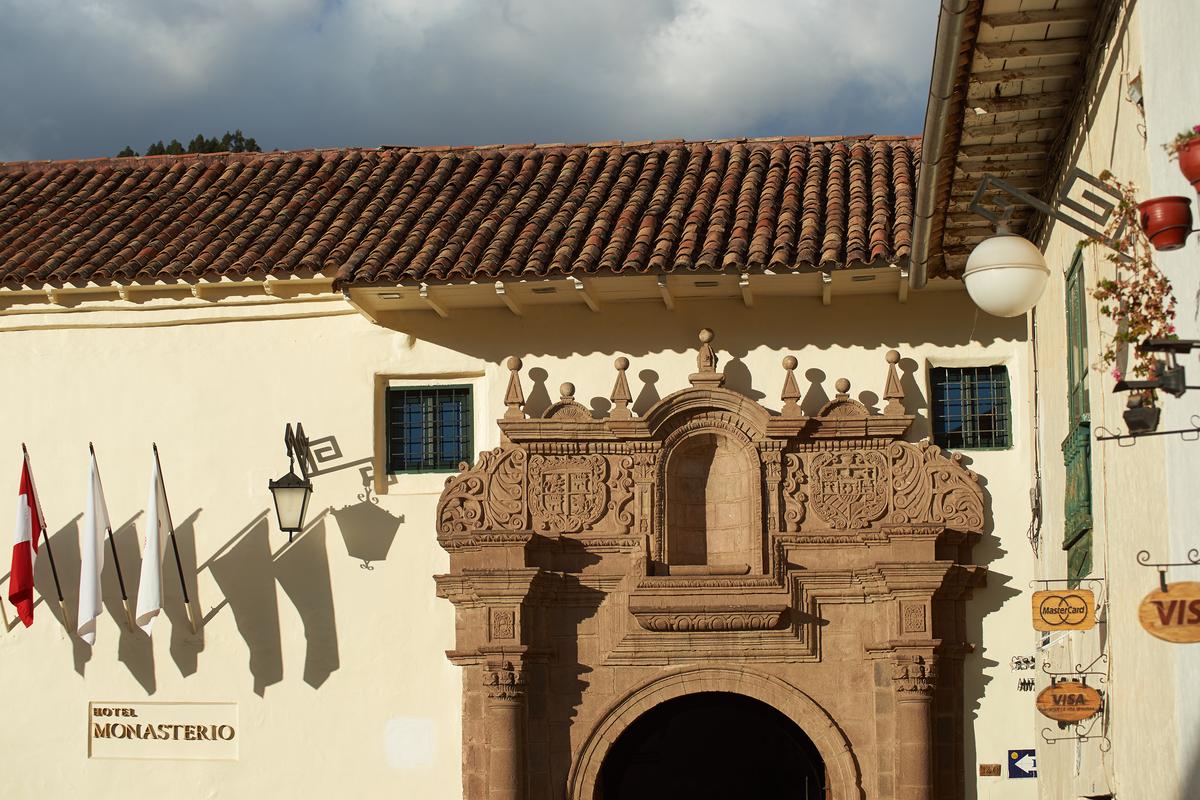
The front entryway’s whitewashed facade is enhanced by a columned and arched stone entryway bearing a Spanish arms escutcheon, which is a carved, embellished shield or emblem with a coat of arms. Acanthus leaf designs flank the escutcheon, and decorative finials dress the door’s pediment. Jeremy Richards/Shutterstock
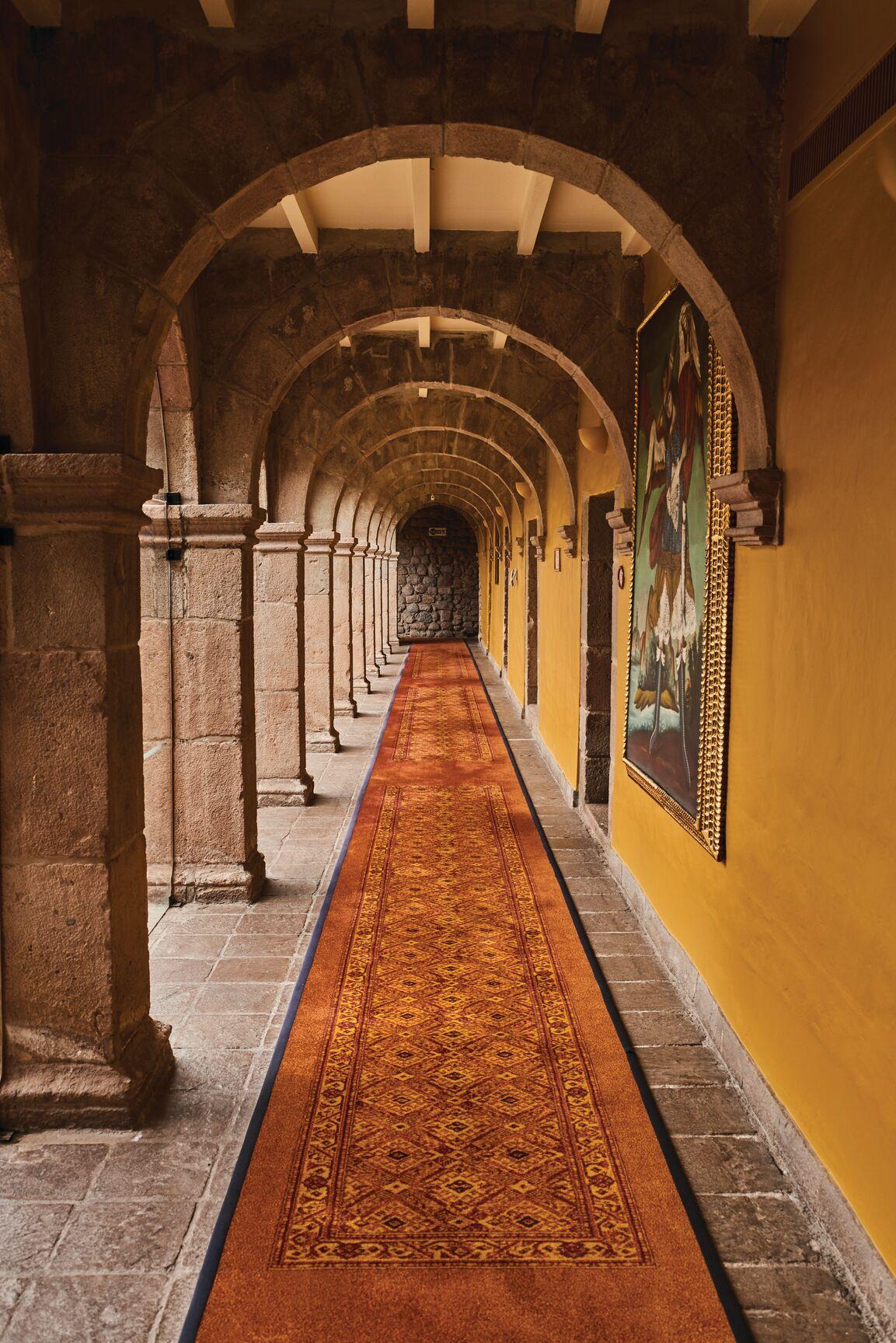
The elongated, arched arcades, also referred to in a monastery or seminary as cloisters, symmetrically frame the rectangular courtyard. These covered stone pathways, supported by stone-block columns, feature gold-painted walls hung with 18th-century colonial Cusquenian (Cusco school) oil paintings. Javier Falcón/Belmond
Exposed brick flooring and stone walls provide contrasting texture to the dominant wood ceiling beams and furnishings in one of the hotel’s bedroom suites. Arched windows allow light to stream into the space. The carved bed sports the ogee three-centered arch often conveyed in Gothic architectural design. Fran Parente/Belmond
The 17th-century baroque style, which features complex forms and bold ornamentation, is most prevalent inside the San Antonio de Abad Chapel. Intricately crafted gold ornamentation frames doorways, frescoes, and paintings, and carved ceiling corbels are festooned with decorative stenciling. Francisco Parente/Belmond
Stone arches contrast with smooth, whitewashed walls to greet diners at one of the two restaurants on the premises of the hotel. Ornately carved and gilded frames and furnishings are this lobby’s opulence, and a simple metal lighting fixture provides a medieval touch. Francisco Parente/Belmond
The precision of the myriad columns and arches, as well as the amount of stone block that had to be carved to form the building’s exterior, is striking. Covering the roof of the second-floor arcades are terra-cotta tiles, each one made by filling a mold with wet clay that is then baked. Fran Parente/Belmond
What arts and culture topics would you like us to cover? Please email ideas or feedback to [email protected]
A 30-plus-year writer-journalist, Deena C. Bouknight works from her Western North Carolina mountain cottage and has contributed articles on food culture, travel, people, and more to local, regional, national, and international publications. She has written three novels, including the only historical fiction about the East Coast’s worst earthquake. Her website is DeenaBouknightWriting.com