Albert Bierstadt’s Westward Dreams on Canvas

Bierstadt translated the lived realities of the Oregon Trail into a narrative of hope and national expansion.
Albert Bierstadt’s Westward Dreams on Canvas
"Emigrants Crossing the Plains," 1867, by Albert Bierstadt. National Cowboy & Western Heritage Museum, Oklahoma City. Public Domain
|Updated:
0:00

In 1867, at the height of America’s westward expansion, Albert Bierstadt completed one of his most ambitious canvases, “Emigrants Crossing the Plains.” Measuring approximately 60 by 96 inches, the sweeping panoramic exemplifies why landscape paintings were popular in the 19th century. Since 1972, the work has been on view at the National Cowboy & Western Heritage Museum in Oklahoma City, Oklahoma, where it remains among the institution’s most popular paintings.

More than a picturesque frontier scene, “Emigrants Crossing the Plains” functions as a visual argument for the idea of Manifest Destiny. The painting reflects the American belief that claiming and cultivating the continent through westward expansion was both a right and a responsibility. Through dramatic light and idealized scenery, Bierstadt translated the lived realities of the Oregon Trail into a mythic narrative of hope, endurance, and national expansion.

Early Life and Western Expeditions

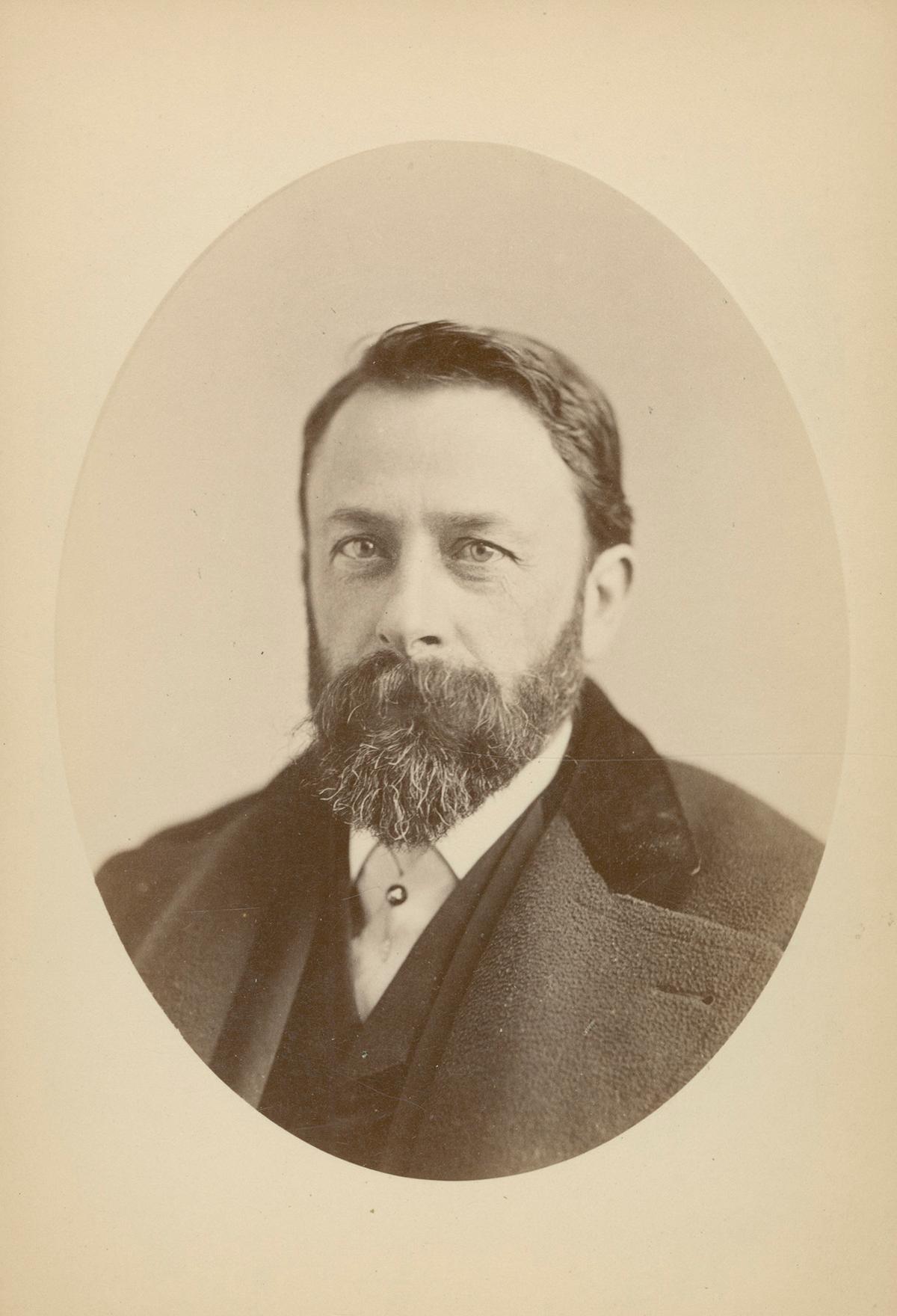
“Albert Bierstadt” by Napoleon Sarony, circa 1870. Albumen print. National Gallery of Art Library,<br/>Washington. (Public Domain)
“Albert Bierstadt” by Napoleon Sarony, circa 1870. Albumen print. National Gallery of Art Library,
Washington.
Public Domain

Bierstadt was born in 1830 in Solingen, Prussia (current Germany), and immigrated with his family to New Bedford, Massachusetts, as a toddler. Despite modest financial means and initial family hesitation about his career path, he showed early artistic promise. In his early 20s, he returned to Germany in 1853 and spent several years studying painting in Düsseldorf. During his years abroad, Bierstadt often visited the mountains, sketching landscapes that would later inspire his comparisons between the European Alps and the Rocky Mountains of North America.

After returning to the United States, Bierstadt exhibited at the 1858 National Academy of Design in New York, gaining critical attention and commercial success. However, it was his journey the following year that proved transformative for his career.

In 1859, Bierstadt set out on the first of several expeditions to the American West. His first trip took him along the Oregon Trail through Nebraska and Wyoming Territory, accompanying Col. Frederick William Lander on a survey expedition.

At its peak between the 1840s and 1860s, the roughly 2,000-mile trail was the principal thoroughfare for thousands of emigrants seeking opportunity in the Pacific Northwest. The route wound through varied and often perilous terrain, crossing lands long inhabited by Native American nations. Captivated by the scenery on this expedition, Bierstadt soon slipped away to travel on his own. During this period, he produced a wealth of sketches, paintings, and photographs, absorbed in the light and scale of the wilderness. These firsthand encounters supplied the raw material for the monumental studio canvases that would come to define his work.

Romantic Vision and the Oregon Trail

In 1863, Bierstadt embarked on a second western trip along the Oregon Trail, this time with writer Fitz Hugh Ludlow. Near Fort Kearney, Nebraska, they encountered a procession of 50 wagons—German emigrants pushing west, their cattle herd trailing behind. The scene inspired “Emigrants Crossing the Plains” and was among the first of Bierstadt’s works to emerge from this journey.
Rooted in Romanticism, the work embraces emotion, awe, and nature’s raw power—dwarfing human presence to suggest both insignificance and spiritual elevation. Bierstadt’s composition emphasizes the scale of the land while situating the settlers within it, their small figures reinforcing the immensity of the scene. Each compositional element guides the eye toward the horizon, underscoring the forward movement of the emigrants’ journey.
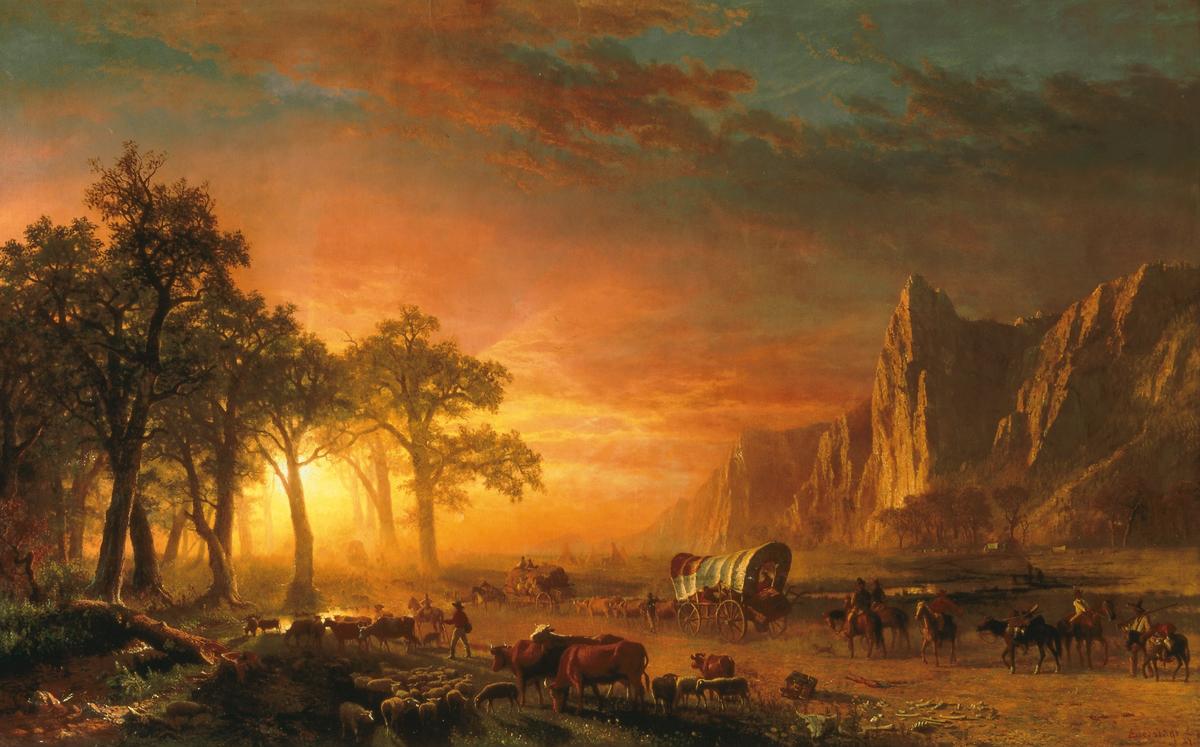
"Emigrants Crossing the Plains," 1867, by Albert Bierstadt. Oil on canvas; 60 inches by 96 inches. National Cowboy & Western Heritage Museum, Oklahoma City. (Public Domain)
"Emigrants Crossing the Plains," 1867, by Albert Bierstadt. Oil on canvas; 60 inches by 96 inches. National Cowboy & Western Heritage Museum, Oklahoma City. Public Domain
The painting’s color palette intensifies its emotional effect, with inky blues and purples giving way to warm golds and rosy pinks. A glowing sunset washes over the sky, burnishing the clouds and prairie in rich, honeyed tones. The illumination transforms what might have been a scene of hardship into one of promise. “Emigrants Crossing the Plains” omits the harsh realities of disease, famine, and conflict, instead presenting a romanticized vision of the American West. Such works resonated with an audience already captivated by stories of frontier adventure, collective determination, and divine providence.

Cultural Reflection and Interpretation

Viewed in the 21st century at the National Cowboy & Western Heritage Museum, “Emigrants Crossing the Plains” invites layered interpretation. On one level, it remains a masterwork of 19th-century landscape painting, demonstrating Bierstadt’s command of light, scale, and composition. On another, it serves as a cultural artifact that reveals how Americans once envisioned expansion.
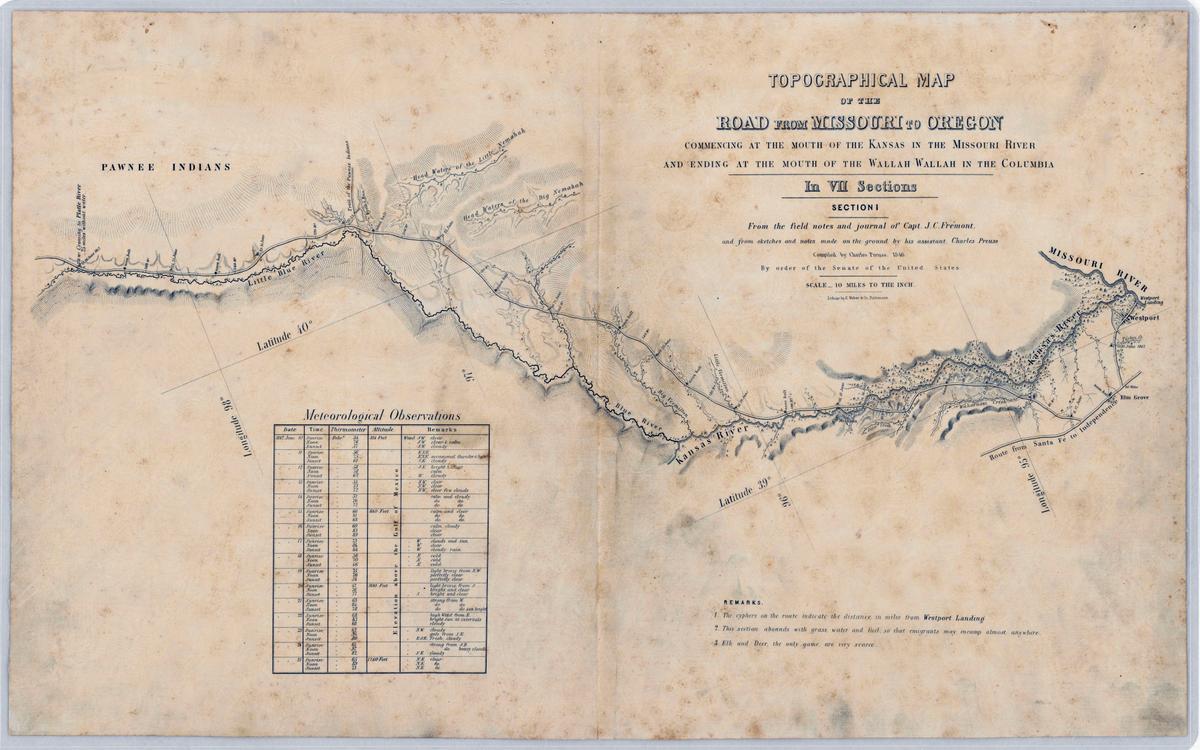
"Topographical Map of the Road From Missouri to Oregon," 1846, from the field notes of Capt. J.C. Frémont and sketches by his assistant Charles Preuss. National Archives. (Public Domain)
"Topographical Map of the Road From Missouri to Oregon," 1846, from the field notes of Capt. J.C. Frémont and sketches by his assistant Charles Preuss. National Archives. Public Domain

The Oregon Trail was a site of hope and suffering, freedom and displacement. Bierstadt’s painting captures one facet of that story. Its resonance lies in what it represents: the determination and hope of those who pressed toward an uncertain horizon.

What arts and culture topics would you like us to cover? Please email ideas or feedback to [email protected] 
Google LogoMark Us Preferred on Google
Sarah Isak-Goode
Sarah Isak-Goode
Author
Sarah Isak-Goode is a writer and art historian rooted in the Pacific Northwest. Her name—pronounced EYE-zik-good and meaning "good laugh"—hints at the warmth she brings to everything she does. Equal parts scholar and storyteller, Sarah brings the past to life through a distinctly human lens, exploring what connects us across the centuries. Away from her desk, she feeds her curiosity through traveling, painting, reading, and hiking with her dog, Thor.