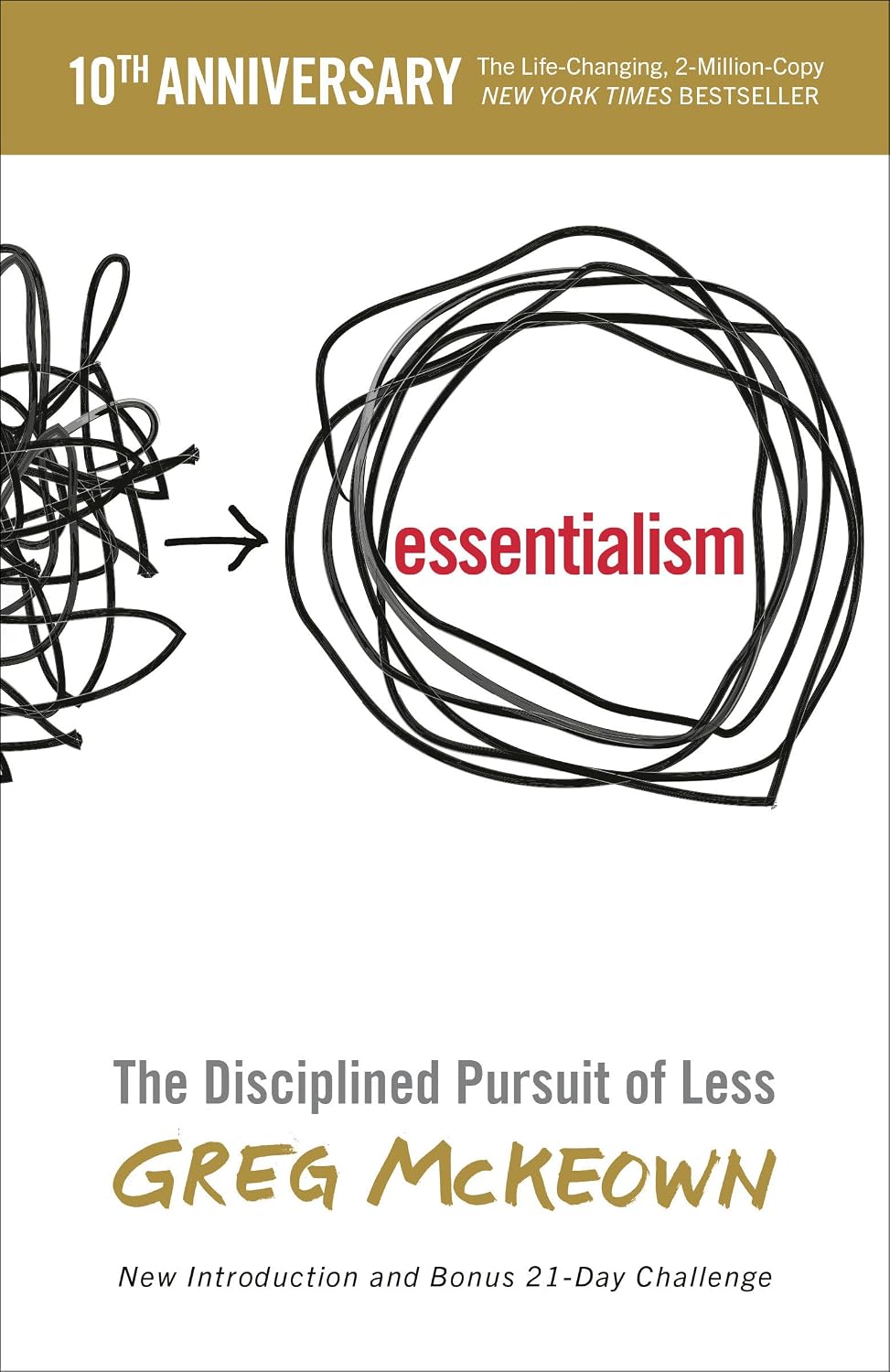
At first glance, Greg McKeown’s book, “Essentialism: The Disciplined Pursuit of Less,” looks like just another productivity book. But it isn’t.
In reality, The New York Times bestseller, now in its 10th anniversary edition, is something much more interesting and revolutionary. It articulates a counterintuitive approach to work and life, disarmingly simple, yet surprisingly potent in its effects: Don’t try to get more done; instead, try to do less. As a result, you will actually have a greater impact at work and a more fulfilling life at home. You’ll regain control and composure, sharpen your effectiveness to a razor’s edge, and ultimately live a life that means more.

McKeown’s book is built on the premise that modern life constantly compels us to take on more, do more, accomplish more. To signal competence, to live up to the expectations of others, or simply to satisfy our own restlessness, we take on more and more obligations, projects, and interests, until our back is breaking under the weight of it all. As a result of the “I can do it all” mindset, we feel stretched taut, our time is no longer ours, and the engine of our life overheats and fails.
McKeown describes this as the approach of the “Nonessentialist,” the person who allows his attention to disperse across numerous pursuits all at once, only a few of which really matter. He contrasts this lifestyle with that of the “Essentialist,” who—as the name implies—hones in on only the pursuits that are truly essential, pouring her energies into just this narrow field of activity, and thus achieving huge results in a few very high-impact area. Meanwhile, the Nonessentialist achieves little because her energy is split across an array of unimportant activities.
While the Nonessentialist has, as McKeown puts it, the “unfulfilling experience of making a millimeter of progress in a million directions,” the Essentialist has the joy of “making significant progress in the things that matter most.”
The Essentialist approach to life requires ruthlessness in sacrificing potential opportunities and interests that look good on the surface but aren’t the most important. In Essentialist thinking, “good” isn’t good enough. McKeown reminds readers, “There are far more activities and opportunities in the world than we have time and resources to invest in. And although many of them may be good, or even very good, the fact is that most are trivial and few are vital.”
Despite their appeal and objective value, McKeown argues that most of the pursuits that draw our attention are just “noise” distracting us from the essential areas where we can make the biggest impact. To find these areas, McKeown insists that we ask the right questions. Not, “Is this a good opportunity?” “Is this valuable?” but rather “Do I love this?” and “Will this activity or effort make the highest possible contribution toward my goal?”
“Essentialism is not about how to get more things done,” McKeown explains. “It’s about how to get the right things done. ... It is about making the wisest possible investment of your time and energy in order to operate at our highest point of contribution by doing what is essential.”
McKeown breaks the book into four sections to help readers understand and apply Essentialist thinking. After the first section lays out principles of Essentialism, the second section provides strategies for analyzing one’s activities and identifying the ones that matter. The third section guides readers through the process of cutting the fluff. Finally, the last section explains how to set up systems that help maintain focus on the essentials and make their execution frictionless.
From the 80/20 rule to the value of daily rituals to how we can manipulate habit cues, there are some useful practical tips throughout the book. The book’s biggest strength, however, isn’t in the detailed instructions it gives for living more efficiently—that content is limited in scope and not particularly original.
Rather, the book’s strength lies in its clear articulation of thought-provoking principles. McKeown writes with clarity and precision about concepts like the importance of play, reflection, and contemplation, the art of saying no, and the way we can ultimately add to life by subtracting.
Most of the case studies in the book derive from the business world, and I would have liked to see more explanation of how these concepts apply to life more broadly. Still, it isn’t hard to translate them into other areas, and, since reading this book, I’ve already seen it yield results in my life. I’ve begun to think more carefully and critically about my commitments, interests, and pursuits. I’ve given myself permission to focus on just a handful of key pursuits, without worrying about trying to accomplish every good idea that crosses my mind.
McKeown has placed his finger on one of the paradoxes of life: by limiting ourselves, by putting up boundaries, we can actually achieve greater freedom, focus, and peace.