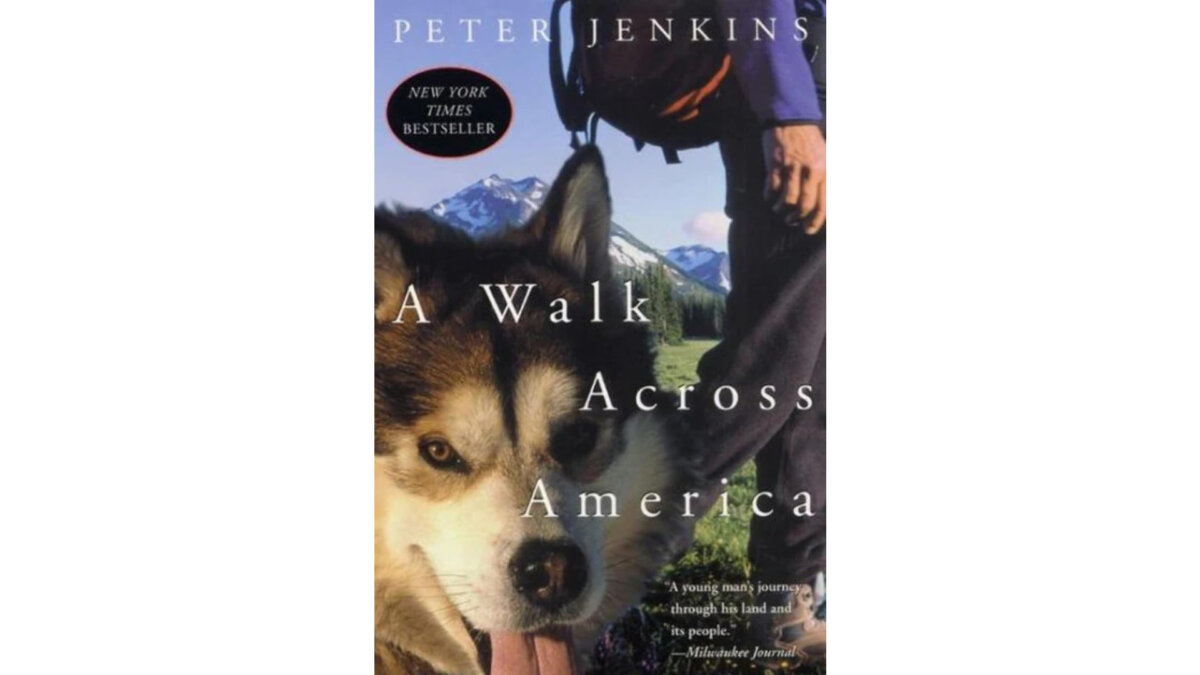
People are driving across America every day to enjoy the land and its people. In July of this year, almost a million vehicles were numbered inside Yellowstone National Park—many of them cross-country recreational vehicles. But few people have walked across America. Yet, that is exactly what Peter Jenkins did in the 1970s, and he wrote about it in the timeless book, “A Walk Across America.”
From October 1973 to January 1979, Jenkins walked from upstate New York through the Deep South and finished on the West Coast, in Florence, Oregon. With him was his Alaskan Malamute dog, Cooper. Instead of having a deadline for completion, he made his way gradually, letting people, places, and basic and financial needs dictate where he would stop and for how long.
Beginning the epigraph with a verse from the book of Genesis, “Arise, walk through the land … for I will give it unto thee,” Jenkins launches right into one of countless anecdotes he shares in his 1979 book.
“Stop right there, son. You ain’t goin’ nowhere in this blizzard. Now sit down!” In the first lines of the first chapter, “Talkin' by the Wood Stove,” lies Jenkins’s story-telling writing style. His prose is not linear, standard journal entries. Instead, he introduces readers to one person and one place after another, weaving in reasons that he took the journey and what he learned from it. Readers join his experiences meeting country storekeepers, rustic cabin dwellers, and rural church attendees.
He points out that everyone he encounters asks him why he is walking across America. “To get to know the country” is his pat response. In some spots, he becomes acquainted with people long enough to consider them friends. Working odd jobs in different locations enabled him to “be where I was,” as he described it. In a nutshell, he tells readers: “I wanted to find the real people out there, what they were made of, experience who they were, how they lived, and how they worked for a living.”
He elaborated that he intended to “share every environment” he walked through and give readers a glimpse of “the folks who were rooted” in the places he visited.
Jenkins’s prose shows instead of tells. For example, he wraps up the 17th chapter describing the aftermath a Mount Zion African American service this way:
“When church let out, everybody went home feeling washed by a sweet spring rain. Today the blackberries bloomed and the dewberries beckoned and many folks went home to pick a few gallons for their home-baked cobblers. The God of these Southern mountain people had brought them all together, and the air around Texana was filled with peace and the goodness of giving.”
Adding greatly to “A Walk Across America” is Cooper, a main character of this nonfiction tale. Jenkins notes his dog’s exploits, everything from killing a copperhead to wrestling with a woodchuck to playing in a snow storm. In fact, of the myriad photos Jenkins includes in the book, Cooper dominates many of them.
Even though Jenkins’s quest occurred a half-century ago, his encounters still fascinate, resonate, and inspire.