On Aug. 15, Christians commemorated “The Assumption of the Blessed Virgin Mary,” the act of God commanding the angels to raise the Virgin Mary’s body and soul to heaven, reuniting her with her son Jesus Christ.
“The term ‘Assumption‘,” according to “The Bloomsbury Guide to Art,” “derives from the Latin ’adsumere,’ ’to take up,' and stresses the important difference the Church observed between Mary’s Assumption (she was a human lifted up to Heaven by angels at God’s command) and Christ’s Ascension (as he was one with God he went up of his own volition).”
Bavarian architect Egid Quirin Asam (1692–1750) designed one of the most gravity-defying depictions of the Assumption for the abbey church of the Assumption of the Virgin Mary, in Rohr, Lower Bavaria. The monumental sculpture effectively evokes awe of the sacred event.
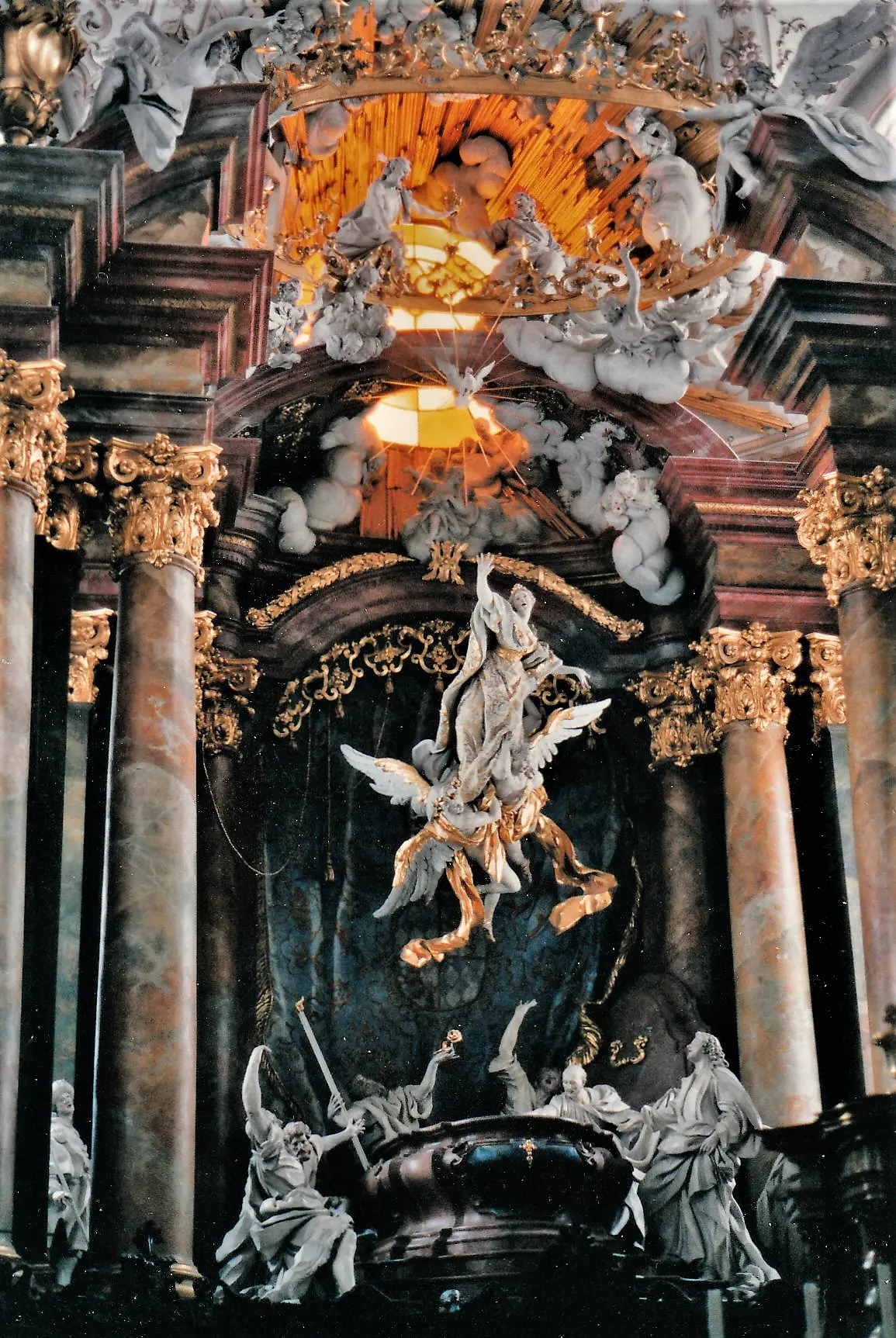
“The Assumption of the Virgin Mary,” between 1717–1723, by Egid Quirin Asam. Abbey Church of the Assumption of the Virgin Mary, Rohr, Lower Bavaria, Germany. Hermetiker/CC BY-SA 1.0
A Typical Bavarian Baroque Sculpture
In the marble-and-stucco sculpture, Asam depicted the Virgin’s empty tomb surrounded by apostles, all in varying states of panic, confusion, and awe as they see two angels carry the Virgin’s body heavenward. Their cheeks flush from exertion, emphasizing that the assumption is raising a human to heaven.The ecstatic Virgin stretches one arm to heaven toward her son and God, who wait in the clouds. The dove above her head symbolizes the Holy Spirit, completing the Trinity: Father, Son, and Holy Spirit.
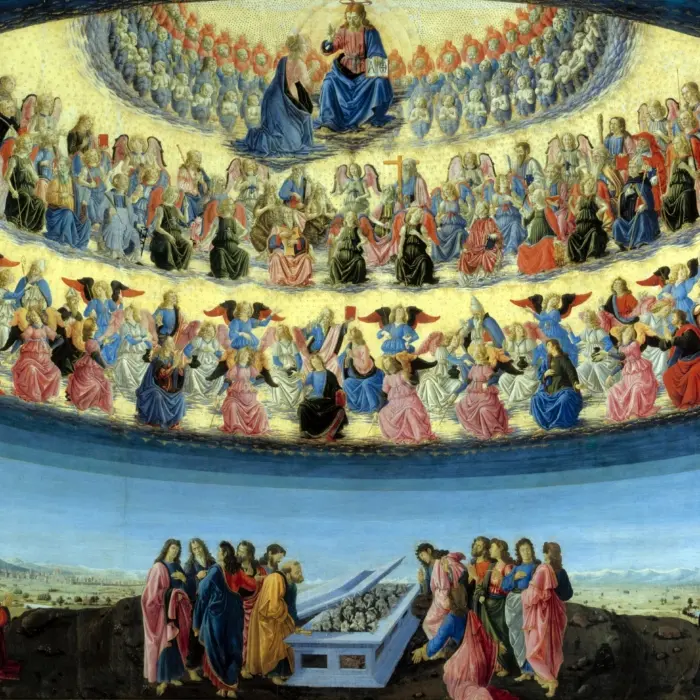
Myriad angelic beings peer down from heaven, watching the miraculous assumption. Some hold flowers or leaves symbolic of the Virgin, such as roses, white lilies, and palm leaves, and these motifs recur throughout the architectural features.
Other angels among the clouds hold a huge crown of stars, alluding to Revelation 12:1. The Virgin’s 12 stars often refer to her ancestors or Christ’s apostles. Theologians also attribute each star to the Virgin’s perfections. Asam added more than 12 stars; at least 13 can be seen in the photograph.
The crown of stars acts as a border to the heavenly realm, where Christ and God hold another crown aloft, indicating “The Coronation of the Blessed Virgin.”
Asam’s assumption defies belief and gravity to this day. Every detail from the Virgin’s floating body, the gilded heavenly rays, and the chorus of angels in the clouds recreates the majesty and awe of the occasion.
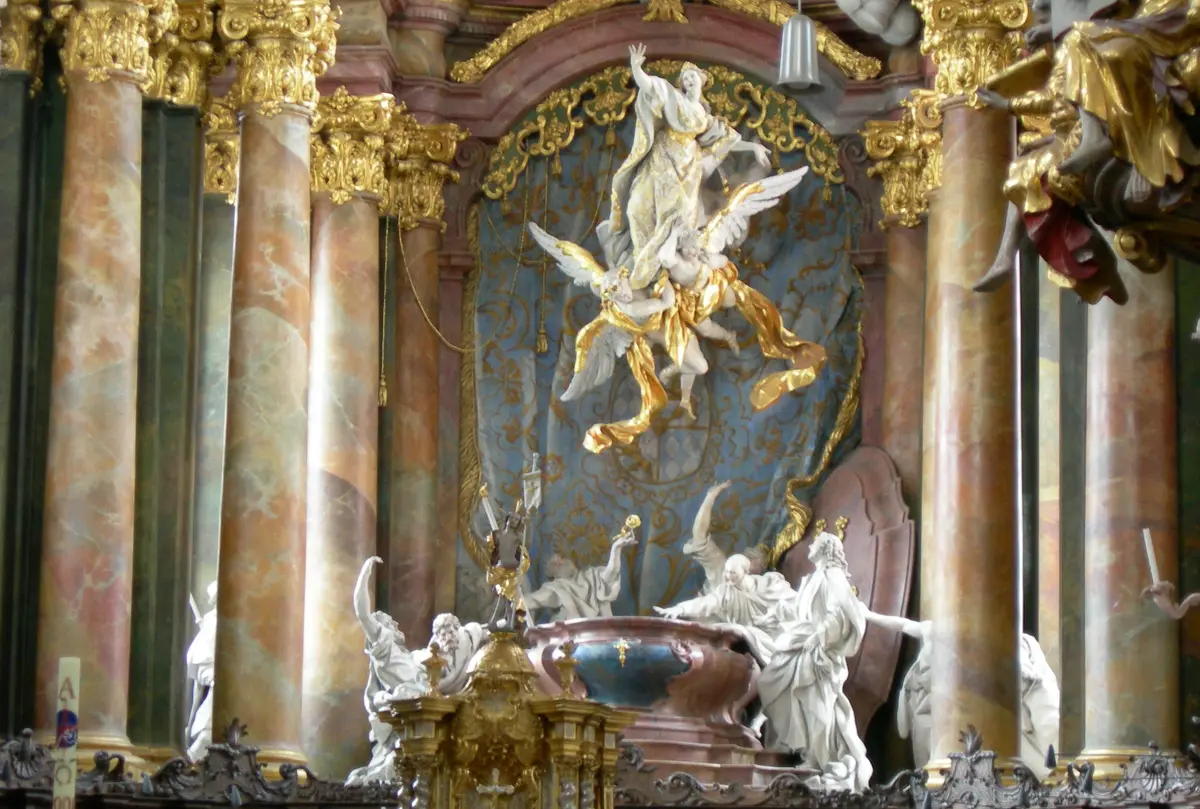
“The Assumption of the Virgin Mary,” between 1717–1723, by Egid Quirin Asam. Abbey Church of the Assumption of the Virgin Mary, Rohr, Lower Bavaria, Germany. Piflaser/CC BY-SA 3.0
The Asam Brothers
Bavarian architects Egid and his older brother, Cosmas Damian Asam (1686–1739), designed and decorated churches. They often worked together with a harmonious effect. Cosmas specialized in painting, and Egid in sculpture and stucco work. Between 1711 and 1714, the pair visited Rome and the works of 17th-century artists Andrea Pozzo and Gian Lorenzo Bernini, which influenced their designs, although the Asams developed a more elaborate baroque style.“The Thames Hudson Dictionary of Art and Artists” notes that the S. German baroque achieved its zenith in the brothers’ work. Their masterpiece is Munich’s Church of St. John Nepomuk, affectionately known as “Asamkirche” (Asam Church).
What arts and culture topics would you like us to cover? Please email ideas or feedback to [email protected].