Since before recorded history, music has brought people together and sustained the cultural and social life of civilization. Music—a universal language—seems to bypass all formalities and go straight to the heart, moving us with a mysterious power. As Benedick quips in Shakespeare’s “Much Ado About Nothing,” referring to a common material for instrument strings at the time: “Is it not strange that sheeps’ guts should hale souls out of men’s bodies?”
A Short History of Folk Music
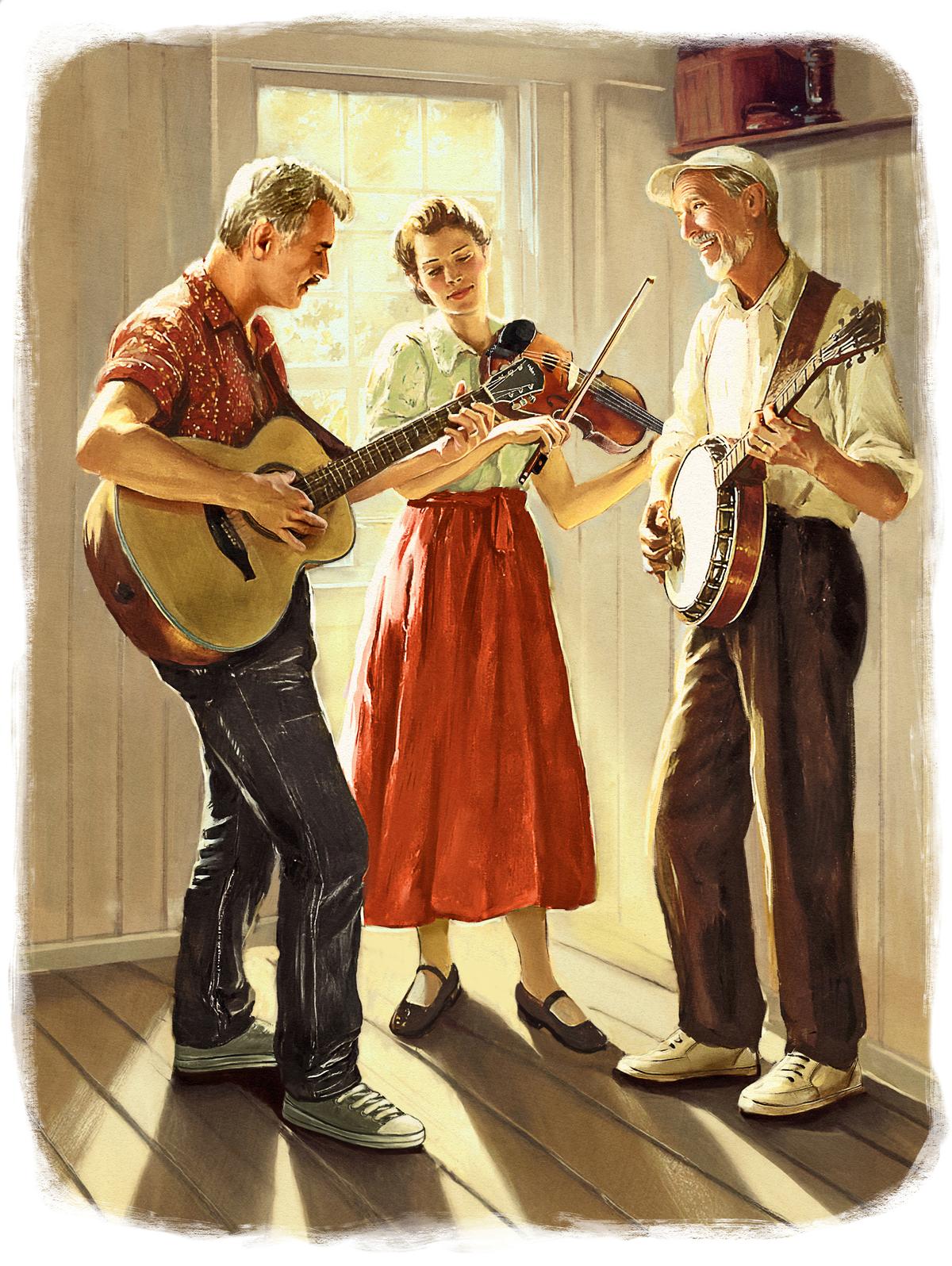
As a natural part of human culture, music accompanied everyday social situations—at the hearthside, after a day of work in the fields, at a barn dance, or at the local pub after a few drinks. Musicians and their listeners who gathered around a fire were warmed by something more than just the flames: laughter, camaraderie, shared artistic appreciation, and the sheer delight of the melodies floating upwards like sparks rising into the night sky. Playing folk music also connected the participants to their ancestors, who had sung and played these same tunes, in some cases for hundreds of years.
Such an experience is still possible today, though by no means as common as it once was. Because of the recording and commodification of music, musical experiences frequently occur in isolation—or if they do take place communally, the music itself isn’t created by the community. Professionals make it, and the community listens passively. That’s not to say professional music isn’t valuable, delightful, or moving.
From Facetime to Face-to-Face
Recently, some friends of mine began hosting a monthly music jam session to recover something of this enriching folk music tradition. A large group of friends gathers. The musically inclined bring their instruments—guitar, banjo, fiddle, and other traditional instruments—and the others bring a willingness to listen. Refreshments are served, and maybe a fire is built. The music begins furtively at first, then swells as someone begins to pick away at an old tune and more instruments and voices take it up and bear it along.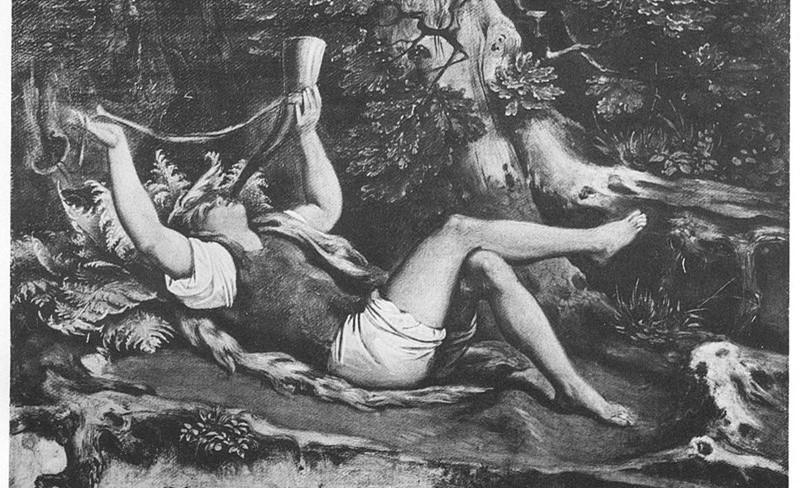
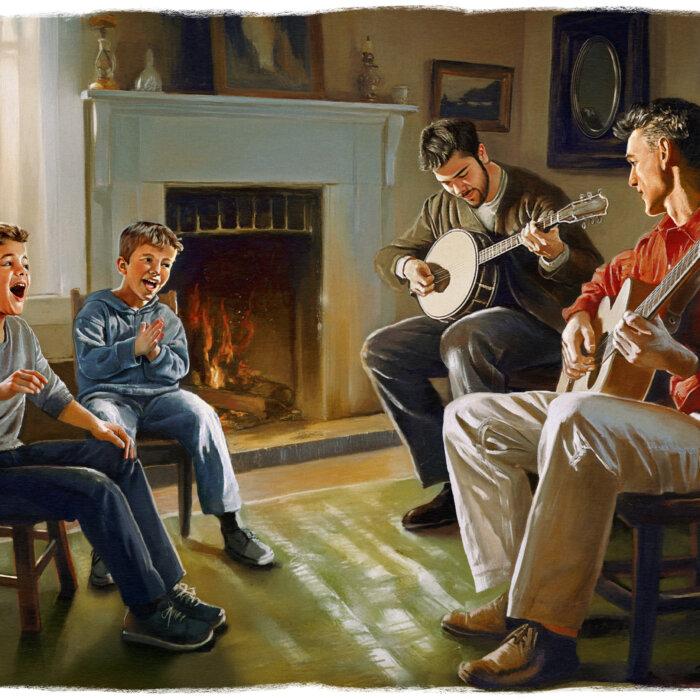
Invariably, someone forgets some of the words, and the tune might tumble and fall flat amidst laughter. The musicians return to softly and contemplatively playing while conversation circulates for a while. Then, pretty soon, someone else catches a thread of inspiration and launches out on another song, and the others follow.
We’re amateurs in more ways than one. Although there are many talented musicians in the group, none of us play professionally. Most of us haven’t played in these types of informal jam sessions for many years, if ever. Though my group is much better-versed in folk music than the average American, we’re all victims of the fact that we haven’t grown up in a culture that promotes folk music. We generally don’t know the same songs, as prior generations often would have.
But with time, we’ll build a shared repertoire. More voices will join in on each song. If we keep it up, our children will grow up in a musical environment where shared music forms a backdrop to their lives and friendships, like a common geography of familiar hills, valleys, and rivers.
Do It Yourself
For those wishing to do something similar, a few words of advice:The project assumes your group has some musical ability, though you don’t need as much as you might think. Ideally, you’d have a variety of musicians and a variety of traditional instruments. However, this isn’t essential. You can get started just by singing together, with no instrumentation, or maybe with a single instrument like a piano or a guitar.
The basics of these instruments can be learned relatively quickly, and most traditional folk songs rely on the basics. A surfeit of old bluegrass songs consists entirely of the G, C, and D chords, which are pretty easy on both piano and guitar.
I recommend compiling songs you want your group to learn and printing off copies of the chords and lyrics to share. Since we don’t live in a culture that naturally transmits folk songs, most of us haven’t grown up with them. We have to learn them, and fortunately there are websites and books to assist us.
Seek to build a common repertoire of songs. You’ll create a lot more than just music: you’ll build shared memories, more resilient friendships, artistic skill, and an heirloom to pass down to future generations. That kind of heirloom is rare in our day—which makes it all the more precious.