The Most Efficient Way to Boost Gut Health, Better Than Any Amount of Probiotics

Like plants, humans need sun–and for much more than calcium absorption.
The Most Efficient Way to Boost Gut Health, Better Than Any Amount of Probiotics
Sunny studio/Shutterstock
|Updated:
0:00

You may have heard that if you lack vitamin D, you are prone to osteoporosis. But vitamin D does much more than that—it directly affects your intestinal health.

Dr. Joel Gould, a Canadian dentist for more than three decades, had a painful intestinal disease called Crohn’s disease for most of his life.

Crohn’s disease is an autoimmune disease in which the body’s immune system attacks the gastrointestinal tract, causing it to become inflamed. The symptoms of Crohn’s disease include abdominal pain, severe diarrhea, fatigue, weight loss, and malnutrition. The inflammation may occur in different areas of the gastrointestinal tract and may spread deeper into the intestines. Sometimes Crohn’s disease can even lead to life-threatening complications.

Gould started taking vitamin D supplements to improve his sleep apnea, and three months later, something amazing happened. When he woke up one morning, he suddenly felt very light. The Crohn’s disease that had plagued him for 34 years was cured. Since then, he hasn’t had to take hormonal drugs or antibiotics. His anxiety and depression, as well as his sleep apnea, have all disappeared, and he is back to full health.

Gould has been sharing his experience ever since. He believes that, no matter how many probiotics you take or if you get a stool transplant, as long as you don’t have enough vitamin D in your body, you can’t maintain a healthy gut microbiome.

Your Intestines Are an Amazing World

The collection of bacteria, archaea, and eukaryotes that reside in the gut is called the “gut microbiota” or “gut microbiome.” There are more than 1,000 species of microorganisms in the human intestine.

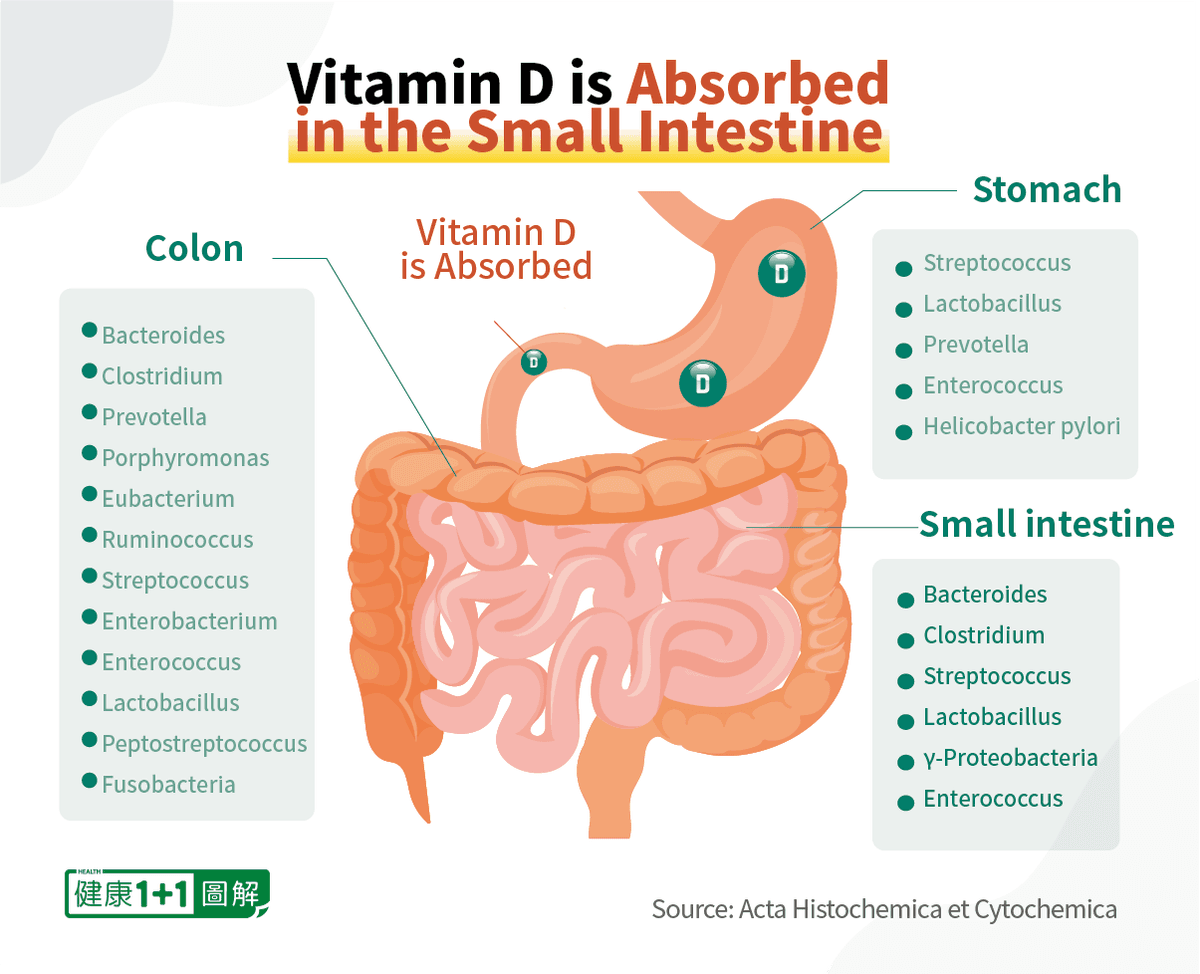
Vitamin D is mainly absorbed in the small intestine—especially in the duodenum, the part directly below the stomach.

The types and number of intestinal bacteria are constantly changing due to the influence of diet, medications, the environment, seasons, stress, and diseases.

The intestinal microbiota are considered an “extra organ” of the human body and are vital to the health of the body. If the intestinal flora, the diverse community of microbes in the gastrointestinal tract, is imbalanced, it can lead to various local and systemic diseases in the body.

Vitamin D’s First Benefit: Beneficial Bacteria

Gould’s experience is an example of how vitamin D regulates the intestinal microbiome and helps cure diseases.

Many studies have shown that there is a significant correlation between vitamin D intake and the gut microbiota.

In a study published in the journal Nature in 2020, 80 healthy but vitamin D-deficient women took vitamin D supplements for 12 weeks. The results showed that vitamin D supplements significantly increased the diversity of these women’s gut microbiota, while promoting an increase of probiotic bacteria.
A 2015 study on 16 people looked at the effects of vitamin D3 on the human body. After volunteers took vitamin D3 supplements for eight weeks, the researchers evaluated the microorganisms in their stomachs, small intestines, colons, and feces. The data showed that vitamin D3 supplements modulated the human intestinal microbiota and had a positive effect on gastrointestinal disorders, such as inflammatory bowel disease and bacterial infections.
In a 2020 study, researchers conducted stool and blood tests on 567 elderly men averaging 84 years of age. They discovered that those with the highest levels of the active form of vitamin D in their blood had the highest diversity and most beneficial types of microorganisms in their feces. Among these microorganisms, there was a higher frequency of butyrate-producing bacteria.
After eating foods rich in dietary fiber, such as vegetables and fruits, the butyrate-producing bacteria in the intestines break down the fiber into the short-chain fatty acid butyrate, which reduces the amount of nitrate produced in the intestines and prevents infection- and inflammation-prone bacteria from surviving.

Vitamin D’s Second Benefit: Immunity

Vitamin D can also maintain the health and integrity of the intestinal mucosa, the inner lining of the intestines.
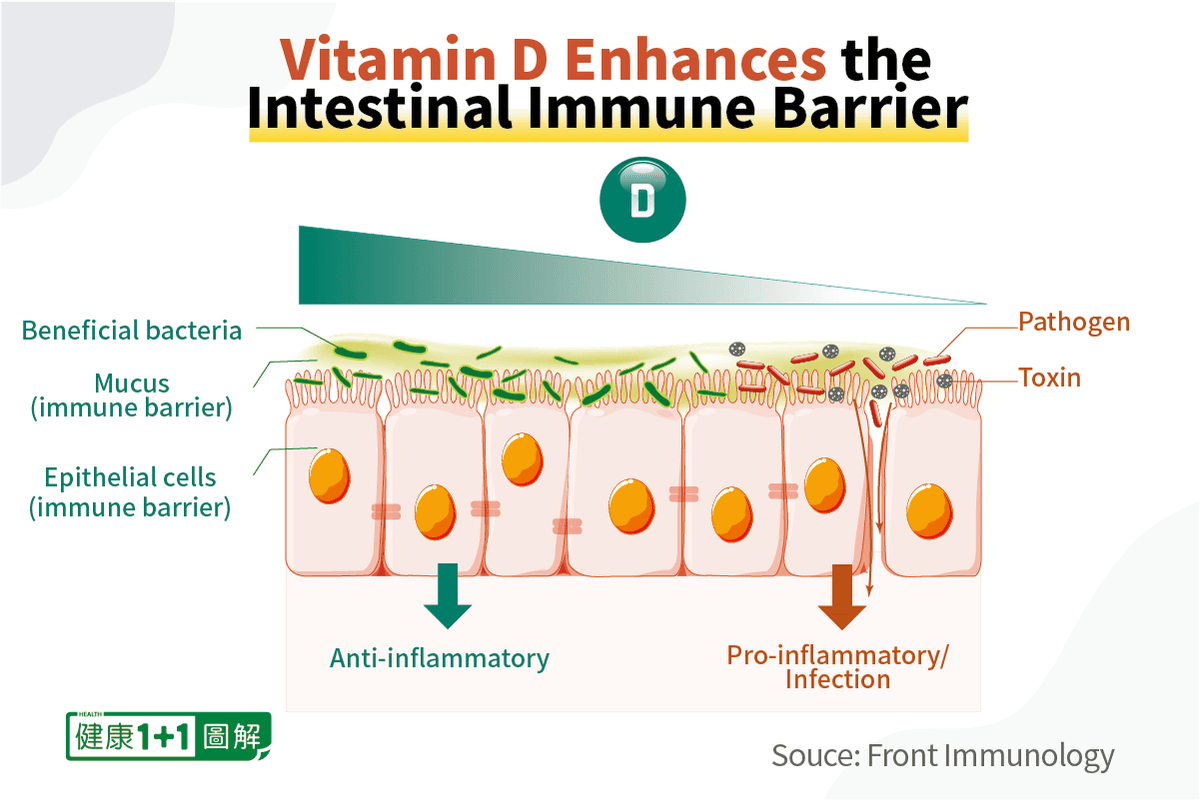
The intestinal tract is constantly exposed to external bacteria, viruses, and toxins. The superficial barrier of the intestines is like a wall that prevents external enemies from entering and is divided into the mucus layer and the epithelial cells. Vitamin D maintains the protective function of these two parts and helps the epithelial cells hold together more closely.

With sufficient vitamin D, the immune system of the intestines can easily perform its disease-fighting and anti-inflammatory functions. If vitamin D is deficient, the intestines are highly susceptible to inflammation and invasion by pathogens.

Furthermore, vitamin D can regulate innate and acquired immunity in the intestines and is excellent at preventing autoimmune diseases.

How to Efficiently Supplement Vitamin D

Normal levels of vitamin D in the body range from 20 nanograms per milliliter to 50 nanograms per milliliter.

The most important forms of the vitamin D family are vitamins D2 and D3.

Vitamins D2 and D3 are originally inactive. However, when they enter the body, the liver converts them into calcifediol, which is the form of vitamin D stored in the body. The kidneys then further convert it into calcitriol, which is the active form of vitamin D.

Studies have repeatedly shown that vitamin D3 has an advantage over vitamin D2. So what is the best way to supplement vitamin D?

1. Efficient Basking in the Sunshine

Plants can synthesize water and carbon dioxide into nutrients through photosynthesis. Our body can also produce vitamin D through a process similar to photosynthesis. Most of our body’s natural vitamin D comes from sunlight.

When the sun’s medium-wavelength ultraviolet B (UVB) rays hit our skin, they convert a type of cholesterol in the skin into vitamin D3, which then enters the bloodstream.

The most straightforward and inexpensive way to get vitamin D is by basking in the sun.

However, if you use a sufficient amount of sunscreen, the skin’s absorption of vitamin D will be reduced by more than 90 percent. For the most efficient sun exposure, don’t use sunscreen and expose about one-third of your skin to sunlight for 10 to 20 minutes at noon, three times a week.
Noon is not only the time when the sun’s UVB rays are strongest. Studies have shown that the body’s most efficient production of vitamin D is between 11:00 a.m. and 2:00 p.m..

2. Eat High-Fat Fish, Egg Yolks, Sun-Exposed Mushrooms

Foods rich in vitamin D include cod liver oil, salmon, tuna, sardines, swordfish, beef liver, and egg yolk.
Another food rich in vitamin D is fresh mushrooms exposed to ultraviolet light. Animal-based foods provide vitamin D3, while plant-based foods, such as mushrooms exposed to sunlight, provide vitamin D2.

3. Supplement With Vitamin D

If getting sunlight and eating vitamin D-rich foods is difficult for you, then vitamin D supplements are an alternative.
For most people, the U.S. Food and Drug Administration recommends a daily dose of vitamin D of 800 international units (20 micrograms). Vitamin D can be supplemented in the winter when there is less sunshine.

Since vitamin D is fat-soluble, it’s best to take it with a meal to ensure absorption.

Flora Zhao
Flora Zhao
Author
Flora is a health reporter for The Epoch Times. She holds a master’s degree in demography and served as editor of a social sciences journal for seven years. Shifting her focus from macro issues like population changes and economic development to personal health, Flora finds great joy and satisfaction in her work. She bases her articles on thorough literature reviews and in-depth interviews with experts, aiming to provide content that genuinely helps people. Email her at: [email protected]
Related Topics