The shape of your largest muscles may reveal hidden health risks, according to research being presented this week at a major radiology conference.
Researchers analyzing more than 61,000 MRI scans found that the shape of the gluteus maximus muscles in the buttocks can signal Type 2 diabetes, frailty, and metabolic dysfunction, with notable differences between women and men.
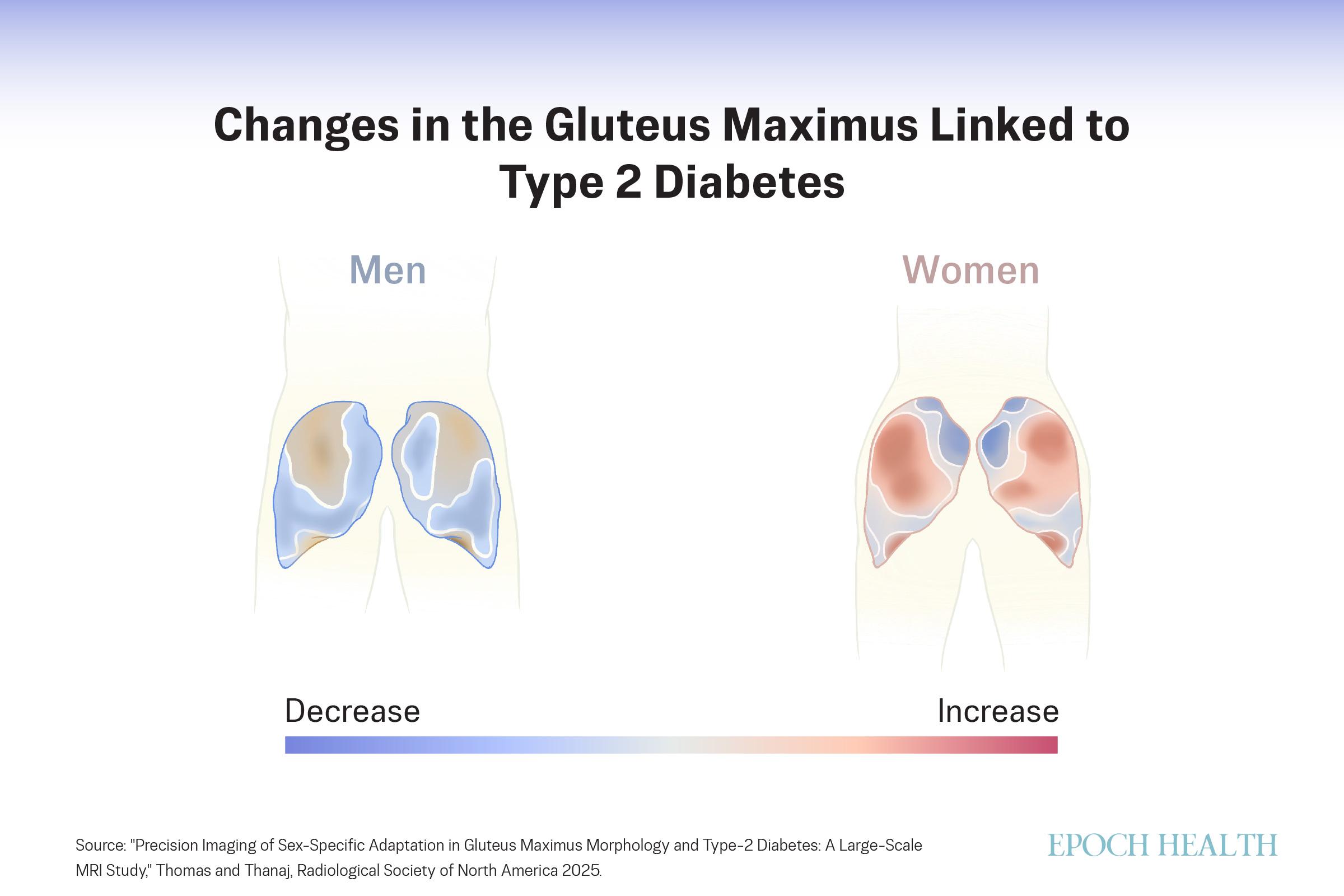
Using body scans, researchers created a detailed map of the areas of the gluteus muscles that expand or shrink in the context of Type 2 diabetes.
The research essentially mapped the size and shape of the gluteus maximus to identify patterns associated with disease risk, Zach Smith, founder and doctor of physical therapy at HIDEF Physical Therapy, who was not involved in the study, told The Epoch Times.
Distinct Differences Between Men and Women
The researchers found that men with Type 2 diabetes showed muscle shrinkage, while women with the condition showed enlarged muscles, likely due to fat accumulation in the muscles.Men showed inward deformation, or an inward dipping of parts of the muscles, possibly indicating early muscle wasting. In women, some muscle areas expanded outward, suggesting that more fat was being deposited inside or around the muscle.


Frail men lost more muscle overall, but frail women only lost muscle in specific, smaller areas.
The team also said changes in the muscle’s shape could indicate early signs of physical decline and metabolic issues in people with Type 2 diabetes.
“Unlike past studies that mainly looked at muscle size or fat, we used 3D shape mapping to pinpoint exactly where the muscle changes, giving a much more detailed picture,” Thanaj said.
General Exercise Recommendations
The gluteus maximus, some could argue, is one of the most important muscle groups throughout our lifetime, Dr. Kelly Danielle Ryan, who specializes in sports and family medicine at MedStar Health, and not involved in the study, told The Epoch Times.“It affects metabolic function, balance, power, back pain, and knee health, among many other things,” she said. “I can’t go a day without counseling my patients on the importance of glute strength and functioning.”
Based on the study findings, Alex Schieck, an orthopedic physical therapist at Hofstra University and Northwell Health Sports Therapy and Rehabilitation Services, and not involved in the study, told The Epoch Times that he would recommend that men focus on building muscle mass.
His exercise prescription involves using a weight that is 75 percent to 85 percent of the maximum a person can lift for a single repetition. The person should do six to 12 repetitions of glute weight-training exercises per set, with three to six sets per exercise.
Rest for up to 60 seconds between sets. Use a controlled tempo: Take two seconds to lower the weight and two seconds to lift it.
“Distribute a weekly volume of 10 to 20 sets for larger muscles across multiple training sessions to maximize muscle protein synthesis,” Schieck said.
To reduce fat infiltration of muscles for women, the most effective exercise prescription combines aerobic exercise and high-intensity resistance training, often alongside a low-calorie diet.
- Stair-stepper or stepmill
- Walking on an inclined treadmill
- Walking stairs or hills outside
“Regardless of sex, consistently building muscle throughout life helps maintain metabolic health, supports glucose control, and improves overall physical function,” she said.
Schieck recommended that people begin with exercises using very light resistance or just body weight. They can initially use furniture for various glute exercises, then eventually graduate to a commercial gym or purchase home equipment.
“An excellent recipe for training at home, assuming the individual possessed all the necessary equipment, could involve daily band hip thrusts, goblet squats, kettlebell swings, and lateral band walks,” he said.