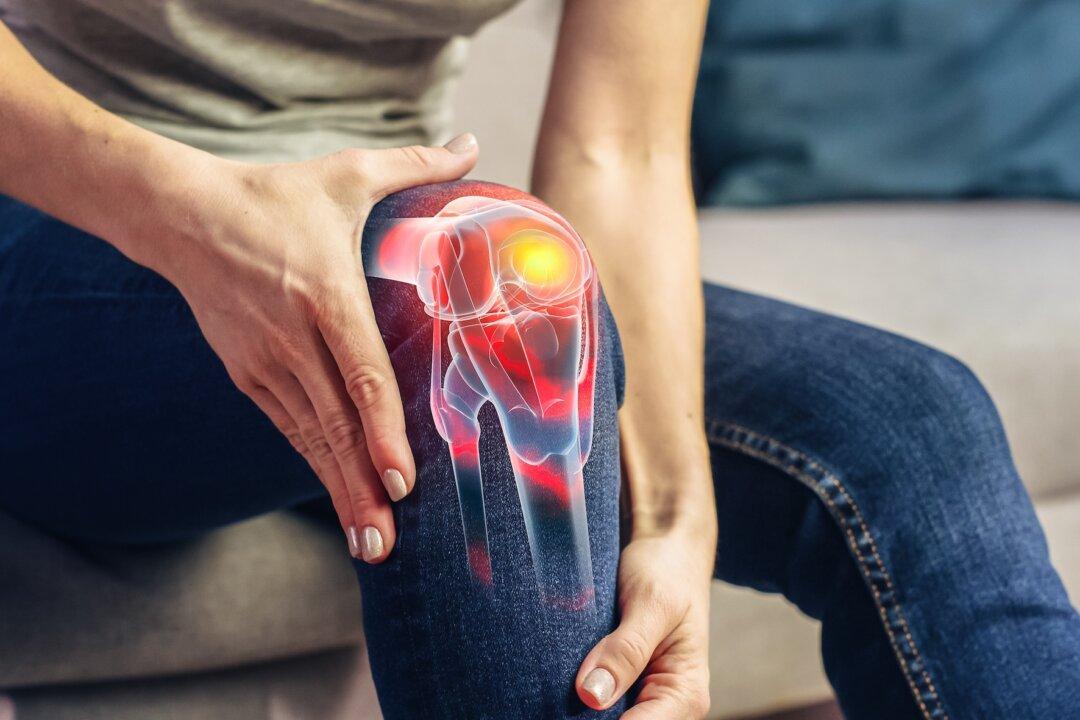
At some time, one out of three cyclists suffers serious knee pain (Am J Sports Med, 2010 Dec;38(12):2494-501). It often occurs with a new bike, upon returning to cycling after a long hiatus, or when you are trying to increase either your intensity or your mileage. If your knee starts to hurt while you are on your bike, stop riding and try to find out the cause.
The most common cause of knee pain in bicycle riders is having the seat set so high that it forces you to fully straighten the knee as the pedal reaches its lowest level. You are never supposed to fully straighten your knee when you do any kind of exercise, particularly cycling or running. If you set your seat too low, you will bend your knee excessively and be at high risk for developing pain behind your knee cap. Other common causes of knee pain are over-training, setting your seat too far forward or backward, not having the cleats on your bike shoes set correctly, or not having the correct crank length.
Seat Height
Set your seat so that your knee is bent 20 to 30 degrees when one pedal is at its lowest level, and is not bent more than 70 to 80 degrees when the pedal is at its highest level. The ball of your foot should be directly over the pedal axle. • When the seat is set too high: you can feel pain inside your knee, on the lateral side of the knee (iliotibial band), the medial back of the knee (pes anserinus tendon), or the lateral back (biceps femoris) of the knee. • When the seat is set too low: excess bending of the knee causes the kneecap to rub against the femur, the long bone of your upper leg.Distance of Seat to Handlebars
When you sit on your saddle, you should be able to reach the brake hoods with your elbows slightly bent and relaxed. You can lean slightly forward, but you should not have to slide forward or back on the seat. Move your seat backward or forward so that when you sit on it, your tibial tuberosity (the bump on your lower leg just below the knee cap) is directly above the ball of your foot when the pedal is at its most forward position. • When the seat is set too far back: you can feel pain on lateral side of the knee (ilio-tibial band) or back of the knee (hamstring tendons). • When the seat is set too far forward: you can feel pain in the front knee cap (patellofemoral joint), the tendon just above the knee cap (quadriceps) or the tendon just below the knee cap (patella).Cleat Position
Pain on the inside or outside of your knee is often caused by setting your cleats so that your feet twist inward or outward. • Cleats rotated too far inward can cause pain on the outside of the leg at the knee. • Cleats rotated too far outward can cause pain and stress on the inside of the knee.Grease your cleat bolts and install the cleats in the bike shoes. Make sure the front middle of the cleat is centered in the middle of the cleat box. Set the forward-back position of the cleat so that when you are clipped into the pedal, the pedal spindle will be just behind the ball of the big toe and just in front of the ball of your little toe. Tighten the cleats. Clip in and ride around and make sure that your feet feel comfortable in the pedals. If you do not feel comfortable, ask for help from your bike shop or other experienced cyclists.
Crank Length
Having cranks that are too long for you causes the knee to bend excessively at the top of the stroke, and to straighten excessively at the bottom of the stroke. You may feel pain in the knee joint itself.Searching for the Cause of Your Knee Pain
It is possible to do this by yourself, but it will be a lot easier if you have a friend to help you. It may take several days because with each change you make, you will need to ride for a while to see if your knee has stopped hurting. First, set your seat height: Sit on the seat in your cycling shoes with your heels on the pedals. Pedal slowly backwards. Seat height is right when your knees straighten at the bottom of the pedal circles without the need to rock on the seat to keep your heels in contact. When you are clipped in at this height you will have a 20 to 30 degree knee bend at the bottom of each stroke. Move the seat up or down until you achieve this. A quarter of an inch can make a difference to your knees.If changing the seat height does not relieve the pain, try the other changes listed above. You may be able to “break in” an uncomfortable saddle, but trying to “break in” painful knees will only lead to a serious knee injury. If one or both knees hurt when you cycle, keep asking questions until you get a solution. Get help from more experienced riders, your local bike shop, or a bike fitter with a special bike-fit machine. A bike fitting can cost you several hundred dollars, but is recommended for serious cyclists, particularly if you are getting a new bike.
Republished from DrMirkin.com