This copy is for your personal, non-commercial use only. Distribution and use of this material are governed by our Subscriber Agreement and by copyright law. For non-personal use or to order multiple copies, please contact The Epoch Times Reprints.
For the first time in a while, pundits and politicians were talking about the drug that kills more people than any other each year in the United States.
Alcohol upstaged opioid abuse in news coverage recently, but only afterRear Adm. Ronny L. Jackson withdrew his name for consideration to head Veterans Affairs in April, in part because of allegations that he has abused alcohol. Jackson has denied having any problem with alcohol.
This provides an opportune time to discuss the seriousness of alcohol abuse.
As someone who has studied alcohol use disorder for over 15 years and who has treated thousands of patients who have it, I think it’s a major, yet often poorly understood, public health problem.
A Social Lubricant
Alcohol can be a quick and easy way to get into the spirit of celebration. And it feels good. After two glasses of wine, the brain is activated through complex neurobiochemical processes that naturally release dopamine, a neurotransmitter of great importance.
When the dopamine molecule locks on to its receptor located on the surface of a neuron, or basic brain cell, a “buzz” occurs. It is often desirably anticipated before the second glass is empty.
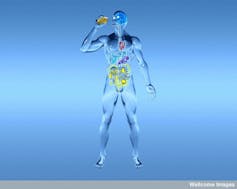
This image shows an illustration of a man drinking a pint of beer, indicating how the body metabolizes alcohol and the organs that this alcohol affects. Wellcome Images via Flickr, CC BY-NC-ND
There are those, however, who drink right past the buzz and into intoxication---or, often, into trouble. For them, the brain starts releasing the same enjoyable dopamine, no different than what happens in the casual drinker’s, but it doesn’t stop there. A compulsion to binge drink can result.
Binge drinking, defined as drinking five or more drinks for men and four for women on the same occasion on at least one day in the past 30 days, is amedical condition that victimizes the comparative malfunction of the pleasure circuits in the brain.
The Three Stages of Addiction
The alcohol addiction process involves athree-stage cycle: binge-intoxication, withdrawal-negative affect, and preoccupation-anticipation.
It begins in the neurons, of which the brain has an estimated 86 billion. These cells communicate through chemical messengers called neurotransmitters.
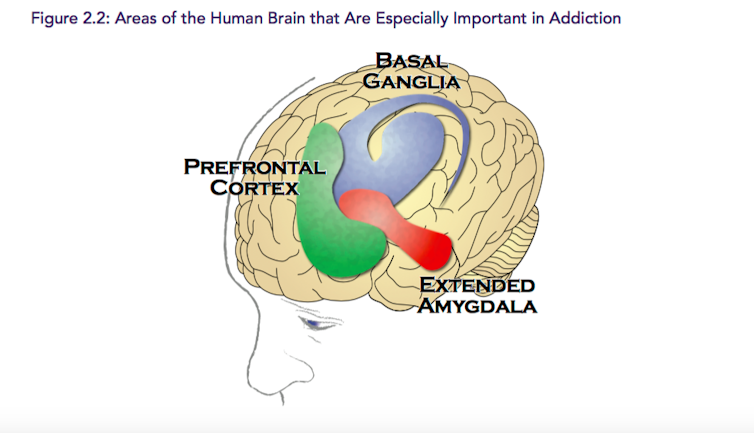
Neurons can organize in clusters and form networks in order to perform specific functions, such as thinking, learning, emotions, and memory. Theaddiction cycle disrupts the normal function of some of these networks in three areas of the brain—the basal ganglia, the extended amygdala, and the prefrontal cortex.
The disruptions do several things that contribute to continued drinking. They enable drinking-associated triggers, or cues, which lead to seeking alcohol. They reduce the sensitivity of the brain systems, causing a diminished experience of pleasure or reward, and heighten activation of brain stress systems. Last, they reduce function of brain executive control systems, the part of the brain that typically helps make decisions and regulate one’s actions, emotions, and impulses.
These networks are critical for human survival. Unfortunately, for the binge drinker,they become “hijacked,” and the bingeing continues even after the harmful effects have begun.
Because binge drinkers’ brains feel intense pleasure from alcohol, there is a powerful motivation to binge drink again and again. What may begin as social binge drinking at parties for recreation can causeprogressive neuro-adaptive changes in brain structure and function. The brain is no longer well enough to function normally.
With continued bingeing, the“habit circuity” is repeatedly activated in another part of the basal ganglia called the dorsal striatum. It contributes to the compulsive seeking of more alcohol. This explains the craving that is triggered when a binge drinker is driving by a favorite bar and can’t resist pulling in, even after a promise to go directly home after work.
During the withdrawal-negative affect stage, there is a break from drinking. Because the reward circuit has a diminished ability to deliver a dopamine reward, there is far less pleasure with natural, safe experiences, such as food and sex, compared to alcohol.
During abstinence from alcohol, stress neurotransmitters, such as corticotropin-releasing factor and dynorphin, are released. These powerful neurochemicals cause negative emotional states associated with alcohol withdrawal.This drives the drinker back to alcohol to gain relief and attempt to reestablish the rewards of intoxication.
Regions of the brain are affected differently by alcohol. Surgeon General's Report on Addiction
After a period of abstinence from alcohol, which may last only hours, the drinker enters the preoccupation-anticipation stage. This involves the prefrontal cortex, where executive decisions are made about whether or not to override the strong urges to drink. This part of the brain functions with a “go system” and “stop system.”
When the go circuits stimulate thehabit-response system of the dorsal striatum, the drinker becomes impulsive and seeks a drink, perhaps even subconsciously. The stop system can inhibit the activity of the go system and is important especially in preventing relapse.
Most importantly, it is important to know that alcohol use disorder is a brain disorder causing a chronic illness. It is no different from diabetes, asthma, or hypertension. When comprehensive, continuing care is provided, the recovery results improve, and the binge drinker has the hope of remaining sober as long as lifelong treatment and maintenance of sobriety become a dedicated lifestyle choice.