



Hand osteoarthritis causes pain and stiffness that can significantly impede a person’s ability to carry out activities of daily living such as dressing and eating, and to enjoy leisure activities.
Treatment Is Tricky
Finding treatments that work for hand osteoarthritis has been difficult because until recently we didn’t understand the causes of the condition. Many doctors are still taught that osteoarthritis is caused by “wear and tear” due to ageing and that inflammation is not an important factor in hand osteoarthritis.

We wanted to understand why. These medications each target one single chemical in the body that causes inflammation, so we wondered if a medicine with a wider mechanism of action, which interrupts the processes causing inflammation in a number of different ways, might work in hand osteoarthritis.
In a survey we did before starting our study, we actually found that many rheumatologists were already prescribing methotrexate “off label” to treat patients with hand osteoarthritis because there was little else to offer them.
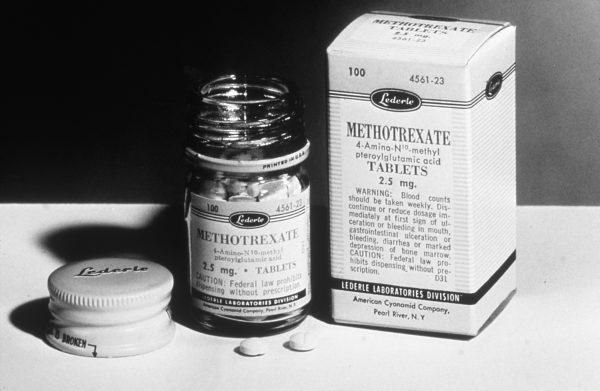
Now We Have Evidence Methotrexate Works
In our trial, we compared a standard dose of methotrexate (20 mg taken orally once a week) to a placebo among patients with hand osteoarthritis and inflammation.We selected people with hand osteoarthritis who had pain on most days in the last three months and moderate pain in the last seven days. We did hand X-rays to show they had osteoarthritis and not some other condition. We also did a magnetic resonance image (MRI) to make sure there was inflammation present.
We studied 97 people—50 on methotrexate and 47 on the control medication—and followed them for six months.
As with most studies of osteoarthritis, we found that pain improved over the first month in both the control and methotrexate groups. This may be because people often enter a study when their pain is at its worst, so there is some improvement back to their baseline.
However, we found that the pain level did not improve any further in the control group but continued to improve in the methotrexate group. In the methotrexate group there was improvement at three months and even more so at six months. Across the full six months, the improvement in pain in the methotrexate group was twice as much as in the control group.
There are a number of limitations to our study. As it lasted six months, further work is needed to see if the pain continues to improve if people are treated for longer.
We also need to see whether methotrexate can reduce joint damage. This can be done by following people over one to two years and taking an X-ray to assess the condition of their joints after treatment.

What Now?
Based on the results of our study, doctors may consider discussing the option of prescribing methotrexate with their patients who have significant symptoms of hand osteoarthritis.
