



Thanks to new legal pathways, people around the world could sue plastics manufacturers for damages totalling more than $20 billion by 2030, with most lawsuits originating in the U.S., according to a new study.
“We found that the negative impacts of plastic on human health are at least as consequential as the environmental risks about plastics that tend to dominate the story,” Dominic Charles, director of finance and transparency at the Minderoo Foundation and one of the study’s coauthors, told EHN. “Working to actually put a number on these social costs was a real eye opener.”
How Is Plastic Harming Us?
While the research is still unfolding, the report concluded that there’s “robust scientific consensus on human health harms resulting from some of the performance-enhancing chemical additives used in plastics.”The study estimates that manufacturers of these chemical additives are most likely to be exposed to litigation stemming from these health harms. Manufacturers of these types of chemicals include companies like BASF, Dow Chemical Company, Eastman Chemical Company and ExxonMobil Corporation.
“Micro or nano plastics have the same kind of persistence in the environment as PFAS chemicals,” Charles said. “Those legal proceedings are going to be highly relevant to the future of plastics litigation.”
Charles added that although these lawsuits could total billions of dollars, they won’t keep pace with the social costs, especially in the near term. These hazards enter the stream of commerce and it’s many years later that scientists start piecing together how harmful they are, he said. Then, it takes years to reach a scientific consensus, and it still takes years before lawyers take action after that.
“That’s why the threat of liability isn’t working as a sufficiently preventative measure right now,” he said. “We also need to change the way we’re regulating these chemicals.”
What Does This Mean for Petrochemical Development?
Credit: Nate Smallwood for Environmental Health News and Sierra Magazine
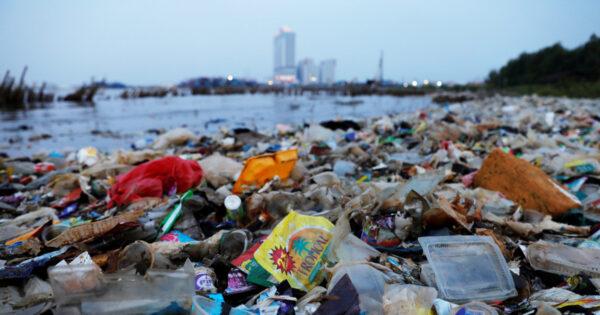
In the first 13 years of the 21st century, plastics manufacturing surpassed total production in the last century, and production is expected to double again in 20 years and almost quadruple triple by 2050. Lawsuits have the potential to slow that growth.
O’Leary, who was not involved in the Minderoo study, said petrochemical development in Appalachia’s Ohio River Valley, which spans parts of western Pennsylvania, Ohio, West Virginia, Virginia, Kentucky, Indiana, Illinois and Tennessee, has already been hampered by unfavorable market conditions for plastics.
Other plans “died not because we convinced a lot of investors to become more climate conscious or environmentally caring,” O’Leary said, “but because we demonstrated that these investments were not wise ones.”
“Shell still has additional investment decisions to make concerning their plant,” he added, “and now they’ll have to take into account at least the possibility of legal action and the risk posed by that.”
“Exposures around production facilities are relatively small compared to the ubiquitous exposures and potential liabilities arising from plastics as a whole,” he said. “That said, they are probably easier to build a case on, and those cases may well be some of the first to be brought in terms of plastic litigation.”
