If you’ve ever tried describing arthritis without naming the condition, you might have said something like, “My legs feel sore and heavy,” or “My knees don’t want to bend.” In traditional Chinese medicine (TCM), you’ve just described the sensations that often indicate Bi Syndrome, a widely recognized condition in which the circulation of blood and qi is blocked due to external pathogens.
The good news is, TCM has a strategy for Bi Syndrome. Right above your knee lies a quiet defender—Yin Market (Yin Shi, ST33), a go-to acupoint to push these intruders out.
Ancient Meaning
Yin Shi was first mentioned in “Zhen Jiu Jia Yi Jing,” the oldest surviving text on acupuncture and moxibustion (a gentle heat therapy using dried mugwort). Its name isn’t just poetic—it’s instructive. “Yin” represents the cold and damp qualities in TCM. “Shi” means market or gathering spot. This acupoint is essentially a hotspot for cold and damp to settle, especially if your diet is rich in greasy, sugary, or uncooked foods (looking at you, salad!)—or if you live in a chilly, humid climate. Over time, these internal and external factors begin to slow down your legs. Yin Shi helps clear them out.Clearing Stagnation, Restoring Motion
When cold and damp pathogens accumulate in the legs, along with discomfort, they reduce mobility and can even lead to muscle weakness or, in extreme cases, atrophy. Yin Shi is a frontline responder. By stimulating it, you help your body relieve soreness, reduce numbness, and strengthen the muscles and tendons of the legs and knees. For people managing arthritis or recovering from leg stiffness, Yin Shi can be a great supportive tool.Clinical Research Adds New Layers
Contemporary research is gaining interest in the ancient practice. In one study, researchers used laser Doppler flowmetry to examine blood flow beneath the skin at multiple points on the Stomach meridian, including Yin Shi. Yin Shi showed significantly higher microcirculatory activity than nearby control points on the opposite leg. The findings suggested that it’s not just a random location—it has real biological activity, possibly due to richer blood vessels or nerve networks beneath the surface.When electroacupuncture was applied at a nearby acupoint (ST36), circulation patterns became more stable and smooth along the meridian, further supporting the idea that these points help regulate internal systems.
In another clinical study on the effectiveness of acupuncture for functional dyspepsia, Yin Shi was part of a treatment group using “non-specific” points along the Stomach meridian. Although this group didn’t perform as well as those using “special” acupoints that are classically prescribed for this condition, the patients still showed better results than the sham group that used non-acupoints. The study found that although Yin Shi isn’t a major player in digestion regulation, it still has a stronger impact on the stomach compared to a non-acupoint.
How to Locate and Activate Yin Shi
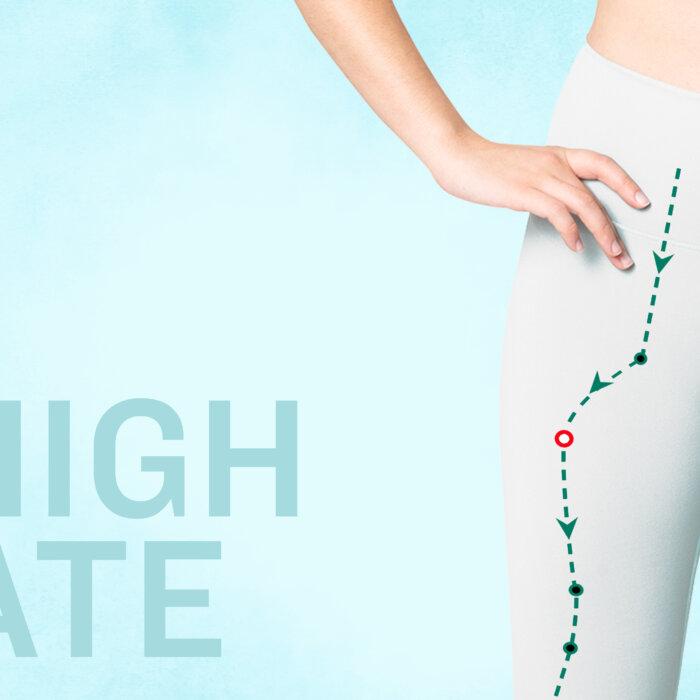
Yin Shi is easy to locate. With your knee bent, measure four finger-widths above the top outer edge of your kneecap along the line toward your hip bone. Press gently until you find a spot that feels slightly sore or tender—that’s your target.Here’s how to activate it:
- Firm pressure: Press firmly for 3–5 seconds, relax for 3 seconds, and repeat for 1–3 minutes on each leg.
- Circular massage: Massage in slow circles using your index finger, thumb, or even the whole palm.
- Tapping: Tap gently with loose fists—three taps as you inhale, six as you exhale.
- Herbal Patch: Apply an herbal patch overnight for deeper activation.
- Advanced methods: Acupuncture, cupping, or moxibustion by a trained professional can deepen the therapeutic effects.
Precautions
Avoid stimulating Yin Shi if you have an unhealed injury or inflammation in the area. If you’re using herbal patches, avoid formulas with harsh artificial ingredients—especially if you have sensitive skin.Simple Daily Practice, Year-Round Benefits
You don’t have to be living with arthritis or deep pain to benefit from Yin Shi. If you’re heading into winter or live in a damp climate, a little proactive stimulation of this point could make a noticeable difference. Just three minutes a day can support leg health, improve circulation, and give you a quiet moment to reconnect with your body. It’s free, simple, and might keep your knees bending more freely all year long.TCM expert Shihhsiang Hung reviewed this article for accuracy and clarity.