And every medical professional could have figured that out if they had stopped to think about it. Injected liquid (of any kind) cannot simply “stay in the arm.” Here’s why.
First, a Diabetic’s Daily Experience
An estimated 8.5 percent to 10 percent of Americans have Type 2 diabetes mellitus. This brings much of the entire U.S. population into acquaintance with one or more diabetic people, and we may even be related to a diabetic or may even live in the same household.With such high prevalence, most adults, and all health care professionals, are aware of diabetics’ need to check their blood sugar frequently. Although there is now an electronic blood sugar monitor that has been helpful for checking blood sugar without a needle poke, the glucometer with needle is still the most common method. The image below shows a glucometer.
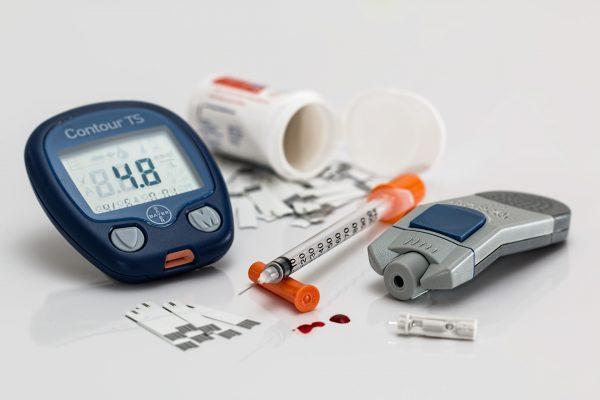
To make it work, a very small needle, called a lancet, is used to elicit a drop of blood, which is then applied to the end of a test strip. The test strip is then inserted promptly into one end of the glucometer, which starts a chemical reaction between the person’s blood sugar (glucose) and of enzymes on the test strip.
The glucometer then displays a number resulting from that chemical reaction. The number is the interpretation from that reaction as the amount of glucose in the person’s blood. But those details are merely an introduction to glucometers—not important to my argument.
Here is the needle that is used in the glucometer (pictured in the photo below). It is 30 gauge, which is 0.312 millimeters thick, and three millimeters long.
A zoomed-in lancet:
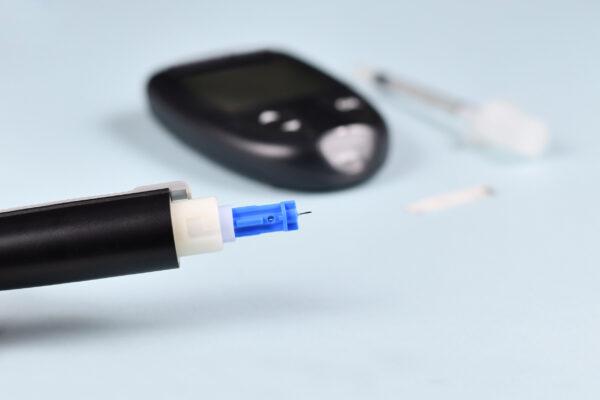
Now if you ask any diabetic, no matter where they poke themselves, even on the fingertips, which are some of the most distant extremities from the heart, they never fail to produce a drop of blood when they are poked with this item. (Unless years of manual labor made thick, tough callouses, and then the needle poke is done on an uncalloused side of a finger.)
Below is a zoomed-in size comparison:
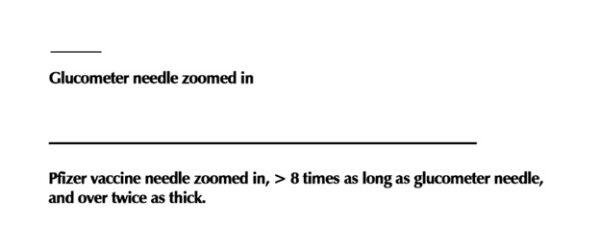
So even a tiny needle, such as a glucometer lancet will not fail to elicit a drop of blood. You don’t even have to map out where the blood vessels run under the skin. Just pick any spot, and be confident that you will strike a leak, no matter where you poke.
You don’t have to repeatedly stab yourself with the tiny needle above, in order to find a rare blood vessel. No matter where you use the glucometer lancet, unless calloused or pathologically coagulated or dehydrated, a drop of blood will travel outward, the entire length of the lancet, and then appear on the skin’s surface.
What Does This Mean for Access to the Bloodstream?
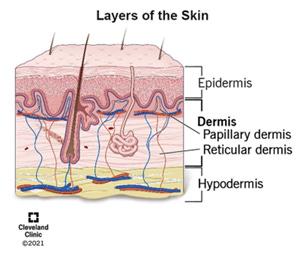
It means that multiple blood vessels have been pierced, and are now leaking, no matter where you poke.So any needle pierce of skin, even as shallow as three millimeters, will allow penetration of the one-millimeter thick epidermis—which does not have blood vessels—and will plunge the needle all the way to the hub, through the three-millimeter thick dermis, which does have blood vessels, and then through that to the subcutaneous layer, or hypodermis, which has larger blood vessels. Cleveland Clinic illustrates the layers here, with their respective blood vessels:
And, we know from the diabetics’ experience of not having to repeatedly stab themselves to try to find a drop of blood, that blood vessels are disrupted every single time, even by the tiny, thin, and short needle above, and to such a great extent, that a drop of blood oozes all the way out past the lancet’s length, and onto the surface of the skin.
So then we see that if the Pfizer vaccine needle is over eight times as long and over twice as wide as the lancet, then all the more blood vessels, including some of the larger and deeper ones in the subcutaneous layer are accessed. (For larger needle use, a Z-track technique is often used, in part to minimize such blood spillage on the surface.) The larger and deeper vessels are farther apart and are less likely to be accessed in any single needle poke.
And then 0.3 ml of liquid is deposited right there, at the site of the broken blood vessels.
Is it any wonder then that any injection of any liquid at all can access the whole body? Except for the non-mixing of oil and water, do you know of any other adjacent liquids that will NOT mix together?So yes, the mRNA vaccine or any other vaccine or injection travels the path of accessing the entire bloodstream.
The body is 55 percent to 60 percent water. And then a liquid is deposited in this semi-solid material by a vaccine. Is it any more likely to stay in one spot than if you add some water to food that you are preparing? So perhaps cooks could also have guessed that a vaccine would not simply stay in the arm.
Liquid With Liquid: Go With the Flow
In medical school we physicians learned centuries-long knowledge of circulation and lymph drainage. Every cell in the body is less than a fingernail’s thickness away from the nearest blood vessel, actually within 50 to 100 micrometers away, as needed for the nourishment to sustain that cell’s life.Innumerable capillaries are pierced and disrupted during vaccination by needle-piercing flesh to a depth of an inch or similar. (Worse vaccine reactions are possibly correlated with a larger blood vessel accidentally pierced.)
Possibly there were laypeople with respect to medicine who had not heard that prior mRNA experiments and prior attempted coronavirus vaccines had killed all the test animals, nor that cationic lipid nanoparticles were known to be toxic to multiple bodily organs. There were even many health care professionals who did not know these essential facts. It is possible that caution was thrown to the wind by both laypeople and health care professionals after hearing—and astonishingly even believing—the assertion that the vaccine would stay in the arm.
As we can see from the above evidence, no injected liquid can be reasonably expected to stay in the shoulder or arm, as it was alleged by the pandemic and vaccine industrial complex.
We would do well to remember the exquisitely intricate circulation in humans and the rest of the animal kingdom prior to accepting any more experimental or otherwise sketchy injections.