This copy is for your personal, non-commercial use only. Distribution and use of this material are governed by our Subscriber Agreement and by copyright law. For non-personal use or to order multiple copies, please contact The Epoch Times Reprints.
Injections designed to protect against SARS-CoV-2 that contain polyethylene glycol (PEG) cause some people to develop PEG-specific antibodies, according to a peer-reviewed article “Anti-PEG Antibodies Boosted in Humans by SARS-CoV-2 Lipid Nanoparticle mRNA Vaccine” published in June 2022 on ACS Publications by a team of Australian scientists.
The first author of the article, along with experts from Ireland and the United States, have just followed up their research with a commentary published on December 20, 2022 in the journal Nature Reviews Immunology. Their commentary, “Impact of anti-PEG antibodies induced by SARS-CoV-2 mRNA vaccines,” reinforces the message that antibodies against PEG may be causing health problems. As the authors insist: “larger and longer studies are needed to analyze the longer-term impact of boosting anti-PEG antibodies by LNP mRNA vaccination.”
In other words, the current SARS-CoV-2 vaccines appear to have an anti-PEG antibody problem. Solutions to counter the problem are urgently needed, as millions of people continue to be injected with these problematic products.
What is Polyethylene Glycol?
Polyethylene glycol, or PEG, is a hydrophilic polymer. A hydrophilic polymer is a water-soluble substance. Hydrophilic polymers are used in a wide range of products and have many biomedical applications.
PEG is a petroleum-derived compound. It can be found in laxatives and pharmaceutical medications, emulsifiers and surfactants used by the cosmetic industry, and also in food.
PEG is one of the most widely used polymers. PEGylated products have been on the market for over thirty years.
Traditional vaccines contain an attenuated or dead bacteria or virus to prompt the body to generate an immune response. But mRNA injections use messenger RNA—a type of RNA necessary for protein production. In the case of the SARS-CoV-2 mRNA vaccines, this mRNA is injected in order to use the human cells to produce spike proteins found on the virus’s outer membrane.
Using the injected mRNA, the body’s own cells then produce the viral proteins. The immune system recognizes the protein as foreign and produces immune responses (including antibodies) against it. These immune responses then allow the immune system to respond quickly when subsequently exposed to the virus, at least theoretically.
PEG in mRNA Injections
Kateryna Kon/Shutterstock
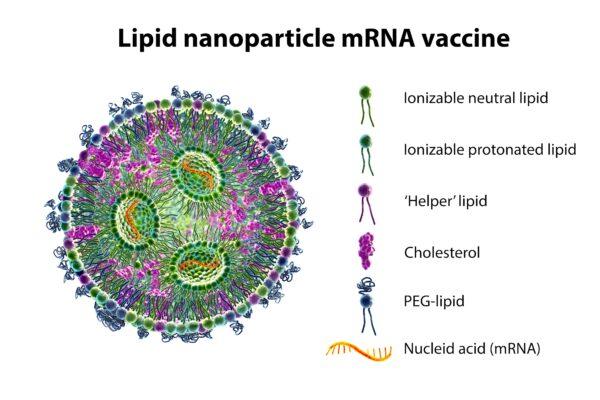
The mRNA in the injections is wrapped in lipid nanoparticles. PEG is incorporated into the vaccines’ lipid nanoparticles in order to stabilize the particles. These nanoparticles help carry the mRNA to human cells.
They also act as an adjuvant—an ingredient that the body recognizes as foreign against which it will mount an immune response.
Lipid nanoparticles in the mRNA injections are “PEGylated.” This means they are chemically attached to PEG molecules, which increase the particles’ stability and viability.
Is PEG Safe?
Both the Pfizer/BioNTech and Moderna mRNA injections contain PEG. While PEG is found in many drugs, before the development of mRNA injections it had never been used in approved vaccines before, according to a 2020 article in the journal Science.
But this new international commentary is part of a growing body of scientific literature that suggests that many of us will develop anti-PEG antibodies when we are exposed to PEG.
In fact, the American Chemical Society (ACS) paper showed that 53 of 75 people tested—71 percent—had anti-PEG antibodies in their blood before they were exposed to mRNA injections.
There are many unknowns about the role of anti-PEG antibodies, according to these scientists. They hypothesize that one of the reasons the mRNA injections have so many reported side effects—some of which are quite severe—may be connected to anti-PEG antibodies.
Anti-PEG Antibodies May Alter Effectiveness
Interestingly, if someone already has high levels of PEG-specific antibodies in the plasma, their immune system may clear the PEGylated nanomedicines in an enhanced way, which could actually limit their efficacy.
Accelerated clearance of PEGylated medicine is one of the concerns the scientists raise. Another is that anti-PEG antibodies could alter vaccine effectiveness, and potentially cause the vaccines to be more inflammatory.
Altered vaccine reactogenicity might include more injection-site pain, redness, and arm swelling, as well as higher fever, body pain, and headaches.
“Further research is needed to study the potential links between PEG-specific antibodies, vaccine reactogenicity and enhanced clearance of other PEG-containing medicines,” the scientists insist in their commentary.
This research is particularly important because when vaccination causes severe side effects, people become more hesitant about getting vaccines.
This hesitancy has been well documented in the scientific literature. For example, in a September 2019 article in the journal npj Vaccines, scientists mentioned that vaccines with troublesome side effects “can lead to needle fear, long-term negative attitudes and non-complaint behaviors, which undermine the public health impact of vaccination.”
Problems with PEG
Soon after the mRNA injections were widely distributed in the United States and other countries, reports started rolling in about very severe side effects.
Anaphylaxis associated with PEG happens within seconds, minutes, or hours of being vaccinated. It often involves a dangerous drop in blood pressure, shortness of breath, and tachycardia.
It may be that people who already have higher levels of anti-PEG antibodies may be at higher risk of having a severe reaction to a vaccine, booster shot, or other medical product that contains PEG. Of the 1,481,226 reports of side effects submitted to VAERS, as of December 9, 2022, there have been 10,240 reports of anaphylaxis following all COVID-19 vaccines.
Contaminated With Carcinogens
But the risk of anaphylaxis is only one of the potential health issues with PEG.
The process of making the polymer itself creates byproducts that are known to be toxic to human health. The worst among these may be 1,4-dioxane, a highly toxic compound that the FDA recognizes as “a potential human carcinogen.”
Several animal studies have shown that mammals intentionally exposed to 1,4-dioxane are at greater risk of cancer and other health issues and immune disruption.
Even tiny amounts of 1,4-dioxane may have negative effects on human health. In Europe it is only considered safe for cosmetic products that come in contact with the skin at levels lower than ten parts per million.
PEG can also be contaminated with ethylene oxide, which has been found to increase the risk of miscarriage, preterm birth, and post-term birth.
In one particularly worrisome study, published in 2019 in the journal Laboratory Animals, laboratory mice injected with PEG became so sickly that half of them had to be euthanized.
A lifelong promoter of vaccines, the Belgian immunologist Dr. Michel Goldman, experienced this firsthand. Diagnosed with lymphoma, Goldman rushed to get a third Pfizer injection. He believed it would protect him from COVID-19, which could be more severe for him given his compromised immune system.
However, the shot exacerbated his night sweats and left him feeling exhausted. His lymph nodes became even more swollen and tender.
After the third Pfizer injection, a scan showed that he had so many more cancer lesions that it “looked like someone had set off fireworks inside [his] body,” according to an article in The Atlantic. New cancer clusters were blooming in his armpit and along his neck.
The case report about the rapid progression of angioimmunoblastic T cell lymphoma, which was the kind of cancer Goldman was battling, was published in the journal Frontiers in Medicine in September 2021.
While Goldman himself “remains adamant that COVID-19 vaccines are necessary and useful for the vast majority of people,” according to The Atlantic, other scientists disagree.
A team of researchers, led by a senior scientist at the Massachusetts Institute of Technology, believe that the side effects of mRNA vaccines, including cancer, are not nearly as “rare” as the mainstream media suggests.
Their peer-reviewed scientific study, published in June of 2022 in the journal Food and Chemical Toxicology, posited that the mRNA vaccines interfere with innate immunity and causes the immune system to let cancer cells grow unchecked by suppressing the type 1 interferon response.
“The mRNA vaccines potentially cause increased risk to infectious diseases and cancer,” the scientists found.
Dr. Rick Kirschner, a retired naturopathic doctor based in Sandpoint, Idaho who served as president of the Naturopathic Medicine Institute in 2020, said he believes everyone needs to be concerned about the lack of safety and the unusually high reactogenicity of the COVID-19 vaccines.
“It seems to me like the precautionary principle has been thrown out the window for anything related to these mRNA vaccines,” Kirschner told us.
“If something is potentially harmful, you can’t assume it’s safe without adequate testing,” he continued.
“It used to be that you had to prove that something was safe. That’s the precautionary principle. In other words, ‘better safe than sorry,’” Kirschner said. “It sure seems to me like using a known carcinogen and toxin like PEG in this novel way is a great example of throwing caution to the wind.”
Views expressed in this article are the opinions of the author and do not necessarily reflect the views of The Epoch Times. Epoch Health welcomes professional discussion and friendly debate. To submit an opinion piece, please follow these guidelines and submit through our form here.
Jennifer Margulis, Ph.D., is an award-winning journalist and author of “Your Baby, Your Way: Taking Charge of Your Pregnancy, Childbirth, and Parenting Decisions for a Happier, Healthier Family.” A Fulbright awardee and mother of four, she has worked on a child survival campaign in West Africa, advocated for an end to child slavery in Pakistan on prime-time TV in France, and taught post-colonial literature to nontraditional students in inner-city Atlanta. Learn more about her at JenniferMargulis.net