Clearly, fairy tales have a strange power that continues to fire the imaginations of children—and of many adults.
Morality and Goodness
In the first place, fairy tales illustrate moral lessons in a way that engages children’s hearts and imaginations alongside their minds. Cinderella shows us the reward for humility and patience. Beauty and the Beast demonstrates that, sometimes, loving someone who seems unlovable will reveal the beauty hidden within them. Plenty of other tales teach lessons about the importance of honesty, quick-thinking, courage, and so on—and the hurt that follows on the heels of vice. And the lessons are expressed through vivid images that stay in the mind and heart of the child long after the last page.
Fairy tales have the rare power to distill reality into clearly recognizable images of good, evil, beauty, ugliness, truth, falsehood, nobility, baseness, and so on. Because they’re intensely concentrated and embodied in tactile images and symbols, these representations have a potency equal to a strong medicine. Or, to take another metaphor, just as a bottle of an essential oil gives off the strong scent of its essence, so also the elemental images in fairy stories communicate the essences of things more clearly than many other types of story. Children breathe in a deep understanding of the moral universe through fairy tales.
Preparation for Life
One of the most significant reasons children ought to read fairy tales is that they provide critical life training. I mean that seriously—in the sense that fairy tales teach children that obstacles and evils can be overcome by goodness.

“Since it is so likely that [children] will meet cruel enemies, let them at least have heard of brave knights and heroic courage,” Lewis argues.
He says this in response to those who think fairy tales unnecessarily frighten children; Lewis points out that children need to be introduced to the concept of evil (which will happen one way or another anyway) in an age-appropriate way through fairy tales, and as an important parallel, they need to be introduced to the forces of good that can defeat evil.
This deep faith in the possibility of the ultimate triumph of the good isn’t just nice to have. One might say it’s among the most important convictions that can be gifted to a child because it is among the most necessary certitudes for adults as they make their way through the dark wood of this world (to use the apt fairy-tale imagery). We can learn this conviction through the vicarious experience provided by story.
G.K. Chesterton also addressed this same point, noting that children already from an early age have some conception of dragons and monsters, produced in their own imagination. And for that reason especially, they need fairy tales.
Fairy tales become a means for overcoming fear and developing courage and hope—something every child will need, now and in later life.
A Sense of Wonder
Finally, fairy tales nurture a spirit of wonder in children. They open to children the notion that this world, too, is in some sense enchanted. “Ordinary” things can take on a new sheen of mystery and beauty for the child steeped in fairy tales. Consider these words of the great fantasy writer J.R.R. Tolkien in his essay “On Fairy Stories”:“Actually fairy-stories deal largely, or (the better ones) mainly, with simple or fundamental things, untouched by Fantasy, but these simplicities are made all the more luminous by their setting. ... It was in fairy-stories that I first divined the potency of the words, and the wonder of the things, such as stone, and wood, and iron; tree and grass; house and fire; bread and wine.”Chesterton, too, picked up on this idea, commenting in his book “Orthodoxy”: “Fairy tales say that apples were golden only to refresh the forgotten moment when we found that they were green. They make rivers run with wine only to make us remember, for one wild moment, that they run with water.”
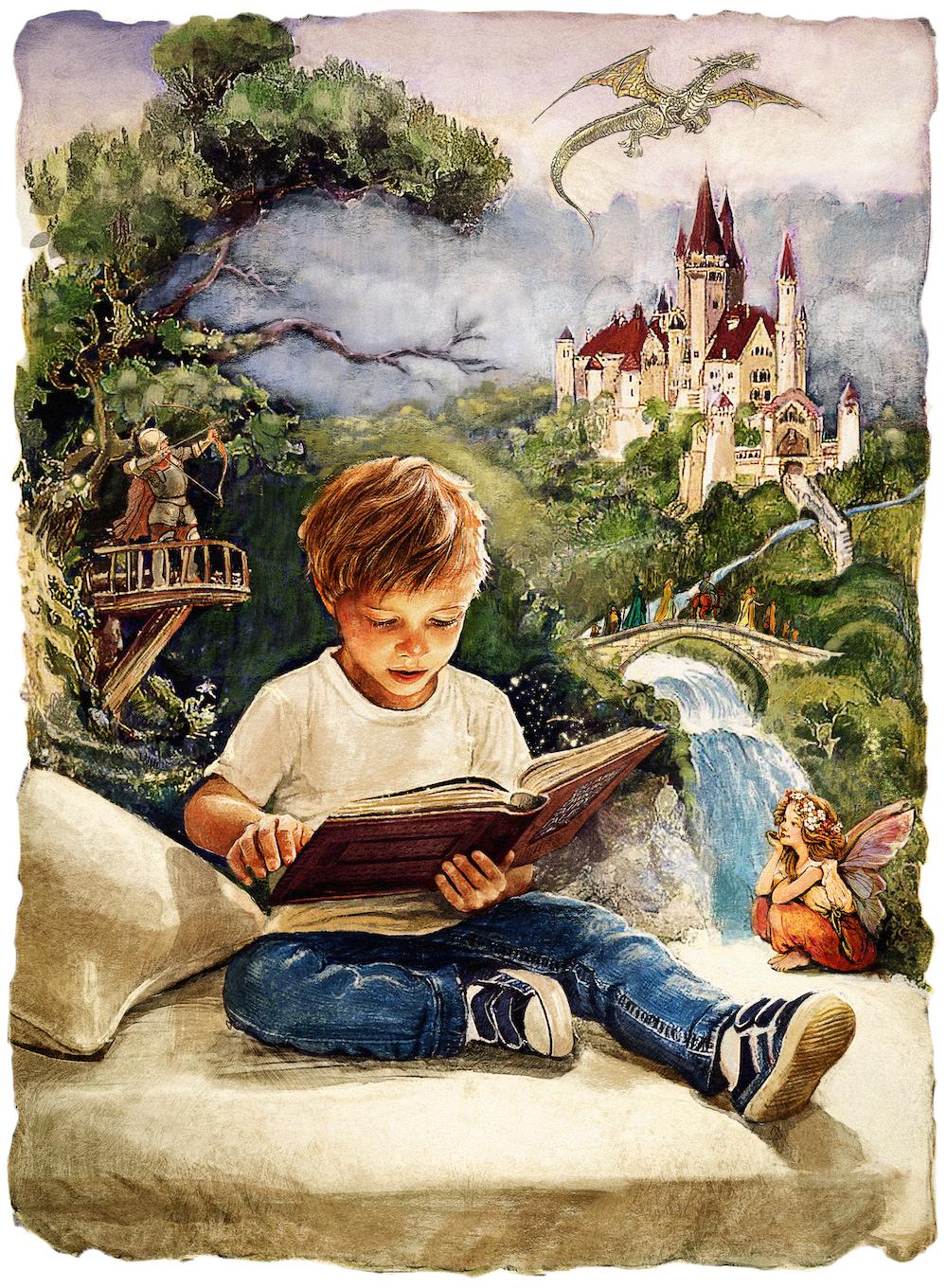
The child who’s been formed by fairy tales and initiated into wonder will grow up with a wordless yearning for fair fields and trees sparkling with dew and waterfalls clearer than air and many-spired castles rising like upraised swords, pointing to the sky. That this yearning for a fairytale land must, like other interests of childhood, mature and grow over time does not make it any less important. The exact form and shape this longing will take in adulthood lies beyond the scope of this article, but I will say simply that the person with a yearning like that possesses a kind of inner compass that will serve him or her well in life. He or she will feel “hiraeth,” the old Welsh word referring to a longing for a homeland.
A fairy-tale-inspired wanderlust and nostalgia help us keep searching for the best and most beautiful things the world has to offer.