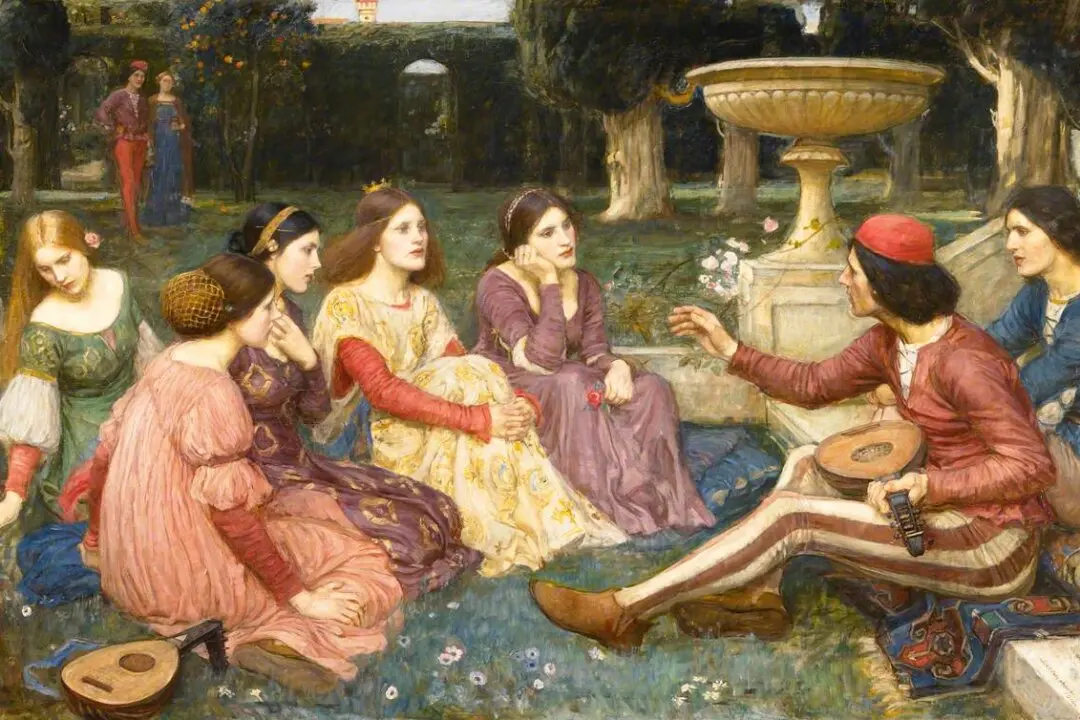
What Was Jane Austen’s Christmas Like?

The traditions we associate with the Christmas season today aren’t far off from the holiday festivities of Jane Austen’s England of 250 years ago.
What Was Jane Austen’s Christmas Like?
"Snapdragon," by Garrett, from the 1899 "American Art and American Art Collections; Essays on Artistic Subjects." Snapdragon was a popular Christmastime game in Georgian and Regency-era England. Public Domain
|Updated:
0:00

Few writers surpass Jane Austen in depicting domestic charm in Regency and Georgian England. The charm and delight of this cozy, fashionable, and mannerly society reached its peak during the Christmas season. In honor of the 250th anniversary of Austen’s birth on Dec. 16, let’s look at the Christmas season during Austen’s era and how it figures in her novels.
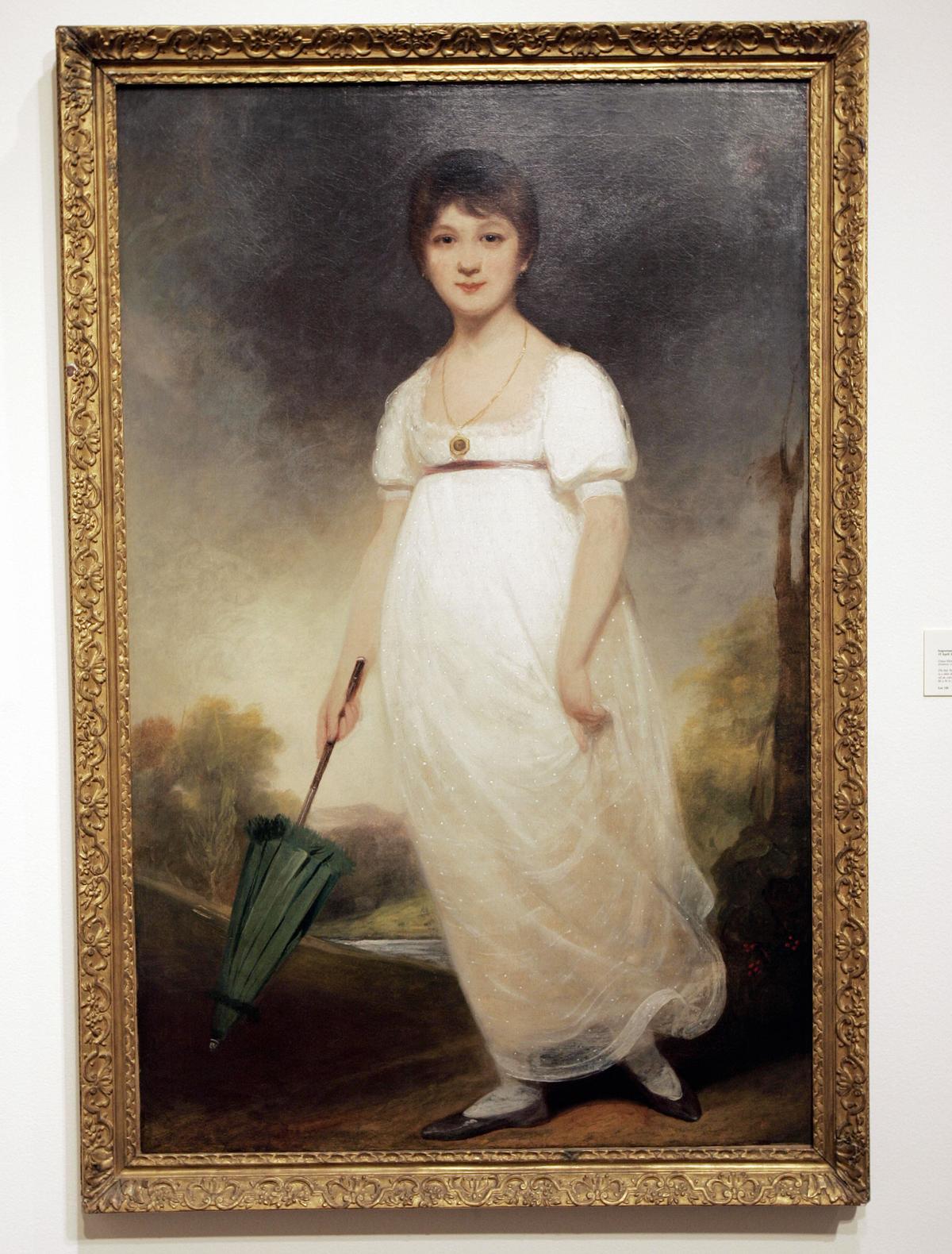
A portrait of Jane Austen by British painter Ozias Humphry (1742–1810). (Stan Honda/AFP via Getty Images)
A portrait of Jane Austen by British painter Ozias Humphry (1742–1810). Stan Honda/AFP via Getty Images

Characters at Christmas

In Austen’s novels, her characters at Christmastime are rosy-cheeked, arms filled with gifts and food, and faces aglow with celebratory joy. Austen mentioned Christmas in all her novels, and one of her most memorable scenes takes place at Christmastime. In “Emma,” the titular character’s family comes to visit for the holidays, and everyone gathers with friends for a Christmas dinner.

Mr. Elton—one of Emma’s admirers—sums up the social aspect of the season:

“This is quite the season indeed for friendly meetings. At Christmas every body invites their friends about them, and people think little of even the worst weather. I was snowed up at a friend’s house once for a week. Nothing could be pleasanter. I went for only one night, and could not get away till that very day se’nnight.”

Mr. Elton has such a good time at the Christmas party, in fact, that he drinks too much and proposes to Emma—who turns him down in a famous comic exchange.

Similarly, in “Pride and Prejudice,” Miss Bingley writes to Jane Bennet about the generally festive spirit of the holiday season:
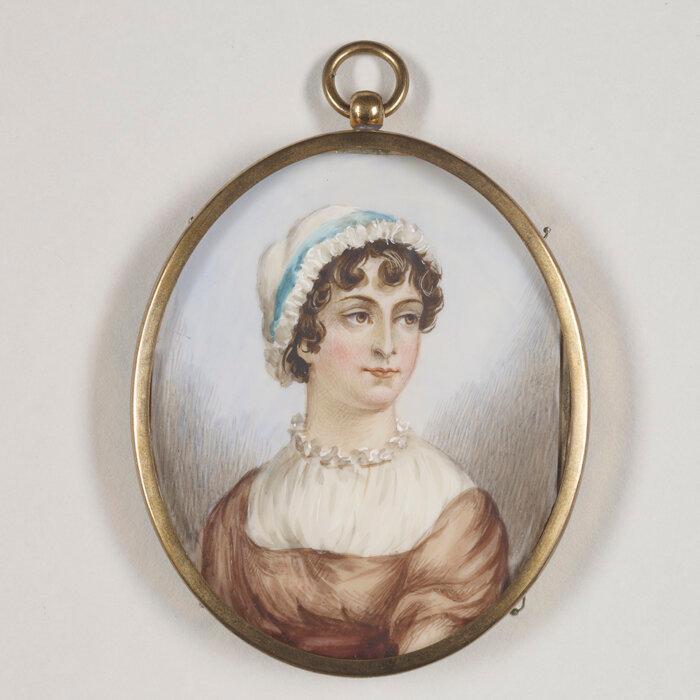

“I sincerely hope your Christmas in Hertfordshire may abound in the gaieties which that season generally brings, and that your beaux will be so numerous as to prevent your feeling the loss of the three of whom we shall deprive you.”
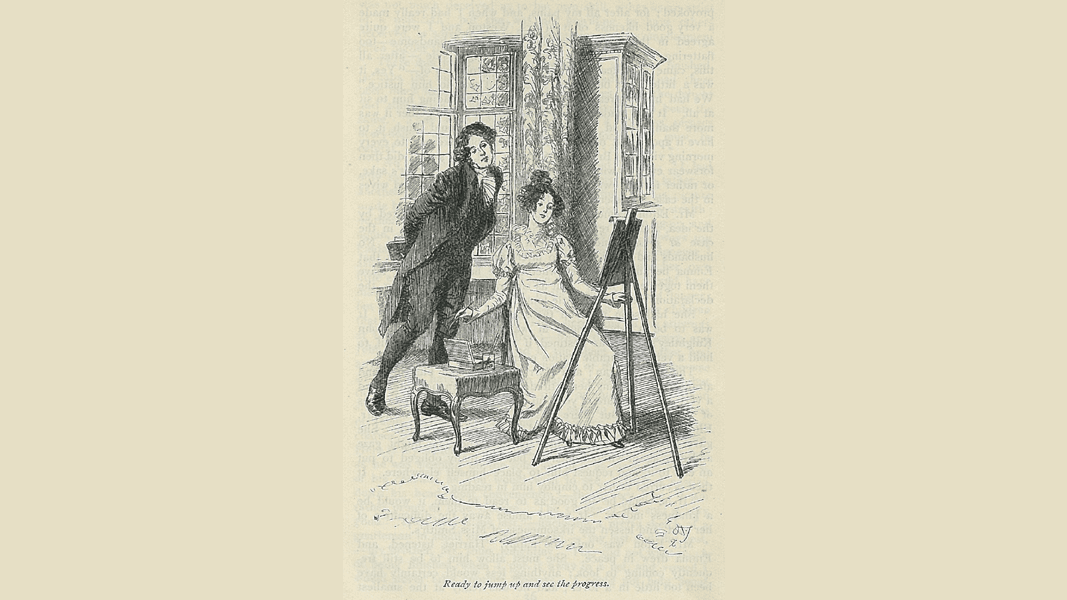
"Mr. Elton and Emma," 1896, by Hugh Thomson.  (Public Domain)
"Mr. Elton and Emma," 1896, by Hugh Thomson.  Public Domain

A Glimpse at the Gaieties

For Jane Austen, the Christmas holidays were a time of religious services, family gatherings, balls, dinners, parties, gift-giving, and doing charitable works. Georgian-era people celebrated many traditions that began before and ended after Christmas Day.

A small preview of Christmas festivities took place on “Stir-up Sunday,” the last Sunday before the Advent season. On this day, families gathered to prepare the Christmas pudding, which needed to be made well in advance so it could age properly before Dec. 25.

But the official Christmas season didn’t begin until Dec. 6, St. Nicholas’s Day, when families and friends exchanged gifts. The landed gentry—Austen’s own social class and the class of most of her characters—spent the season at country houses and estates. It was often a time of family reunions, with children at boarding schools returning home and extended family congregating at one of their fine houses.
On Dec. 21, the traditional feast day of St. Thomas the Apostle, widows, elderly, and the poor would go “Thomasing”: passing from house to house asking for money or other gifts. An old nursery rhyme describes the custom:

Christmas is coming and the geese are getting fat, Please spare a penny for the old man’s hat, If you haven’t got a penny, a ha’penny will do, If you haven’t got a ha’penny, God bless you.

On Christmas Eve, decorations went up in houses. These decorations lacked a Christmas tree, which didn’t become popular in England until the Victorian period, when people were inspired by an Illustrated London News engraving of the royal family around a Christmas tree in 1848.
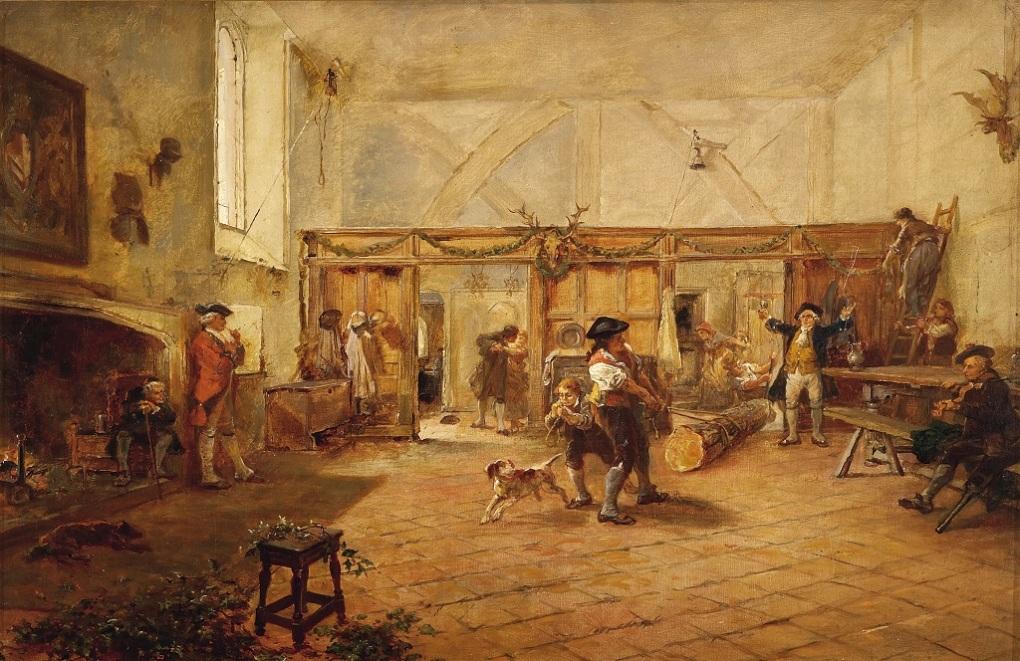
The Yule Log being brought in at Hever Castle, by Robert Alexander Hillingford. The largest possible log was sought out to burn throughout the Christmas season. (Public Domain)
The Yule Log being brought in at Hever Castle, by Robert Alexander Hillingford. The largest possible log was sought out to burn throughout the Christmas season. Public Domain
In the Georgian era, instead of the Christmas tree, people gathered around the fireplace’s blazing, popping fire, fueled by the Yule log, a large piece of wood chosen on Christmas Eve. It was wrapped in hazel twigs and kept burning as long as possible. A chunk of the Yule log would be retained to light the next year’s Yule log.

In addition, poor and rich families alike bedecked their dwellings with wreaths of evergreen, ivy, holly, hawthorn, bay, rosemary, Christmas roses, fruit, holly berries, and ribbons. The traditional mistletoe boughs emerged by the late 18th century.
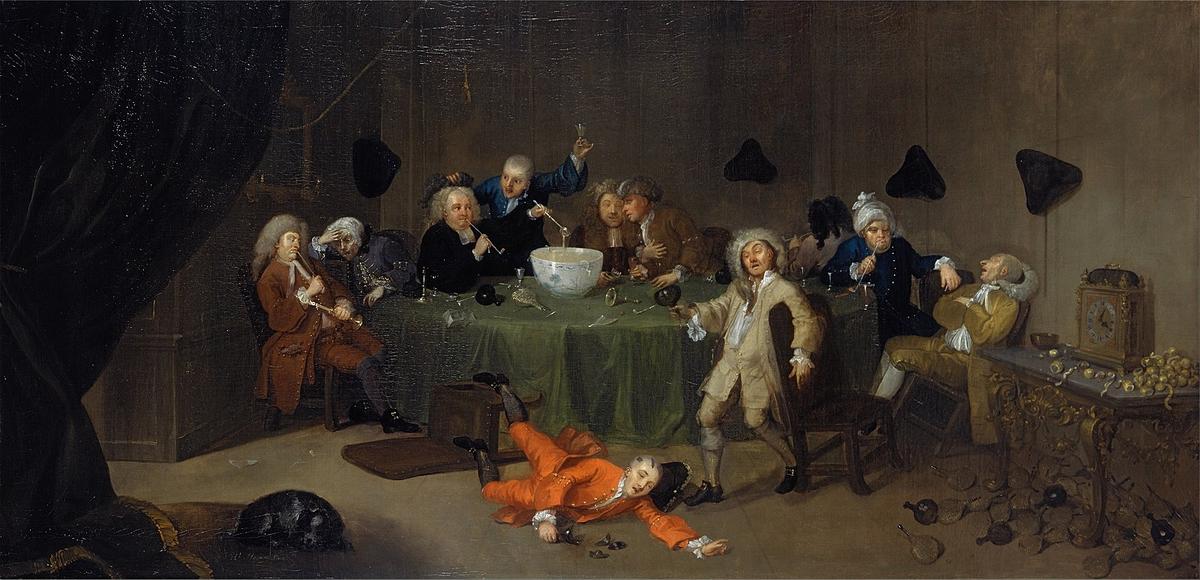
On Christmas day, the people of Austen’s time went to church and then celebrated a sumptuous Christmas dinner. It often featured a turkey, goose, venison, or even a boar’s head. A Wassail bowl might also adorn the table, filled with punch or mulled wine and apples. The pudding made on Stir- up Sunday at last appeared on the table, where it was doused in brandy and set aflame, enhancing the brightness and excitement of the moment. Singing carols and playing parlor games provided the day’s entertainment.
"A Midnight Modern Conversation," circa 1732, by William Hogarth. Yale Center for British Art, New Haven, Conn. This group of revelers is having a festive evening around a Wassail bowl. (Public Domain)
"A Midnight Modern Conversation," circa 1732, by William Hogarth. Yale Center for British Art, New Haven, Conn. This group of revelers is having a festive evening around a Wassail bowl. Public Domain

One of the Georgians’ favorite games was a mildly dangerous pastime called Snapdragon. A bowl full of hot brandy and raisins was set alight, and players attempted to snatch and eat raisins from the flames without getting burnt.

The charitable side of the season re-emerged on Dec. 26, St. Stephen’s Day, when wealthier families gave their servants, tenants, and craftsmen boxes containing gifts and money. For this reason, the day came to be called “Boxing Day.”

The holiday season didn’t end until Jan. 6, Twelfth Night—the holiday that gives its name to Shakespeare’s play. The celebrations ended with a bang: Masked balls, games, and revels took place on this day, and could be quite raucous.
All of that partying wore people out, of course. In an 1807 letter to her sister, written after the close of the Christmas season, Jane Austen sounds tired: “I shall be left to the comfortable disposal of my time, to ease of mind from the torments of rice puddings and apple dumplings, and probably to regret that I did not take more pains to please them all.”

Despite this remark, the joy of the Christmas season shines through at key points in Austen’s novels, revealing what the season looked like for Regency folk, giving us a window into the period and into Austen’s works.


What arts and culture topics would you like us to cover? Please email ideas or feedback to [email protected]
Google LogoMark Us Preferred on Google
Walker Larson
Walker Larson
Author
Before becoming a freelance journalist and culture writer, Walker Larson taught literature and history at a private academy in Wisconsin, where he resides with his wife and daughter. He holds a master’s in English literature and language, and his writing has appeared in The Hemingway Review, Intellectual Takeout, and his Substack, The Hazelnut. He is also the author of two novels, “Hologram” and “Song of Spheres.”