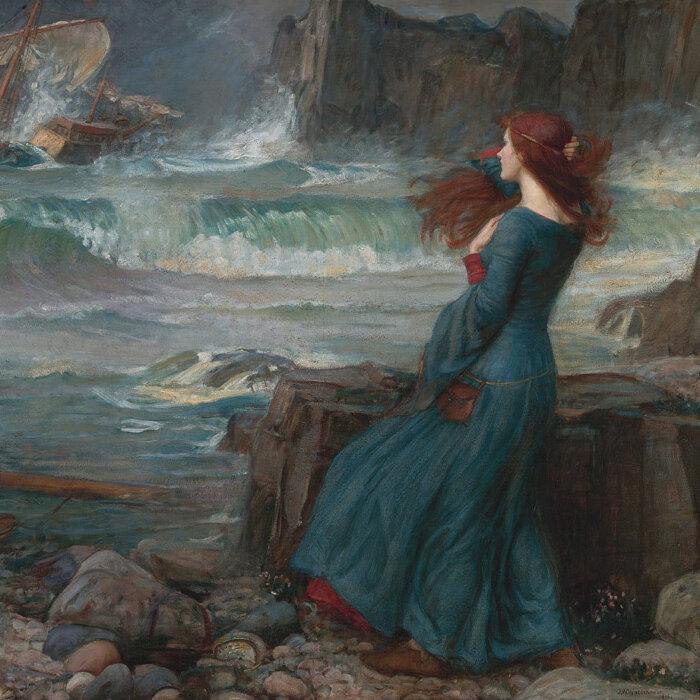
Women, water, and magic were common motifs throughout the oeuvre of British artist John William Waterhouse (1849–1917). Two canvases of the same subject, “Miranda” (1875) and “Miranda—The Tempest” (1916), exemplify these themes.
A Sculpted Painter

Waterhouse was born in Rome to English parents who were painters. When he was a young child, the family returned to London, and his artistic talent was fostered through sketching in the city’s renowned museums. Waterhouse studied formally at the Royal Academy of Arts, pursuing sculpture before settling on painting. He exhibited nearly every year at the Royal Academy of Arts from 1874 to 1917. He was elected to the prestigious status of full Academician in 1895.
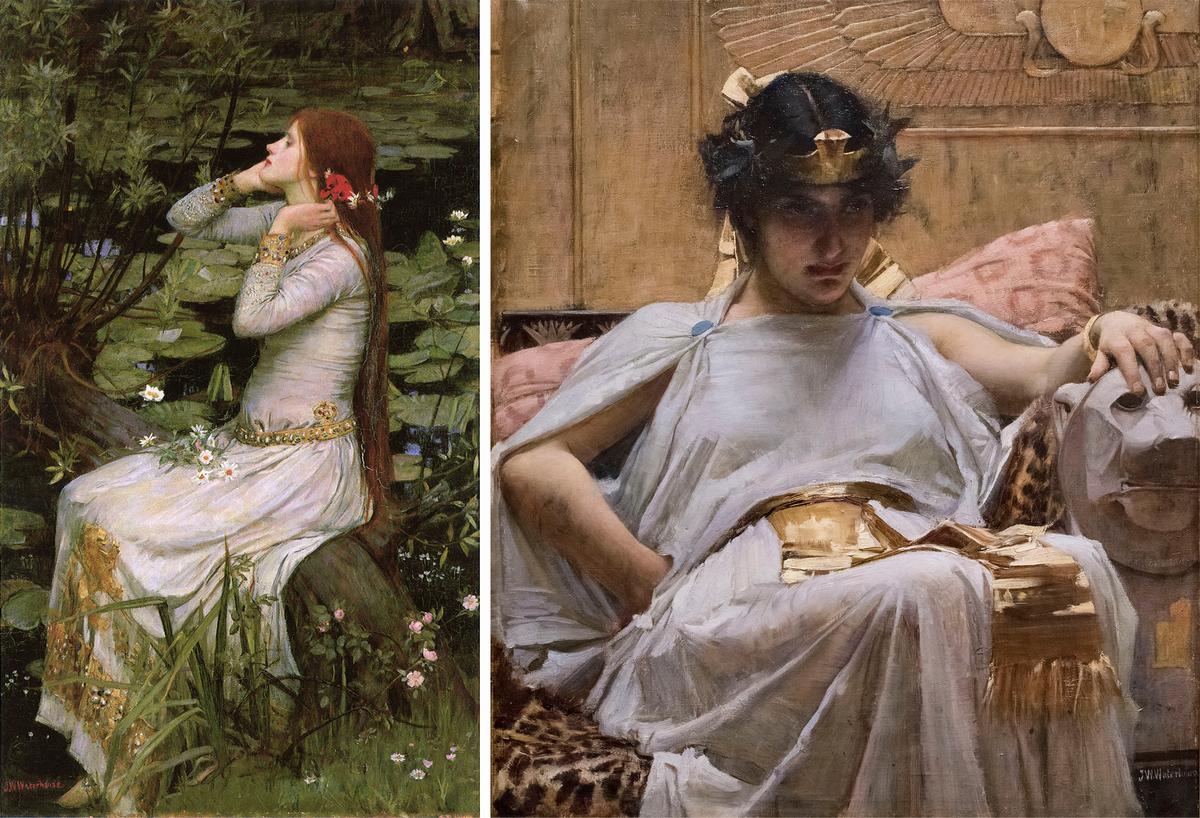
The mature work of Waterhouse continued the traditions of the Pre-Raphaelite Brotherhood. He embraced subjects that had interested the movement’s originators, including mythology, history, and contemporary literature. His canvases center often on a solitary beautiful woman. The 19th-century poem “The Lady of Shalott” by Alfred Tennyson inspired several famous Waterhouse canvases that date to different decades of his career, like his revisited Miranda.
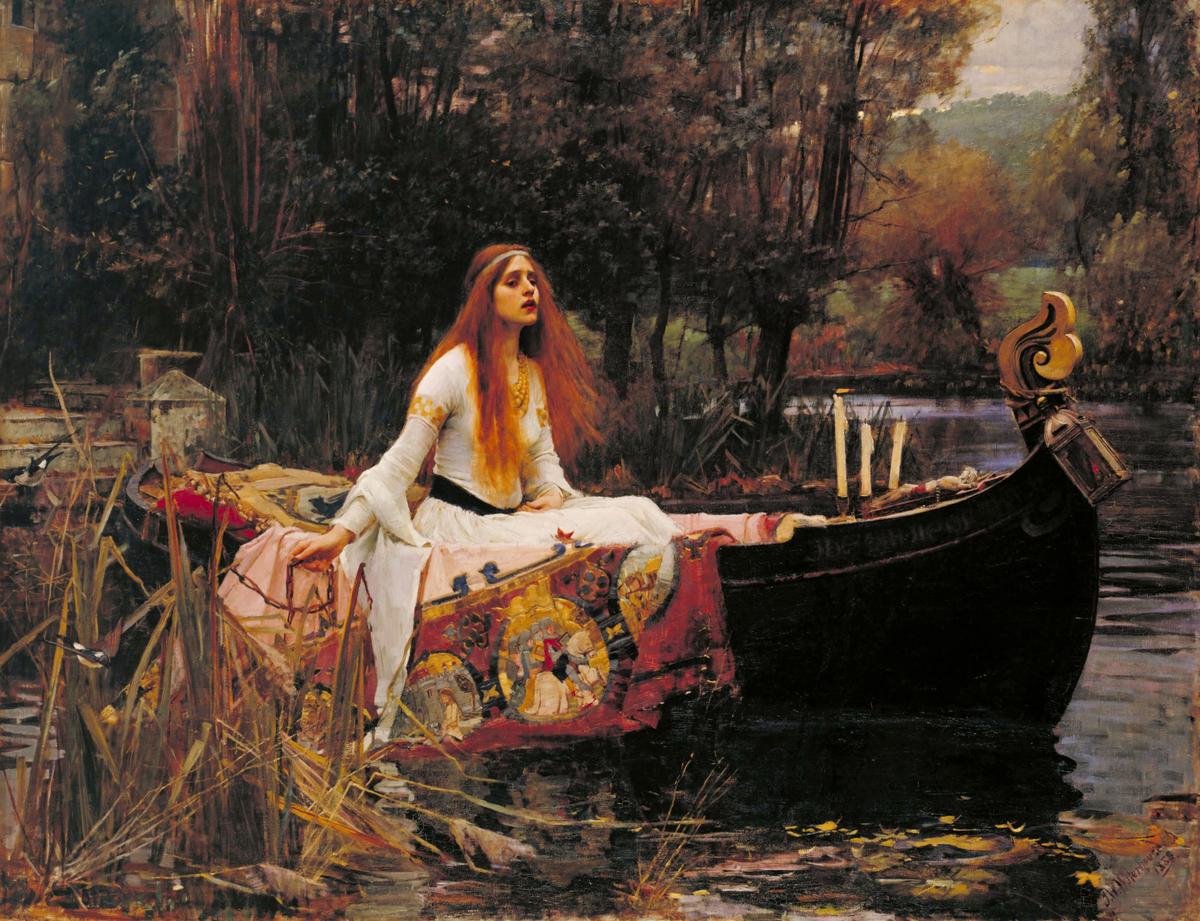
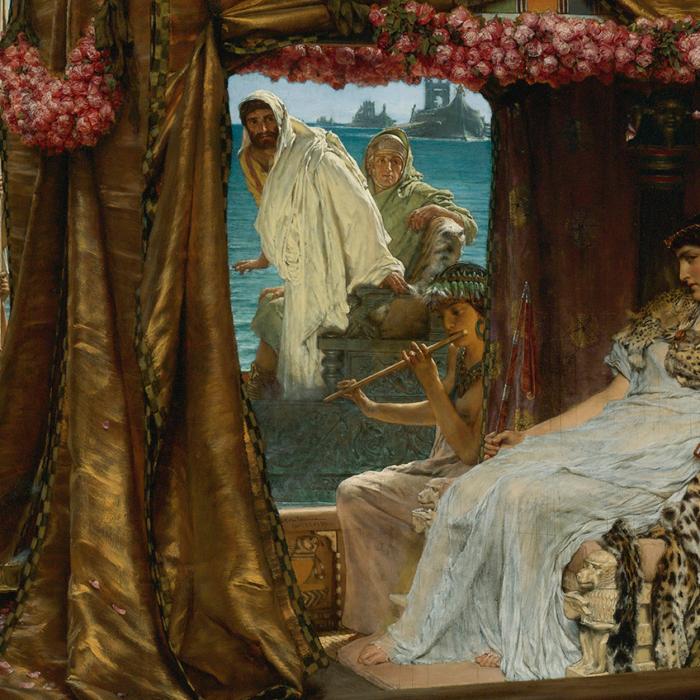
A favorite subject of the Pre-Raphaelites was Shakespeare’s works. In addition to “The Tempest,” Waterhouse drew on other plays by the Bard for inspiration in works depicting Ophelia from “Hamlet,” of which he made multiple versions, and Cleopatra from “Antony and Cleopatra.”
However, early in his career, Waterhouse painted in the Academic style and was influenced by neoclassicism. His 1875 “Miranda” reflects these inspirations, although it was his first depiction of a Shakespearean heroine.
Serene, Poetic Beauty
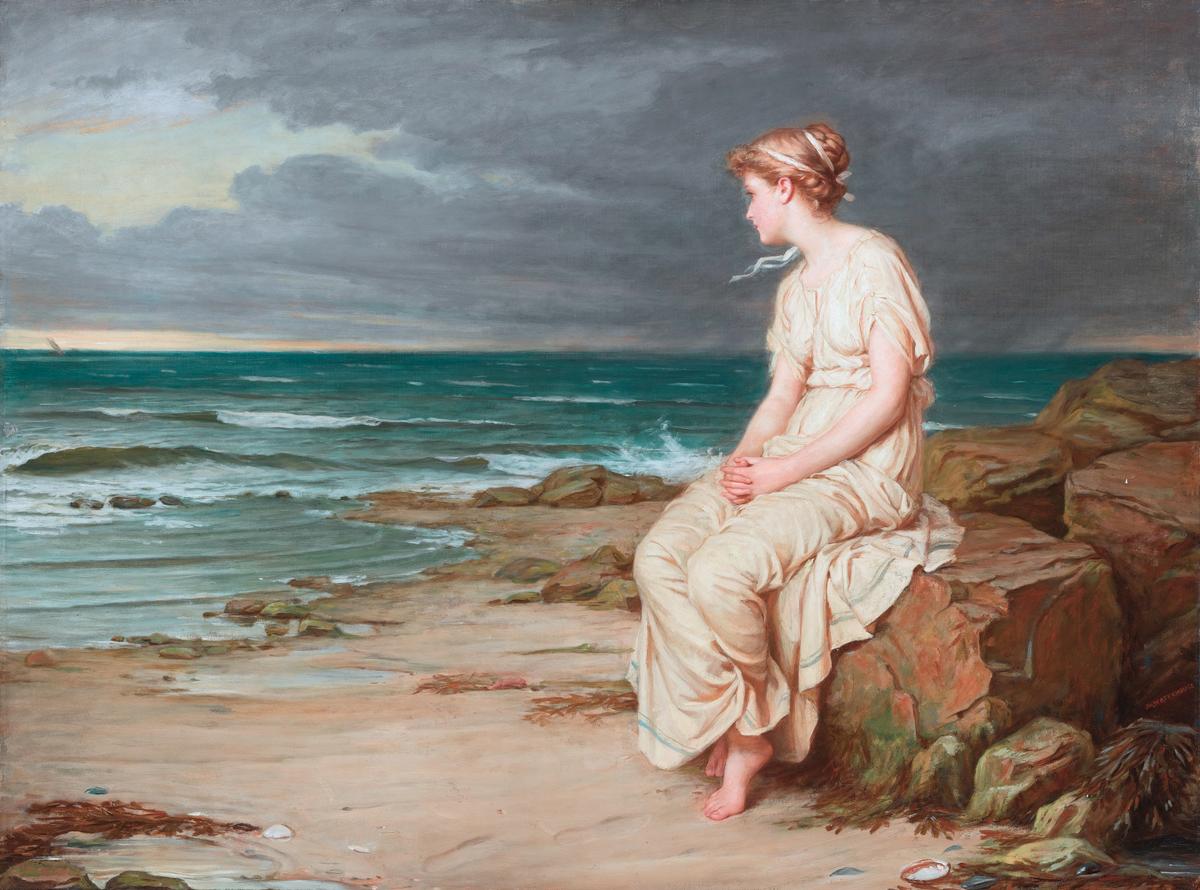
Waterhouse situates Miranda, wearing an ancient Greek chiton and bandeau, on a sandy beach with seashells and seaweed in soft evening light. His interest in classicism, prevalent in his 1870s works, accounts perhaps for his dressing Miranda in such garb instead of 17th-century dress.
Furthermore, Waterhouse may have been referencing the work of his contemporary Albert Moore (1841–1893), who specialized in depicting maidens in drapery in decorative paintings such as “Shells,” which was painted the year before Waterhouse’s “Miranda.” Additionally, Moore’s use of figures depicted with their backs to the viewer may account for Waterhouse’s composition in his own painting.
Interestingly, Waterhouse does not select a visually stirring scene to illustrate. Clouds are gathering, but the water is not particularly rough. Artists were often drawn to the dramatic parts of the play, showing the storm conjured by the magician Prospero (Miranda’s father) and a distressed Miranda witnessing the wreck of a ship that carries Ferdinand (her future husband).
Waterhouse pursued such a vignette in “Miranda—The Tempest,” but in this first picture, he invents his own composition that precedes the opening of the play. “Miranda” is thus a sensitive, personal interpretation of a subject, which is a characteristic of Waterhouse’s art.
Dramatic, Romantic Narrative
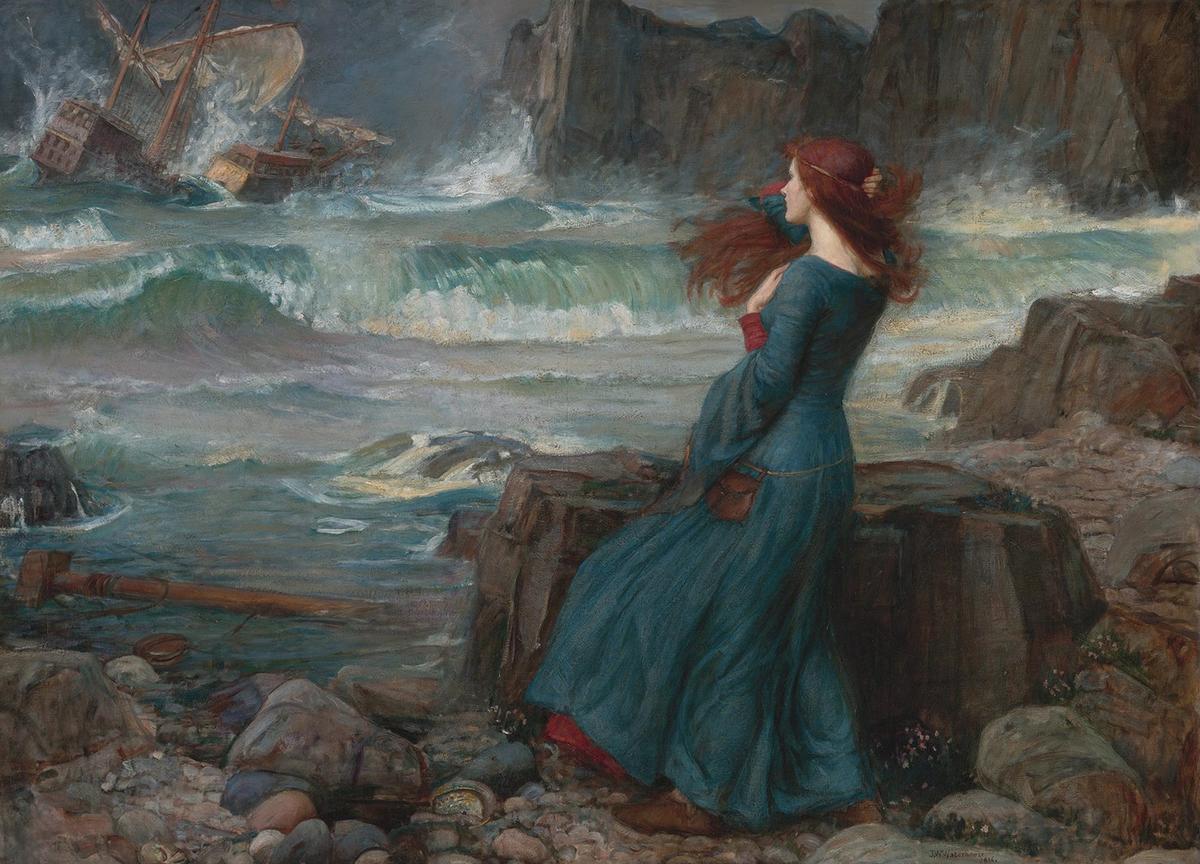
“Miranda—The Tempest” was painted in 1916. It is a more tempestuous treatment: Waterhouse shows a windblown Miranda in 17th-century dress with her left hand on her heart and right hand in her hair as she stands before a stormy shipwreck. The gesture likely refers to these lines spoken by Miranda: “Against my very heart! Poor souls, they perish‘d./ Had I been any god of power, I would/ Have sunk the sea within the earth or ere/ It should the good ship so have swallow’d” (Act 1: 11, 8, 12).
As with his first painting, Waterhouse hides Miranda’s expression from the viewer, presenting her in profile. It was auctioned at Sotheby’s in 2009.
The scholarly theory is that this forceful composition, in such marked contrast to the 1875 painting, was a patriotic stance as a response to the horrors of World War I. During the war, many artists turned to historic British subjects such as Shakespeare’s plays. Miranda’s overflowing heart and feelings of helplessness would have resonated with women whose husbands, sons, and brothers were facing perils abroad. Waterhouse displays brilliantly not only advanced technicality, but also the power to evoke emotion in the viewer through nature, romantic narrative, and feminine mystery.