Shakespeare’s “Romeo and Juliet” explodes with emotions. The passionate hatred of the Capulets for the Montagues and the Montagues for the Capulets is matched by the wildly passion love the title characters have for each other. The whole plot tilts toward inevitable tragedy, for, as Friar Laurence warns Romeo: “These violent delights have violent ends/ And in their triumph die, like fire and powder/ Which as they kiss consume.”
What better subject to serve as the model for a colorful, dynamic, over-the-top piece of majestically Romantic music? The “Romeo and Juliet” Fantasy Overture by Pytor Ilyich Tchaikovsky (1840–1893) is a perfect picture of 19th-century musical excess. Not that excess is a bad thing here—quite the opposite. Music of the 18th century proceeded by similarity, one theme resembling the next, adding up to a likely whole. But 19th-century music proceeded by contrast, with themes clashing like primary colors in a tumbling kaleidoscope.
In 1869, Tchaikovsky was 29. He had composed a First Symphony and an opera, neither of which earned him fame. He had also written a tone poem (a piece of programmatic orchestral music) called “Fatum,” dedicated to his friend, fellow Russian composer Mily Balakriev. It failed (Tchaikovsky later burned the score), both with the public and with Balakirev, who gently criticized his friend and advised a more structured approach to future compositions.
Balakirev had composed an overture on “King Lear” (it never achieved popularity) and suggested “Romeo and Juliet” for Tchaikovsky’s next tone poem. Happily for lovers of the symphonic repertoire, Tchaikovsky took him up on it.

Galina Ulanova and Yuri Zhdanov in “Romeo and Juliet,” in 1954. RIA Novosti/image #11591 / Umnov /CC-BY-SA 3.0
A first version of the score premiered in 1869, and a revision followed in 1870. But it wasn’t until a third version was written in 1880 and premiered in 1886 that the work took fire as an audience favorite. By then, the composer had only seven years left to live. It was to this last rewrite that Tchaikovsky attached the label “Fantasy-Overture,” perhaps to encourage performances as a curtain-raiser. The work remains a programmatic tone poem of the highest order.
The Marvel
Tchaikovsky presents three themes, developing and intertwining them throughout almost 20 captivating minutes. (Watch and listen)The first theme belongs to Friar Laurence—a sepulchral chorale-like theme of great solemnity. Friar Laurence may not seem like a major character beside Mercutio or Tybalt, but he marries the star-crossed lovers after cautioning Romeo of the dangers involved. Friar Laurence’s holy incantations are interrupted by the second theme—jaggedly rhythmic music depicting the warring families. Finally, emerging out of the violence is a love theme that literally soars above the fray. Like many pieces of classical music that have been over-performed, this theme has been lampooned in many a cartoon. But listen to it with fresh ears and you will appreciate its originality.
The three themes unfold in sonata form: They are presented, developed, then brought back transformed. There’s no need for an itemized description of each phrase, for the composer has clearly laid them out for listeners. But notice one particularly special transformation at the very end, just before the concluding timpani roll and final chord. That is the famous love theme, now slowed down and couched in more mournful terms. Yet somehow it suggests that the love felt by Romeo and Juliet persists in a higher, heavenly state.
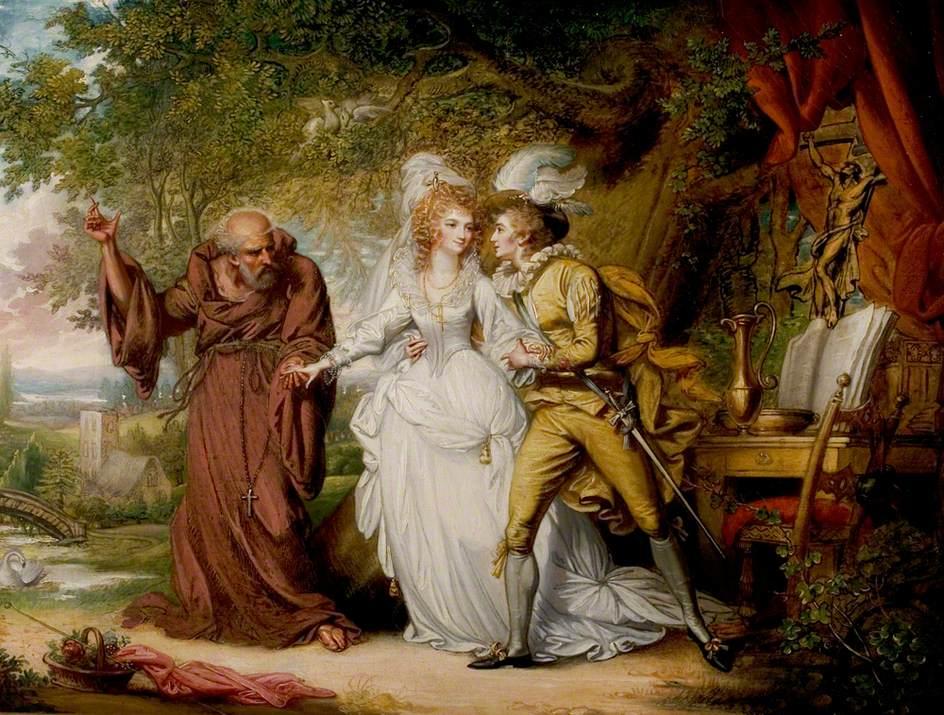
"Romeo and Juliet with Friar Lawrence," circa 1805, by Mather Brown. Royal Shakespeare Company Collection. Stratford-upon-Avon, England. Public Domain
What arts and culture topics would you like us to cover? Please email ideas or feedback to [email protected]