Founding Father Thomas McKean may not have the same name recognition as his more prominent contemporaries, but his legacy is no less colorful and controversial. Outspoken and ambitious with a personality described as “brusque,” the Delaware delegate was once challenged to a duel by the chairman of the Stamp Act Congress in 1765 after a vigorous policy debate.
The blunt politician of Scotch-Irish descent had the distinction of serving as a Delaware delegate in the Second Continental Congress while also serving as chief justice of the Pennsylvania Supreme Court, a position he held for 22 years. At that time, it was permissible to hold public office in different states because the boundary dividing Pennsylvania and Delaware was debatable, and there was no law restricting such an arrangement.
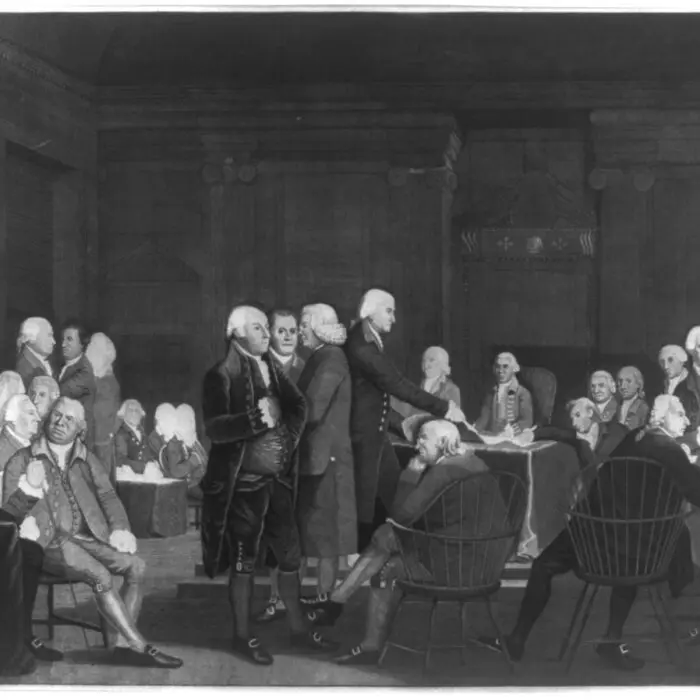
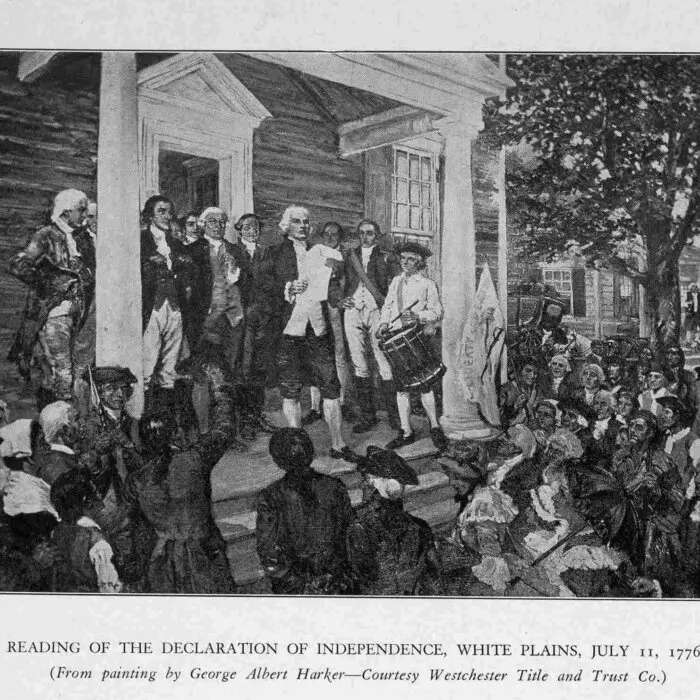
McKean is also believed to be the last delegate to sign the Declaration of Independence. After voting for independence, McKean, a colonel with the Pennsylvania militia, joined his unit as they marched to assist Washington in the unsuccessful defense of New York City.
Dates vary as to when McKean actually signed the founding document, but evidence points to sometime between late 1777 and 1781, at the latest, when he became president of the Continental Congress.
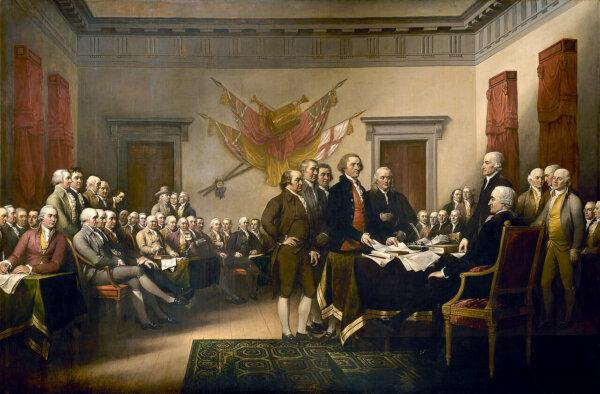
"Declaration of Independence," 1819, by John Trumbull. McKean is featured among the revolutionary delegates representing Delaware. Public Domain
Family Roots
McKean was born to William McKean and Letitia Finney McKean on March 19, 1734, in New London Township, Chester County, Pennsylvania. He was educated at home until age 9, when he and his brother Robert continued their education at the New London Academy in Pennsylvania. After finishing his studies there, he moved to Newcastle, Delaware, to study law under his cousin, David Finney.He was admitted to the Delaware bar in 1754 before the age of 20 and continued his legal training in London before returning to the colonies. He quickly built a successful legal career and soon entered politics, becoming deputy attorney general for Sussex County, Delaware, in 1756. He was elected a Delaware assemblyman in 1762 and served as speaker several times until his departure in 1779.
McKean was an early and passionate advocate for colonial rights. He was active in the Stamp Act Congress and grew into a colonial leader in the resistance to British policies.
The Push for Independence
As a Delaware delegate voting for independence in 1776, it was McKean who convinced fellow delegate and cancer-stricken Caesar Rodney to ride 80 miles through a thunderstorm to cast the deciding vote for independence. Unfortunately, Delaware didn’t share their representatives’ zeal for severing ties with Great Britain and both men lost reelection in October of 1776.Undeterred, McKean won back his delegate seat the following year and helped draft the Articles of Confederation. McKean also served as the acting president (what is now governor) of Delaware from Sept. 22, 1777 to Oct. 20, 1777, until the rightful successor could take over after the then-president was captured during the War of Independence.
McKean experienced a similar circumstance in 1781 when President of Congress Samuel Huntington resigned due to ill health. McKean served 118 days until John Hanson became the first president to serve the full one-year term as proscribed by the Articles of Confederation that McKean helped write. During his brief stint as president of Congress, Britain’s Cornwallis surrendered to Washington at Yorktown, ending the Revolutionary War.
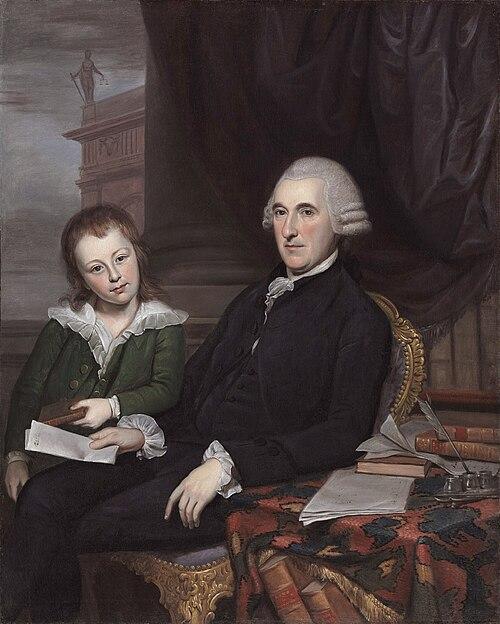
"Portrait of Chief Justice Thomas McKean and His Son, Thomas McKean, Jr.," 1787, by Charles Willson Peale. During McKean's 22-year career on the bench, he helped establish key legal rules, such as judicial review, while juggling public duties in two states. Public Domain
Judicial Legacy
Sometimes referred to as a Forgotten Founding Father, some of McKean’s most significant accomplishments came while serving as chief justice on the Pennsylvania Supreme Court.When Pennsylvania rewrote its state constitution to more closely mirror the new U.S. Constitution in 1790, McKean helped establish the precedent of “judicial review” on the state level a decade before “Marbury vs Madison” did the same on the federal side. This precedent established judicial review as a significant check on unconstitutional laws created by the legislative branch.
Justice McKean’s judicial decisions helped establish Pennsylvania as one of the most influential state courts following independence, leading the way in protecting defendants’ rights and penal reform. Conversely, his rulings were slow on recognizing the rights of women and processing the gradual elimination slavery in the Keystone State.
Pennsylvania Governor
In 1799, McKean retired from the Pennsylvania Supreme Court to successfully run for governor as a Jeffersonian Republican. Formerly a staunch Federalist, he left the party in 1796 due to dissatisfaction of its domestic policies and its decision to align with Britain rather than France.He served three terms as Pennsylvania governor, helping to expand free public education, but there was also controversy. He purged Federalists from government offices, creating what became known as the spoils system. The spoils system refers to an election winner rewarding supporters with government jobs or other benefits. It often means replacing previous party officials with one’s own. When running for his third term, McKean was at odds with the Republican party. When the General Assembly nominated someone else, McKean again ran as a Federalist, winning a third term and surviving an impeachment attempt after purging Jefferson supporters from state offices.
McKean retired from politics in 1808, spending his retirement years in Philadelphia, where he continued writing about politics before his death in 1817 at the age of 83.
Today, Thomas McKean is remembered as an influential but controversial founder whose versatility and intellect helped shape government and the judiciary.
What arts and culture topics would you like us to cover? Please email ideas or feedback to [email protected]