At approximately 2 p.m. on Sept. 7, 1876, all hell broke loose on the streets of Northfield, Minnesota.
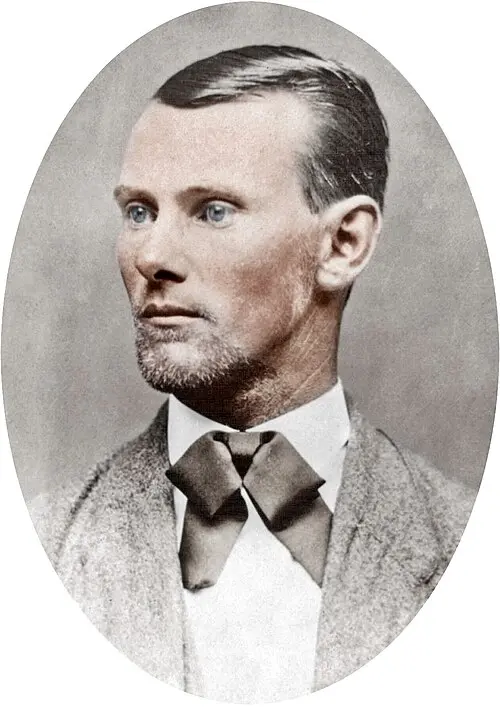
A few of Northfield’s approximately 2,000 citizens had already taken note of the eight strangers who had ridden in three separate groups into town, all wearing white linen dusters and with horse bridles decked out in silver. Five of these men—Jesse James, brothers Cole and Jim Younger, Clell Miller, and Bill Stiles—tethered their horses and loitered on Division Street near the prosperous town’s First National Bank. The three others—Charlie Pitts, Bob Younger, and Frank James—strode into the bank, now empty of customers.
Pulling their guns, one jumped through the teller’s open window while the other two leaped onto the countertop and took aim at the three employees. Bank clerk Frank Wilcox later recounted that the men had been drinking—“the smell of liquor was very strong”—and that one of them shouted, “Throw up your hands! We are going to rob the bank.”
A Study in Contrasts
The eight men who rode into Northfield that day were all criminals accustomed to violence and murder. In a glaring understatement made after his arrest, a wounded Bob Younger later said to his captors, “We are rough men and used to rough ways.”Along with two of the Younger brothers, Jesse and Frank James first tasted blood while riding with Quantrill’s Raiders during the Civil War. They participated not only in military actions, but also in atrocities. In the 10 years that followed the war, the men turned to crime, robbing banks and trains, and sometimes killing those who resisted. Their faces and reputations were familiar to lawmen, Pinkerton detectives, and bankers throughout the West.
The town they chose for this day’s holdup included a college, a preparatory school that would become a college, a railroad, and thriving businesses, including Allen’s hardware store. Grain mills and Holstein dairies were the county’s two primary enterprises. Northfield was a peaceful community and should have been a pushover for the outlaws, yet within seconds of Allen sounding the alarm, several men sprang into action to defend the bank.
These citizens had good reason to snatch up guns and ammunition. Inside the bank’s safe was more than $15,000 ($468,150 today). That seems a paltry sum, yet in that time, there was no government guarantee or private insurance protecting that money as there is today. Had the James-Younger gang gotten into that safe and escaped, many citizens’ savings would have departed with them, likely crippling the local economy for decades.
The Fight
As is so often the case with such events, actions recorded later by eyewitnesses or dramatized by writers give differing accounts of what happened that day. Several sources falsely claimed that the James-Younger outfit burst into town, whooping and with pistols blazing, to frighten citizens off the street. Here we’ll turn to the local newspaper, the Rice County Journal, and to the Northfield History Center as our chief sources.Once Allen raised the alarm, two gang members jumped on their horses and rode up and down the street, firing pistols into the air and shouting for people to clear the street. They were soon joined by the other three accomplices stationed nearby. Somewhere in this initial fracas, Swedish immigrant Nicolaus Gustafson, who understood little English, was shot in the head. He wouldn’t be the only one to die in the ensuing carnage.
Medical student Henry Wheeler, was sitting outside the Dampier House Hotel across the street from the bank when Allen raised the alarm. Within a couple of minutes, he had gotten hold of an Army carbine in the hotel’s lobby, dashed upstairs, and began picking off his targets, killing Miller and wounding Bob Younger. The owner of the town’s other hardware store, Anselm Manning, snatched a rifle from his stock and spotted outlaw Bill Stiles as he sought to escape the melee. According to the editors of the Time-Life book “The Wild West,” one witness later reported that Manning took aim and fired “as cool as though he was picking off a squirrel.” Several others joined the two men in blasting away at the invaders.
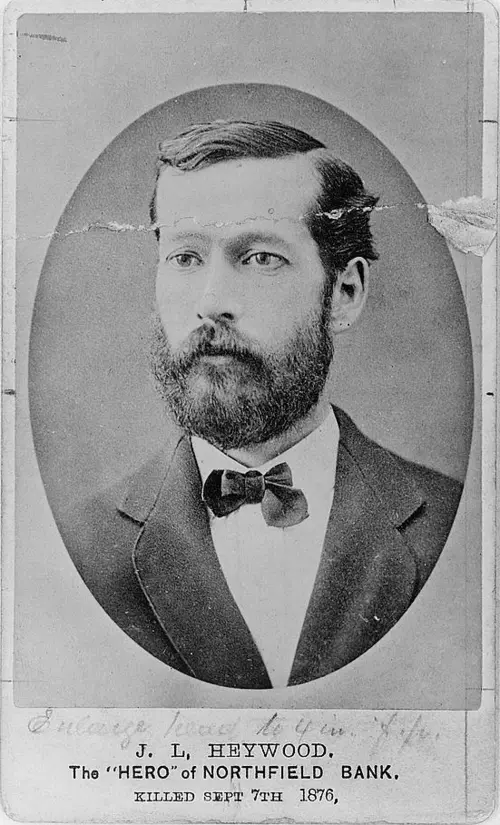
Meanwhile, inside the bank, chaos ensued. One of the gang members, likely Frank James, ordered the bank officer, Joseph Lee Heywood, to open the safe. Though putting himself at risk, Heywood lied to him, claiming the safe was on a time lock. When James attempted to enter the vault to get at the safe, Heywood tried to shut the door, and James struck him on the head with his pistol, knocking him temporarily unconscious to the floor. When the firing outside the bank erupted, distracting the robbers, the bank’s teller, Alonzo Bunker, fled out the back door. Pitts pursued him and shot him in the shoulder, but Bunker successfully made his getaway.
By now, as the Journal reported, Cole Younger was shouting from outside for them to give up the robbery: “For God’s sake, come out, they are shooting us all to pieces!” Pitts and Bob Younger fled the bank with $26.70. As Heywood staggered to his feet, Frank James turned and shot him through the head, then followed the other two men.
Aftermath
Despite the intensive hunt, Jesse and Frank James, both unhurt, escaped this dragnet of men and horses. They formed a new gang in 1879 and returned to robbery, but Jesse was shot in the back of the head by an acquaintance, Robert Ford, seeking the reward offered for him dead or alive. Afraid he would meet the same fate, Frank turned himself in, was later freed, and spent his life on a farm, though he once operated a Wild West show.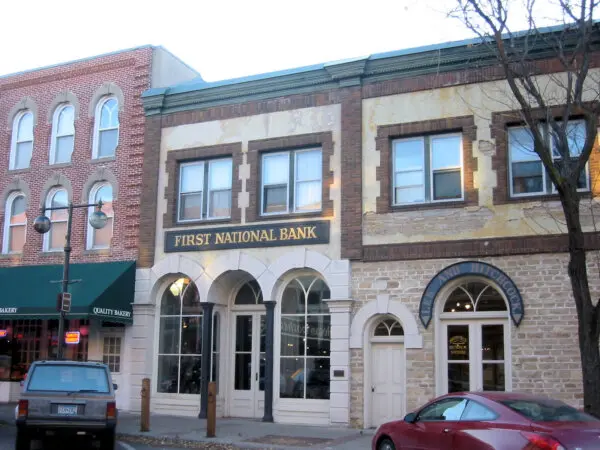
The three Younger brothers, all wounded, and Charlie Pitts were surrounded 15 days after the Northfield debacle near Madelia, Minnesota. In the ensuing gun battle, Pitts was killed, and the brothers were once again shot; the Youngers surrendered. Bob Younger died of tuberculosis in prison, Jim Younger committed suicide soon after his release in 1901, and Cole Younger, for a time, joined the Wild West show with Frank James, where he spoke at times on the evils of a life of crime.
In Northfield, the townspeople rightly regarded J. Sim Allen, Henry Wheeler, and Anselm Manning as heroes in the gun battle, but reserved their greatest honors for the murdered bank clerk Joseph Lee Heywood, who, as the Rice County Journal announced in its headlines, “was Shot Dead at his Post—Would not open the Safe.” All recognized that Heywood had prevented serious damage to the town’s well-being by refusing to open the safe, thereby preserving the theft of its savings. Grateful bank officials awarded his widow and daughter a substantial sum for his bravery and more than 450 banks from across the nation contributed to the “Heywood Fund,” allowing Heywood’s grieving family to live in relative comfort.
Every year, on the weekend following Labor Day, Northfield celebrates the Defeat of Jesse James Days. The town features reenactments of the robbery, a rodeo, an art show, and other events that draw thousands of visitors. Just as importantly, since 1983, the Heywood Award committee has annually recognized an outstanding Northfield citizen for contributions to the community to “remind us of our past and our promise to improve our community for the future.”
There is a legacy and a call to noble ambition applicable to all of us.