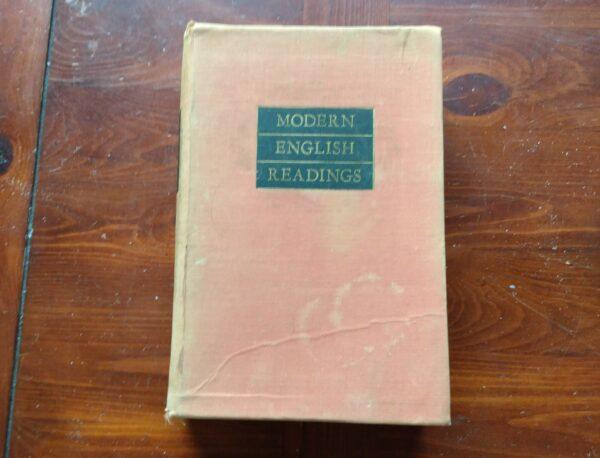
At the top of the first page of my copy of “Modern English Readings” (MER) is this inscription: “Mr. & Mrs. James E. Minick ’46.” That succinct claim of ownership hides a chapter of family history. This was the year my parents married. This was the year my father received his discharge from the U.S. Army after fighting as an infantryman with the 88th Division in Northern Italy against the Germans. And this was the year my parents entered Pennsylvania’s Westminster College, where they read and studied from textbooks like this classic guide to composition and literature.
“All writing worthy of the name of literature confers on the sensitive reader a thrill of pleasure,” reads the first sentence of the MER’s “Introductory,” and the book then sets out to prove that assertion. Originally published in 1934—mine is the 5th edition, 1946—this textbook, with its 1,092 pages, was common in college classrooms across the country. Designed for freshman composition and literature classes, it inadvertently represents America’s postwar prosperity. While nations like Britain and France faced paper shortages for several years, the United States had clearly recovered from wartime paper rationing.
The objectives of the anthology cited in its “Preface” also bear witness to the war. MER’s threefold intention is teaching composition through the use of models of prose and poetry, “the quickening of the student’s interest in literature by giving some of the best fiction, drama, essays, biography, and poetry of the last hundred years to read attentively and to enjoy,” and introducing “those problems which, today more than ever, if left unsolved or wrongly solved, mean individual misery and a world in utter chaos.”
Then and Now: A Different Slant
Let’s note first that the two Columbia University professors who edited this thick collection, Roger Sherman Loomis and Donald Leman Clark, were not themselves modernists. Loomis was renowned among scholars for his work in Arthurian literature. Clark did teach rhetoric and composition, but his literary field of expertise was John Milton.Yet clearly these two men were familiar with literature in English from the 19th century to the middle of the 20th. Here we find the name of writers still familiar today, like Willa Cather, Somerset Maugham, Robert Frost, and James Thurber. Then-popular poet and short story writer Stephen Vincent Benet appears several times, while F. Scott Fitzgerald and William Faulkner are nowhere to be seen, the former regarded at the time as passe, the latter little known.
Names now obscured by the passage of time, like journalist Betty Fible Martin and free speech advocate Alexander Meiklejohn, account for a sizable portion of the MER’s writers. Though instructive and a pleasure to read, some of the nonfiction pieces also address topics now of little concern, like “The Lessons of TVA,” “The Radio Boom and the Public Interest,” and “Three Kinds of Hash,” which refers not to street drugs but to food.


Of all these authors and topics, even a casual 21st century observer will notice that some of today’s political and cultural minefields, like diversity, equity, and inclusion (DEI), mass migration, and climate change, are nowhere to be found in these readings. The writers who do address politics write chiefly on the maintenance of freedom and the rebuilding of the war-torn world.
Then and Now: Students
An even sharper contrast with our era today can be drawn in the approach of this book to its students. In their “Introduction” and the brief notes preceding each genre of selections, Loomis and Clark treat their students as adults. There is no pandering. It’s a serious book without illustrations of any kind, its prose clotted with dense paragraphs, longer sentences, and an elevated vocabulary absent in today’s student reading.One article particularly pertinent to our own time is a 1941 essay “Education for Freedom.” Here Robert Maynard Hutchins, then president of the University of Chicago and co-founder with Mortimer Adler of the Great Books Foundation, criticizes the weak reading and writing abilities of entering students. In his essay he also strongly supports the study of “the liberal arts, the arts of reading, writing, speaking, and calculating. Education for freedom consists in transmitting to the rising generation the civilization they have inherited, together with the technics by which it may be understood.”
Hutchins’s critique of student reading is even more applicable to our schools today. Reports from studies and from the experiences of professors in upper-tier colleges like Harvard and Yale contend that many students lack the stamina and focus to make their way through a book, even novels, with the blame for this inattention generally assigned to cell phone and screen usage.
Of equal concern for the future of our country is the yawning gap between Hutchins’s vision of a liberal arts education as a handing over of a civilization to the next generation and education today. The material assembled in MER takes aim at that transmission, whereas many 21st century students are steeped in ideas and ideologies no older than a few decades, with little or no knowledge of the history, literature, and arts that have gifted them a civilization.
At the end of this anthology is a poem by James Oppenheim, “The Slave,” whose last line runs: “Free men set themselves free.” Americans in 1946 knew that free men also kept themselves free.
“Modern English Readings” offers these lessons again and again. We need to take that message from this monument of the past and teach our children the same.