The ancient Greek philosopher Plato is credited with the aphorism “Science is nothing but perception.” But what happens when perception morphs into a political platform that seeks to force its partisan will on scientific education? What also happens when scientists and professors try to protest the imposition of this ideology?
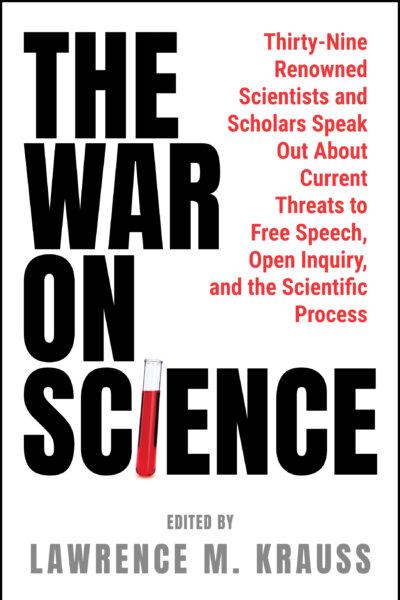
Lawrence M. Krauss, the distinguished theoretical physicist, has recruited 39 prominent scholars, researchers, and scientists to share their observations and experiences on what they view as an extreme ideological assault on the basic tenets of their profession. The result is “The War on Science,” which makes a provocative argument that higher education is under siege.
Krauss explains in his introduction that today’s academic environment has become strangled by identity politics. Those who practice this ideology have a preternatural touchiness about having their ideas questioned, Krauss adds, and they are not shy about punishing those who don’t agree with them.

Hostility
The book emphasizes that much of this environment is based on a hostility to almost anything associated with a white European heritage. Sergiu Klainerman, the Higgins Professor of Mathematics at Princeton University, details in his essay “Radical Equalitarianism and Mathematics” that some professors insist algebra and geometry are symbols of white privilege because of their roots among the ancient Greeks. But as Klainerman points out:“One obvious problem with these views is that mathematics did not originate in Europe. Our contemporary number system, which makes crucial use of the concept of zero, had its origins in India. The numbering system became more widely known through the writings of the Persian mathematician al-Khwarizmi and the Arab mathematician al-Kindi. It was then popularized in the West by Fibonacci in his book, ‘Liber Abaci.’”
Anna I. Krylov, the University of Southern California Associates Chair in Natural Sciences, and statistician Jay Tanzman collaborated on the essay “Spotlight on Scientific Research.” The essay details how nonscientific outside forces are pressuring scholars to think a certain way.


They recall how a paper titled “Meta-Analysis: On Average, Undergraduate Students’ Intelligence Is Merely Average” was removed from the peer-reviewed Frontiers of Psychology after users on Twitter (now X) angrily complained that the concept of the paper was offensive. This was despite the fact that only the abstract was online and the full research wasn’t available for public view.
Krylov and Tanzman also warn that scholars were made into pariahs when their research offered conclusions antithetical to certain political talking points. One scholar was Harvard economist Roland Fryer, whose career was threatened. The statistical evidence in Fryer’s published research showed no racial bias and affirmed the use of deadly police force in the United States.
Multiculturalism
Another issue raised in the book is whether the advocacy for multiculturalism is at odds with basic educational standards. Jerry Coyne, professor emeritus in the Department of Ecology and Evolution at the University of Chicago, and Luana S. Maroja, a professor at Williams College, use their joint essay to detail the New Zealand example of incorporating Maori traditions into contemporary university studies.The authors share that New Zealand’s students are learning that the Polynesian ancestors of the Maori were the first to discover Antarctica in the seventh century, even though there is no evidence to support that claim. They also highlight teaching university students about the supposed benefits of using traditional Maori herbal and spiritual remedies for medical treatments; the authors point out that there is no clinical testing to support their effectiveness.
Coyne and Maroja stress that they aren’t belittling the Maori experience. But they warn: “Conflating indigenous knowledge with modern science will confuse students about what constitutes knowledge and the nature of science itself.”
“The War on Science” ventures into several controversial political topics that have permeated scientific education. The book points out how the accommodation of transgenderism is radically redefining biology studies.
There is also the question of having professors use their academic authority to make political statements on nonscientific subjects, most notably regarding the war in Gaza.
The rise of antisemitic incidents on today’s college campuses is addressed in “The Treason of the Intellectuals,” an unsettling history lesson by Sir Niall Ferguson, a senior fellow at Stanford University and Harvard University. Ferguson finds unsettling parallels between the hostility against contemporary Jewish students and the early years of the madness that disfigured Germany in the 1930s.
Some authors who contributed essays to “The War on Science” may be familiar to readers based on their television and social media prominence. These include Oxford professor Richard Dawkins and Canadian psychologist Jordan Peterson.
While a book on the state of scientific education might seem a bit esoteric for readers outside of that field, “The War on Science” needs to be read by anyone concerned about today’s academic environment and the damage it could inflict on tomorrow’s world.