A British Frolic
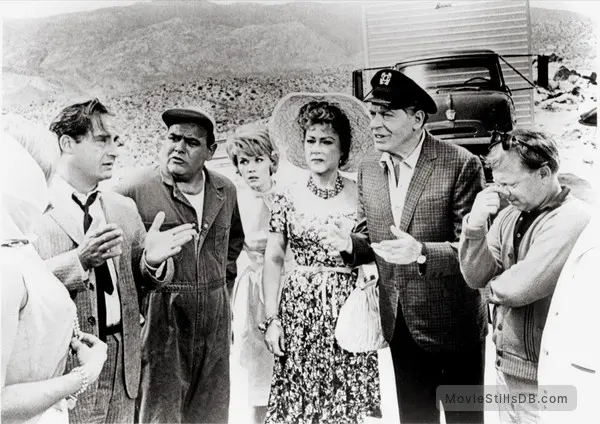
The film was conceived by William Rose, an American working in the British film industry who wrote the classics “Genevieve” (1953), “The Ladykillers” (1955), and “The Smallest Show on Earth” (1957).
Rose envisioned a comedy about a group of motorists who witness a wild automobile crash. The driver of the wrecked vehicle is a fugitive who uses his dying breath to tell the motorists where he buried an ill-gotten fortune. From there, according to Rose, “we have ‘Greed’ on wheels” as the story becomes a Mack Sennett-worthy scramble to find the hidden money.
Rose’s story, titled “Now for a Frolic,” was to be filmed in Britain with that nation’s leading comic actors. But he decided the feral aspects of the story belonged across the Atlantic.
“Americans are incomparably a more violent society,” Rose stated as he began pitching Hollywood.
An All-Star Team
Curtis effectively details how Kramer and casting director Lynn Stalmaster assembled an all-star comedy cast. Initial choices Jackie Gleason, Red Skelton, and Carol Channing were unavailable. At 75, Sophie Tucker was considered too elderly for the cantankerous mother-in-law role, which was cast with Ethel Merman.

Mort Sahl was rejected due to his inadequacies with scripted material. Stan Laurel and Harold Lloyd declined to come out of retirement for cameo appearances.
Milton Berle became available after withdrawing from the Broadway musical “A Funny Thing Happened on the Way to the Forum.” Sid Caesar was committed to the Broadway musical “Little Me” and an ABC variety series, but agreed to fit the film into his schedule.
An Uphill Challenge
“Comedy Is a Grim Business” gets its title from Kramer’s post-production sigh of exasperation. Curtis does an extraordinary job in detailing how the film drove the filmmaker to fatigue.Kramer’s scope of physical comedy was without precedent. There were multiple high-speed automobile pursuits, daredevil airplane maneuvers, and complex chase scenes with stunt doubles wearing latex masks of the leading players.
This was all unleashed on a mammoth Ultra Panavision screen. Some actors were required to do stunts but wound up ill or injured from the physical stress.
The exterior locations across Palm Springs and the California desert during the summer of 1962 production came amid triple-digit temperatures. Edie Adams was constantly swatting flies and Dorothy Provine’s high heels stuck to the tar road.
Even more onerous were the comics trying to upstage each other. For the sequence where the hidden fortune is discovered, Curtis writes, “Choreographing the positions and movements of all fourteen actors, especially some of the more undisciplined ones, took time and patience.”
Some actors were aware of their shortcomings. Terry-Thomas lamented, “Off the set those fellows just never unwound, never relaxed.” Dick Shawn observed, “These guys are not conditioned to be held down.”
A Tortured Release
The November 1963 release of “It’s a Mad, Mad, Mad, Mad World” ran three hours and 35 minutes, including an intermission. Almost immediately, United Artists demanded that Kramer reduce the running time.The film played in a roadshow release at 192 minutes and in general release at 159 minutes, harvesting a massive box-office return. However, Kramer spent several years in litigation with United Artists over the profits and rarely spoke glowingly of the film.
Sadly, no one bothered to maintain the director’s cut or the subsequent trims. Curtis expertly tracks the exhaustive search to locate lost footage, with many scenes found in private collections of film buffs around the world.
“Comedy Is a Grim Business” has a few imperfections. Its sprawling biographies on Kramer and William Rose in the years before and after the film’s creation could have easily been telescoped down. Curtis never explains why the film has been excluded from the Library of Congress’s National Film Registry, especially when so many lesser comedies are on that celebrated list.
But, ultimately, “Comedy Is a Grim Business” emerges as one of the most impressive film history books to come along in years. It’s great, great, great, great fun.